
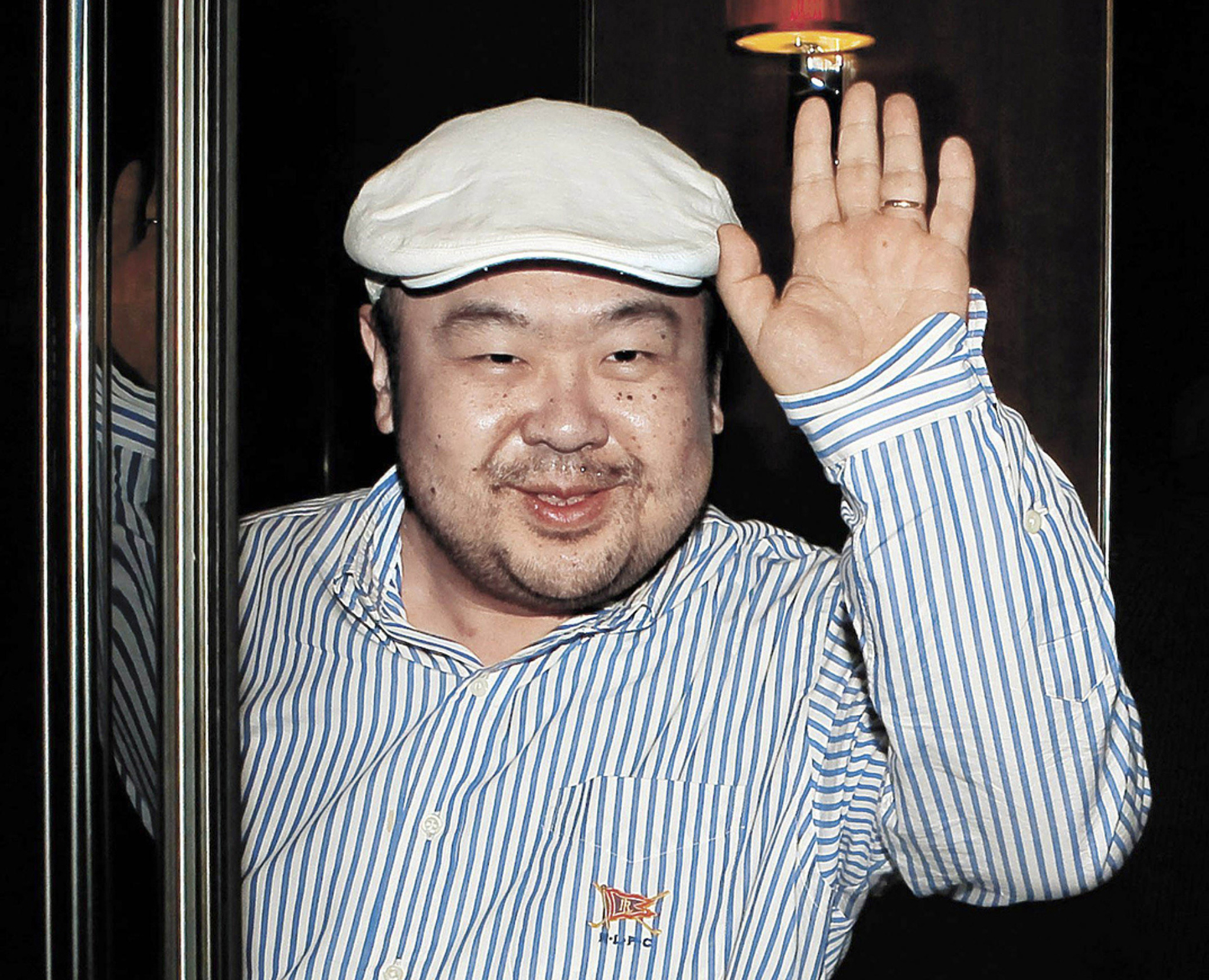
MACAU — The heavy-set man got out of a taxi one night last September and headed for the lobby bar of the swank Wynn Macau — a quiet place, where women are often in evening dresses and gamblers can relax with $300 Cuban cigars. He was dressed casually. There were no bodyguards, no flashy women.
It wasn’t what you’d expect of a man once tipped to be the next dictator of North Korea.
Kim Jong Nam had spent years in exile, gambling and drinking and arranging the occasional business deal as he traveled across Asia and Europe. In recent years, his fortunes had apparently declined, and he’d moved his family from a luxurious seafront condominium complex in Macau to a more affordable apartment building. He was looking for company when he bumped into a friend outside the Wynn.
“He wanted us to join him because he didn’t want to drink alone,” said an insider in Macau’s gambling industry who was introduced to Kim that night by a mutual friend. In a city awash in new money and Chinese gamblers flaunting their wealth, Kim was low-key and polite, making no mention of his powerful family.
“It just seemed odd that the son of a dictator would just be — you wouldn’t know him from an average dude on the street,” said the insider, who spoke on condition of anonymity, not wanting to alienate the city-state’s gambling fraternity, where privacy is deeply valued.
Kim may have seemed easygoing, but he had reason to worry. He’d known for years that his younger half-brother, now the ruler of North Korea, had ordered him hunted down, South Korean intelligence officials say.
On a Monday morning in mid-February, that order apparently was carried out.
Kim was walking through Kuala Lumpur’s cavernous budget airport terminal, a few steps past a Baskin-Robbins ice cream shop, when a pair of women who Malaysian police say were recruited by a team of North Koreans approached.
At least one of the women suddenly wiped a powerful toxin on Kim’s face, smearing him with VX nerve agent before quickly walking away. Minutes later, after walking to the airport’s medical clinic, Kim went into convulsions.
A few minutes after that, as an ambulance rushed him to a hospital, Kim Jong Nam died. He was 45 years old.
Strange life
Kim’s mother was one of North Korea’s most famous movie stars. His father was the dictator-prince of North Korea, a deeply isolated country where the same family has been in power since 1948 and the rulers are worshipped in all-encompassing cults of personality.
But Kim Jong Nam’s grandfather, the founding ruler Kim Il Sung, didn’t approve of his mother, and refused to allow his parents to marry. So Kim spent his childhood in luxurious isolation, hidden from his grandfather, shuttled among Pyongyang mansions and watched over by platoons of bodyguards. When his mother fell ill, reportedly suffering from depression, she was sent to Moscow for treatment and Kim was raised by his maternal aunt.
In those days, his father, Kim Jong Il, loved him deeply, almost desperately. He rocked his son to sleep, and cooed to him “the way a mother calms a crying baby,” the aunt, So’ng Hye-rang, wrote in a memoir after she defected to South Korea in the 1990s.
At some point in his childhood, Kim Jong Nam left home, spending years living either with his mother or in boarding schools in Moscow and Geneva. He came back as a worldly teenager, a young man conversant in a string of languages who found himself back in the walled-off mansions and with just a cousin, his aunt’s daughter, for company.
“They had nothing to do. They had no place to go,” So’ng wrote in her memoir. They would occasionally be driven around the city, but weren’t allowed out of the car. At the seaside, they’d be kept in a sealed-off area where they “experienced the sorrow of being on the vast empty beach.”
By that time, Kim Jong Il also had another family, with a dancer named Ko Yong-hui who gave birth to current ruler Kim Jong Un, and his brother and sister. Kim Jong Il, who succeeded his father in 1994, shifted what So’ng called his “abnormal, tearful love” of Kim Jong Nam to his new children.
It was probably around this point that Kim Jong Nam — then seen by most analysts as his father’s successor-in-waiting — was pushed aside, almost certainly by his step-mother.
“I think Kim Jong Nam was already out” of the succession race because of the proximity to Kim Jong Il of Ko and her children, said Chang Yong Seok, a senior researcher at Seoul National University’s Institute for Peace and Unification studies.
“A queen can play a very important role when a crown prince is proclaimed,” he added.
Kim Jong Nam began traveling more as he grew into adulthood, setting up homes in Beijing and Macau, where he had children with two women.
In 2001, he was caught with his family trying to enter Japan using a fake passport. He told Japanese officials they were going to Disneyland and was quickly expelled, a major embarrassment for Kim Jong Il that seemingly ended any chance he could succeed his father.
Still, most analysts believe he was financially supported by his father, as well as by the Chinese government, North Korea’s main ally. He also reportedly worked as a freelance businessman, arranging deals where he could.
It was not always a lonely life.
“He had mistresses abroad, used to meet North Korean diplomats and had a network of friends in North Korea,” said Nicolas Levi, a researcher with the Polish Center of Asian Studies. For a while, he also traveled back to North Korea, though he did not attend his father’s 2011 funeral.
In Macau, a former Portuguese colony turned Chinese gambling center, Kim’s son and daughter joined the Portuguese-language Lusophone Scouts and the family attended Mass, hoping to fit in better.
“The family was trying as much as possible” to live normal lives, said Ricardo Pinto, a Macau magazine publisher who closely watched the family for years.
There’s no evidence Kim ever got involved in his homeland’s politics, though he told journalists that he didn’t believe in the regime’s system of hereditary dictatorship.
While Kim never fell on hard times, his jet-setting ways appeared to have slowed in recent years. Two years after his father died, his powerful uncle, Jang Song Thaek, was arrested and executed by Kim Jong Un’s government. Jang had been close to Kim Jong Nam, and also may have financially supported him, said Chang, the South Korea-based analyst.
He also knew that his brother wanted him dead, apparently fearing he — and his illustrious bloodline — could someday be used against the regime, South Korean intelligence officials have said.
After a mysterious failed attempt to kill him in 2012, South Korean officials say Kim sent his brother a letter, begging for the assassination order to be lifted.
“We have nowhere to go, nowhere to hide, and we know that the only way to escape is to commit suicide,” he wrote.
Instead, two women — one Indonesian and the other Vietnamese — were recruited to kill him, with the Indonesian woman telling authorities that a group of men had recruited her for what she believed was a harmless prank.
They paid her $90.
Sullivan reported from New Delhi. Associated Press writer Hyung-jin Kim in Seoul, South Korea, contributed to this report.
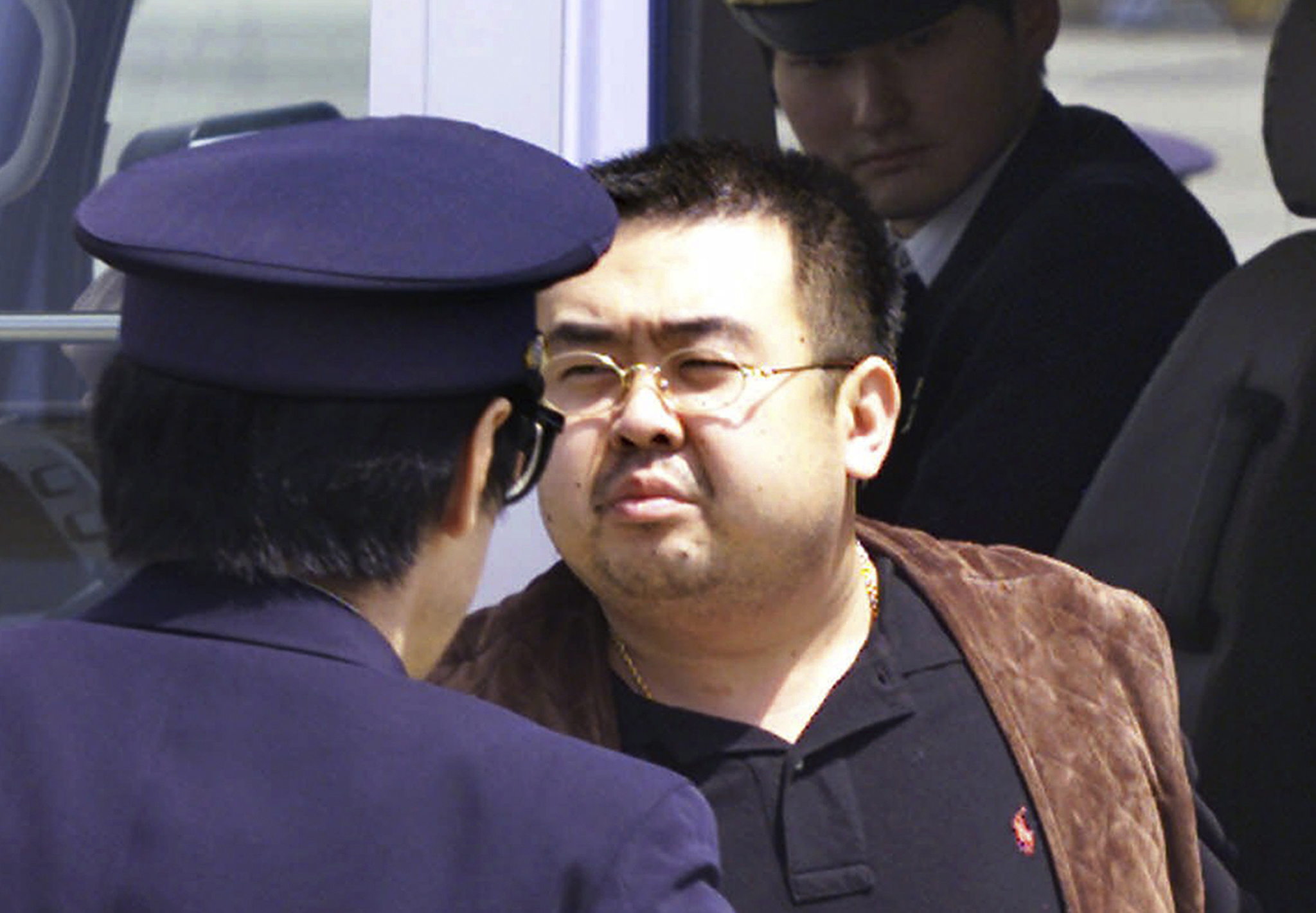
This May 4, 2001 photo shows Kim Jong Nam, exiled half brother of North Korea’s leader Kim Jong Un, escorted by Japanese police officers at the airport in Narita, Japan. Kim was caught with his family trying to enter Japan using a fake passport. He told Japanese officials they were going to Disneyland and was quickly expelled, a major embarrassment for Kim Jong Il that seemingly ended any chance he could succeed his father. (Itsuo Inouye | The Associated Press File)
