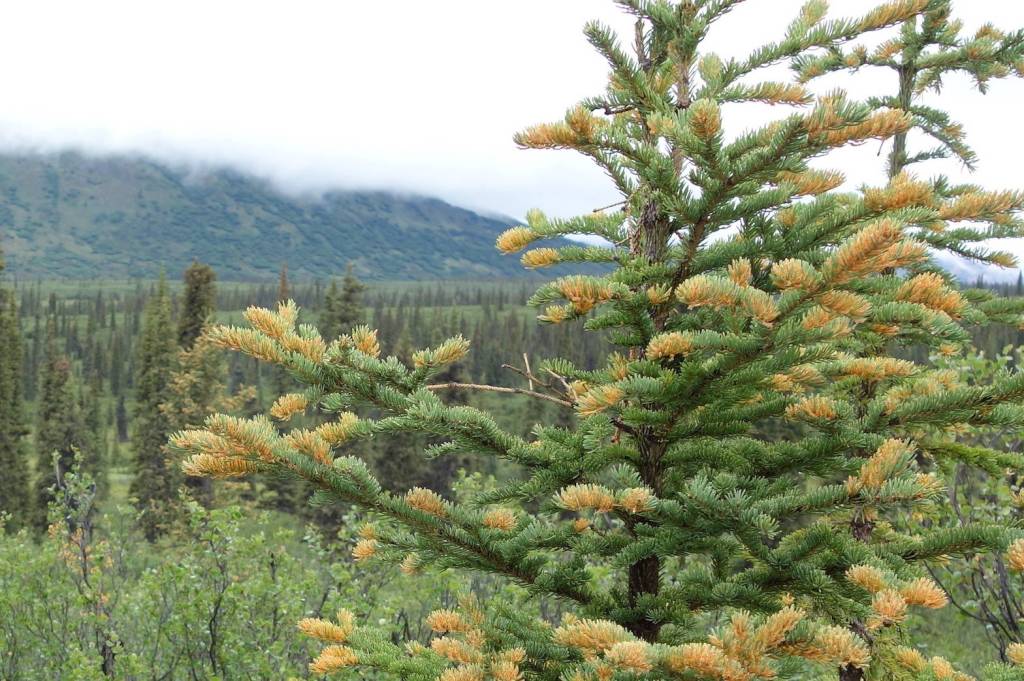
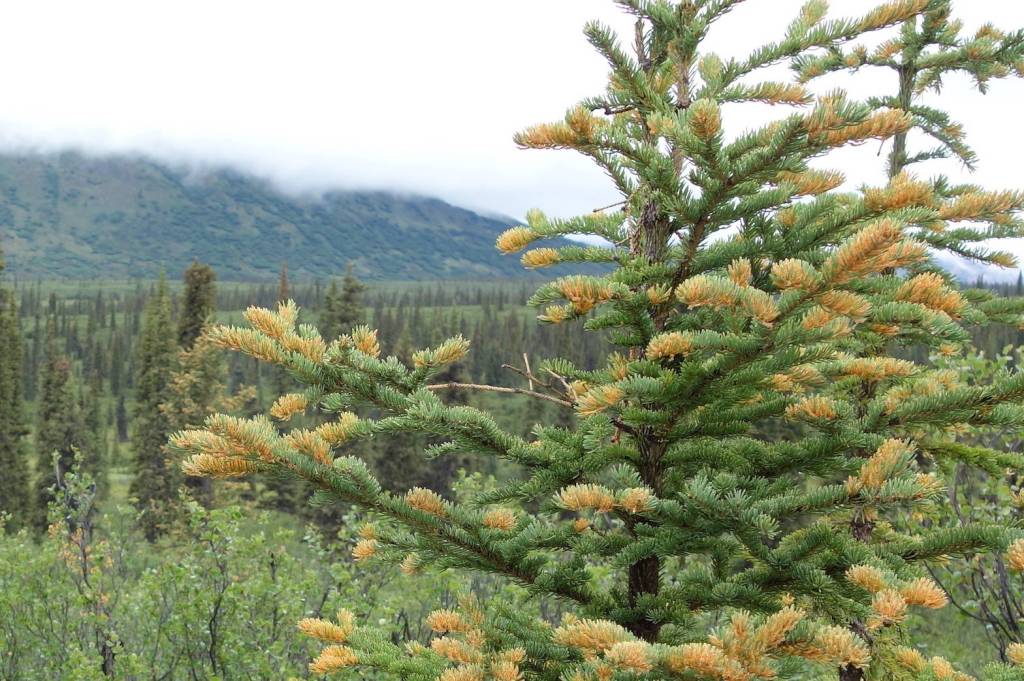
A white spruce tree infected by spruce needle rust fungus, a cosmetic disease that does not kill the tree. Photos by Ned Rozell. (Courtesy Photo / Ned Rozell)

A white spruce tree infected by spruce needle rust fungus, a cosmetic disease that does not kill the tree. Photos by Ned Rozell. (Courtesy Photo / Ned Rozell)

The cause of orange trees in the Alaska Range may surprise you

It was as if someone had pepper-sprayed the Denali Highway.

By Ned Rozell

While wandering middle Alaska this summer, I noticed orange spruce trees along the entire length of the Denali Highway, from Paxson to Cantwell. In what looked like a dendrological case of frostbite, tips of every branch were afflicted with something.

The real show happened when the wind blew: An entire valley glowed apricot. After the wind died, a Tang-like orange powder floated on rivers and puddles. It was as if someone had pepper-sprayed the Denali Highway.

I suspected an insect outbreak — maybe the orange dust was millions of little eggs laid on spruce branches — but insect expert Derek Sikes of the University of Alaska Museum of the North said bugs were not to blame.

It was a tree disease known as spruce needle rust, which infects only the current year’s needles of white, black and Sitka spruce trees.

[River Piracy strikes the Yukon]

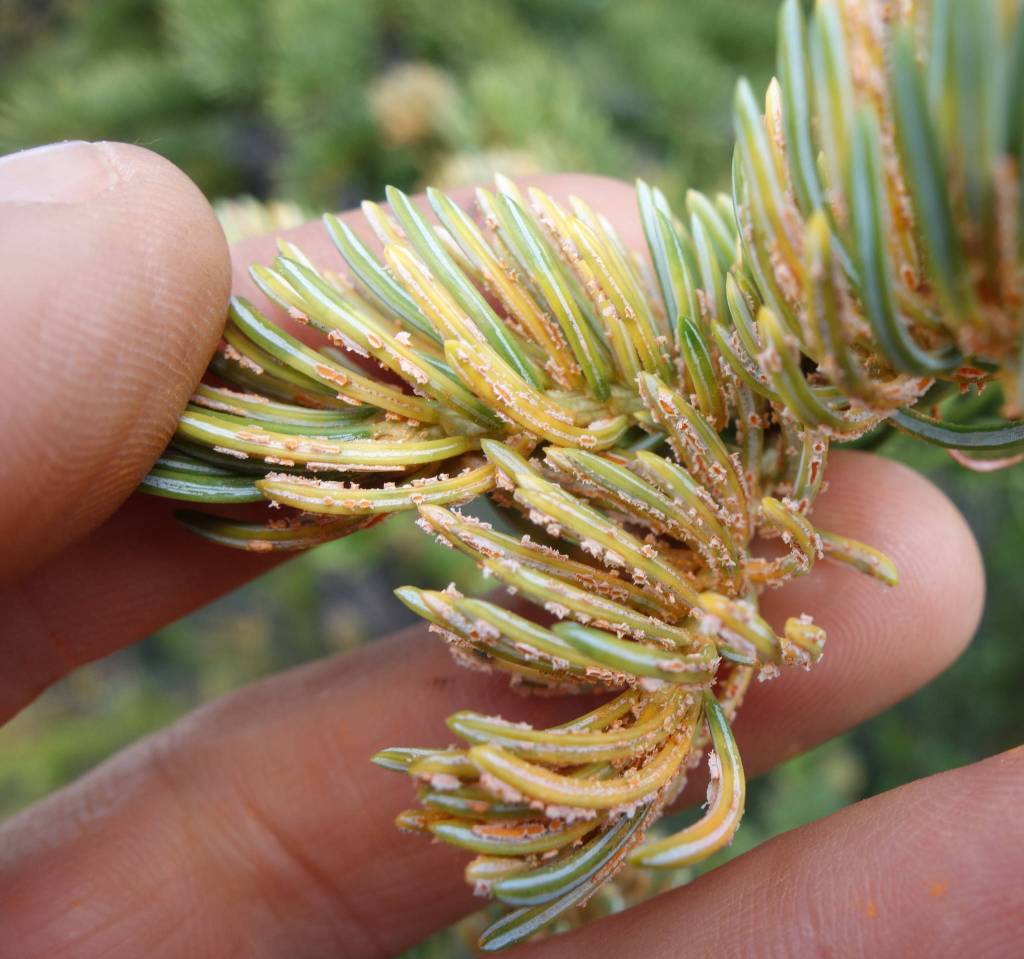
The orange powder is composed of millions of tiny spores, which the rust fungus uses to reproduce. Paul Hennon, an expert on forest diseases, wrote about spruce needle rust fungus in a 2001 bulletin for the Alaska branch of the USDA Forest Service.

Those orange spores rely on the wind to spread them to another organism, Labrador tea. The spores need the other plant to complete the spruce needle rust fungus’s life cycle.

Spores of the spruce needle rust fungus on needles of white spruce trees growing off Alaska’s Denali Highway. (Courtesy Photo / Ned Rozell)

Spores of the spruce needle rust fungus on needles of white spruce trees growing off Alaska’s Denali Highway. (Courtesy Photo / Ned Rozell)

Labrador tea emits a smell of turpentine when you walk through it. The knee-high plant is the “alternative host” for the spruce tree rust fungus. Spruce trees and Labrador tea plants are two life forms the fungus cannot do without.

Here’s the part of the life cycle I witnessed: Liberated by wind from spruce needles, some lucky spores land on Labrador tea leaves.

There, those particles generate other spores, which also settle on top of Labrador tea leaves. These new specks spread to the leaves of neighboring Labrador tea plants. The rust fungus then settles down, overwintering on the leaves.

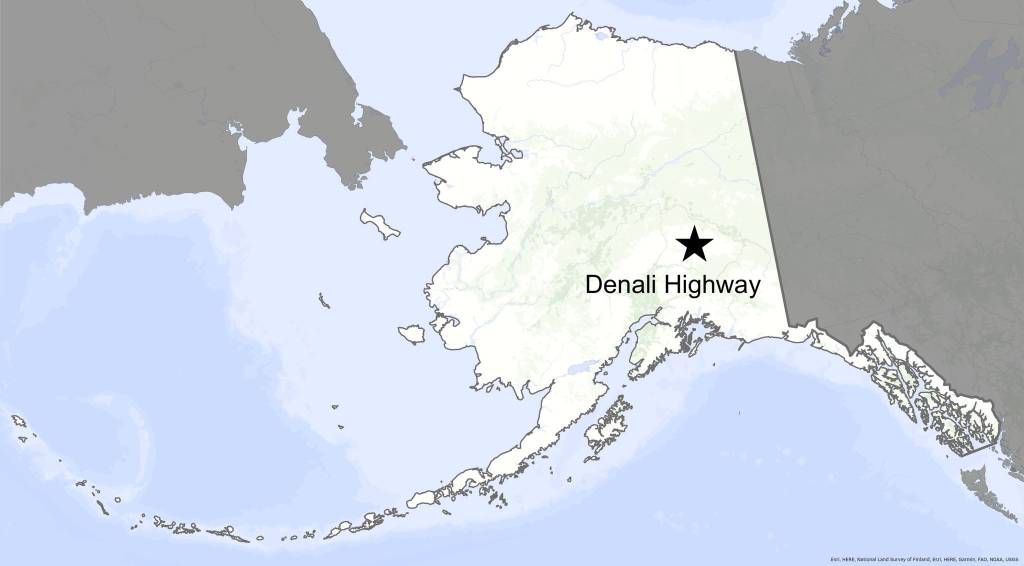
This map shows the location of Denali Highway, where orange spruce trees can be seen. (Courtesy Image / Ned Rozell)

This map shows the location of Denali Highway, where orange spruce trees can be seen. (Courtesy Image / Ned Rozell)

Next spring, another type of spore will morph from the ones that survived the winter on the surface of Labrador tea leaves. The new spores will perhaps catch a favorable wind to infect the emerging, succulent needles of spruce trees.

This interesting life form that enlists two others for its survival had optimal conditions — wet and cool — in summer 2020.

While the rust fungus inhibits the work of new spruce needles — which produces the sugars that feed the tree — the fungus does not kill them. Hennon wrote that the damage to trees is mostly cosmetic, and Alaska foresters have noticed that outbreaks rarely last more than a few years.

• Since the late 1970s, the University of Alaska Fairbanks’ Geophysical Institute has provided this column free in cooperation with the UAF research community. Ned Rozell is a science writer for the Geophysical Institute.
More in News

A Capital City Fire/Rescue truck drives in the Mendenhall Valley in 2023. (Clarise Larson / Juneau Empire file photo)
Juneau man found dead following residential fire

The cause of the fire is still under investigation.

CBJ sign reads “Woodstove burn ban in effect.” (City and Borough of Juneau photo)
Update: CBJ cancels air quality emergency in Mendenhall Valley Sunday morning

The poor air quality was caused by an air inversion, trapping pollutants at lower elevations.

A dusting of snow covers the Ptarmigan chairlift at Eaglecrest Ski Area in December 2024. (Eaglecrest Ski Area photo)
Update: Waterline break forces closure at Eaglecrest Friday, Saturday

The break is the latest hurdle in a challenging opening for Juneau’s city-run ski area this season.

Patrick Sullivan stands by an acid seep on July 15,2023. Sullivan is part of a team of scientists who tested water quality in Kobuk Valley National Park’s Salmon River and its tributaries, where permafrost thaw has caused acid rock drainage. The process is releasing metals that have turned the waters a rusty color. A chapter in the 2025 Arctic Report Card described “rusting rivers” phenomenon. (Photo by Roman Dial/Alaska Pacific University)
Ecosystem shifts, glacial flooding and ‘rusting rivers’ among Alaska impacts in Arctic report

NOAA’s 2025 report comes despite Trump administration cuts to climate science research and projects

The U.S. Capitol in Washington, D.C., on Oct. 1, 2025. (Photo by Jennifer Shutt/States Newsroom)
Moderate US House Republicans join Dems to force vote on extension of health care subsidies

WASHINGTON — Republican leaders in the U.S. House will face a floor… Continue reading

The National Weather Service Juneau issues a high wind warning forDowntown Juneau, Southern Douglas Island and Thane due to increased confidence for Taku Winds this afternoon. (National Weather Service screenshot)
Taku winds and dangerous chills forecast for Juneau

Gusts up to 60 mph and wind chills near minus 15 expected through the weekend.

Chloe Anderson for the Juneau Empire
Fallen trees are pictured by the Mendenhall river on Aug. 15, 2025. Water levels rose by a record-breaking 16.65 feet on the morning of Aug. 13 during a glacial outburst flood.
Lake tap chosen as long-term fix for glacial outburst floods

The U.S. Army Corps of Engineers and Juneau leaders agreed on the plan.

Gift card displays, such as this one in a CVS in Harlem, N.Y., have been a source of concerns for lawmakers hoping to combat gift card fraud. “Card draining,” or stealing numbers from poorly packaged cards, is one of the costliest and most common consumer scams, and states are trying to combat it with consumer alerts, arrests and warning signs on store displays. (Photo by Robbie Sequeira/Stateline)
Alaskans targeted by scammers posing as government officials, FBI warns

The FBI reports Alaskans lost over $26.2 million to internet-based scams in 2024, with $1.3 million of those losses due to government impersonation scams

A buck enters the view of an Alaska Department of Fish and Game trail camera on Douglas island in November 2020. (Alaska Department of Fish and Game courtesy photo)
Douglas deer: The island’s hunt faces calls for new rules

Board of Game is seeking public comment on regulation changes that would affect Juneau.

Most Read