
By Mary F. Willson
Most of us appreciate beautiful scenery, be it driving the Going to the Sun Road in Glacier National Park or driving through the upper Midwest when the fall colors are at their best. Maybe we even stop here and there, to feel the breeze on our faces and sniff the fresh air.
When I’m in a beautiful place, however, I usually want more than that. Post-card pretty and fresh air are good but not entirely satisfying. I want to walk around in that place, hearing the local sounds, smelling the local flowers, touching the rocks and tree bark, as well as feasting my eyes on the local geology, plants, and animals. Basically, I love to experience some of the details of an area, not just the big picture but also the things that comprise it.
[On the Trails: Wildlife is everywhere —event at solstice]
But to get the full experience of a place, I have to immerse myself in it. This takes a while, perhaps two or three days. On my solo canoe trips in the canoe country on the Minnesota-Ontario border, years ago, the first day out was a sort of shake-down cruise, getting used to packing and unpacking the canoe at portages, remembering how best to set up my tent, getting the feel of the paddle again. By the second day, my ‘civilized’ life was beginning to fade into the background, temporarily of no concern. Then on the third day, I could wake up in the morning and be totally IN the experience. And there I could stay for days on end, paddling to new lakes and new campsites, seeing and listening and feeling. Unbeatable!
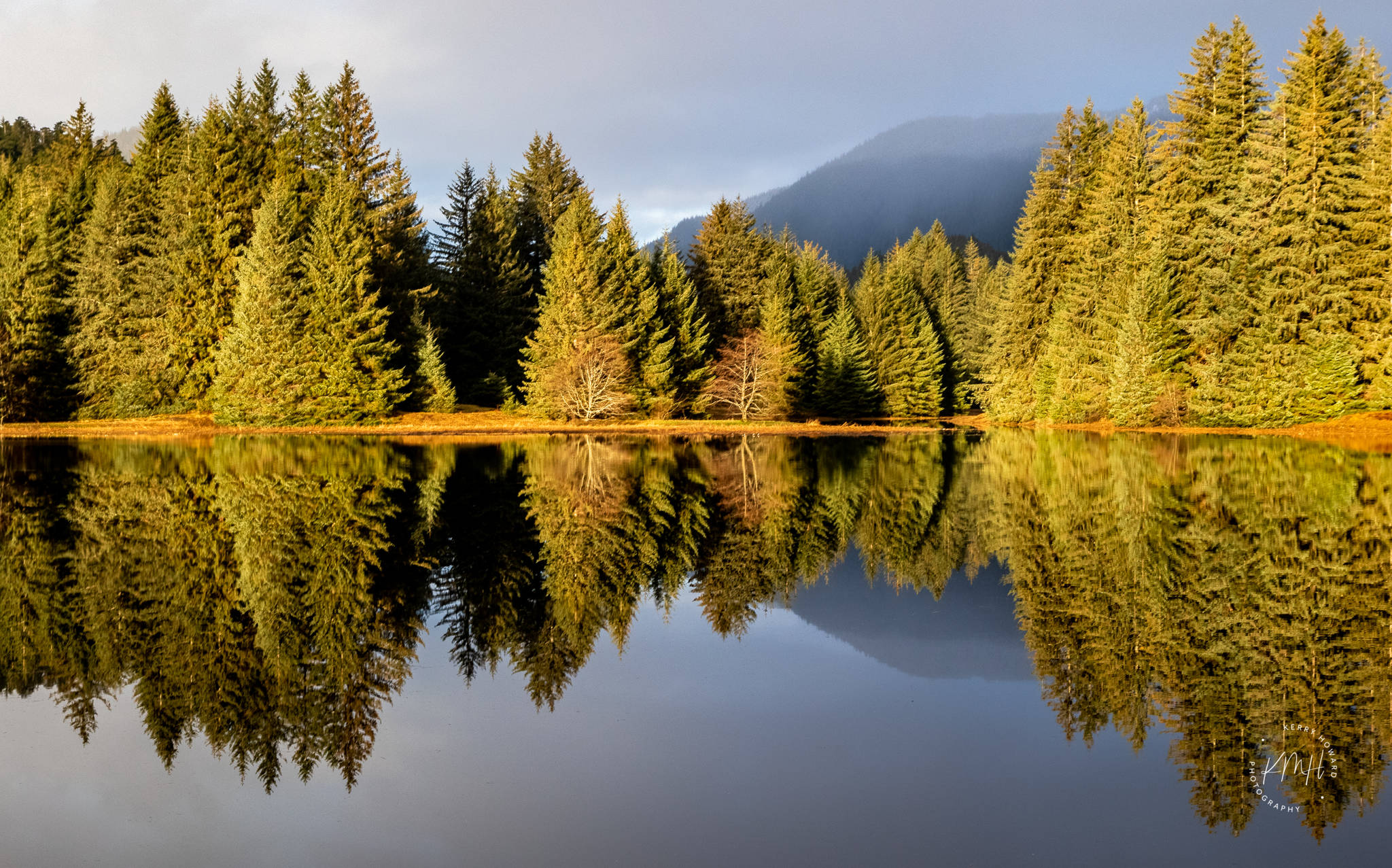
Courtesy Photo / Kerry Howard Perfect reflections are shown in the still waters of Amalga saltchuck
When I cannot achieve that full experience, I can settle for a walk-about in some interesting place. But I have also learned that when I look at a lovely bit of scenery, I am often aware of some of the things that under-pin the scene. Not a fully conscious awareness — I’m not thinking actively about how the trees grow, or what the glacier did, or what birds might be nesting there. But at some level, I am aware of those kinds of things and they deepen my appreciation of what I’m seeing.
In a way, that is a little like listening to a fine piece of classical music (for me, who is not a musician, by any stretch of imagination). I’m not capable of being analytical of what I’m hearing — the modulations, the counter-points, and so on. The top of my listening mind usually dwells on the melody, but I’m very aware, at another level, of the bassoons and horns making the foundations and the middle voices breathing life into the piece. All of it has to be there.
[On the Trails: Wondering woodpeckers and active arthropods]
However, there is yet another level of appreciating scenery (or the music, for a musician): looking for the underlying patterns and thinking about their meanings. There are some who say that the close focus often needed for science and analysis gets in the way of appreciation. Indeed, there are folks who habitually ‘can’t see the forest for the trees’, and that is no doubt true for all of us some of the time. But it is possible to see both the trees and the forest—to see the trees as part of the intricate network of the whole forest, not isolated beings but part of a complex set of interactions. In fact, recognizing the interconnectedness that makes the network often leads to better science, while simultaneously enriching the experience of viewing the scenery.
Every scenic place has stories to read and music to hear, if one chooses to do so.
• Mary F. Willson is a retired professor of ecology.“On The Trails” appears in the Juneau Empire every Wednesday.
