
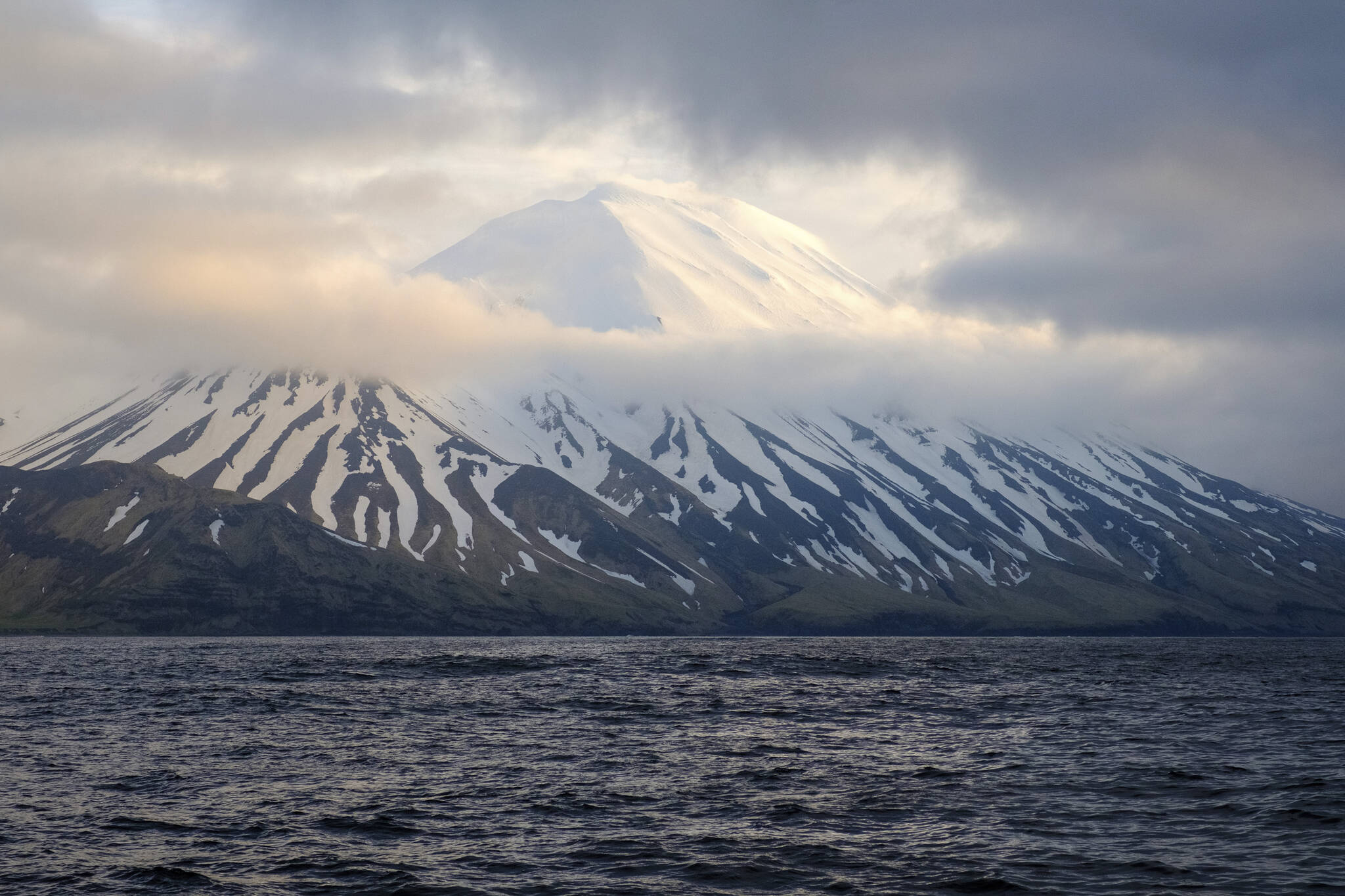
In this photo provided by the Alaska Volcano Observatory/U.S. Geological Survey is the Tanaga Volcano near Adak, Alaska, on May 23, 2021. A swarm of earthquakes occurring over the past few weeks has intensified at a remote Alaska volcano dormant for over a century, a possible indication of an impending eruption. The Alaska Volcano Observatory raised the alert level to advisory status for Tanaga Volcano late Tuesday, March 7, 2023, after the quakes became very vigorous. (Matt Loewen/Alaska Volcano Observatory/U.S. Geological Survey)

In this photo provided by the Alaska Volcano Observatory/U.S. Geological Survey is the Tanaga Volcano near Adak, Alaska, on May 23, 2021. A swarm of earthquakes occurring over the past few weeks has intensified at a remote Alaska volcano dormant for over a century, a possible indication of an impending eruption. The Alaska Volcano Observatory raised the alert level to advisory status for Tanaga Volcano late Tuesday, March 7, 2023, after the quakes became very vigorous. (Matt Loewen/Alaska Volcano Observatory/U.S. Geological Survey)

Swarm of quakes at Alaska volcano could mean eruption coming

The Alaska Volcano Observatory raised the alert level to advisory status for Tanaga Volcano.

ANCHORAGE — A swarm of earthquakes occurring over the past few weeks has intensified at a remote Alaska volcano dormant for over a century, a possible indication of an impending eruption.

The Alaska Volcano Observatory raised the alert level to advisory status for Tanaga Volcano late Tuesday after the quakes became very vigorous.

“We started seeing a whole lot of earthquakes occurring, one after the other, several per minute,” said John Power, a research geophysicist with the U.S. Geological Survey stationed in Anchorage at the Alaska Volcano Observatory.

There have been hundreds of small earthquakes, none larger than magnitude 2.75, but they are concentrated beneath the summit of the volcano, he said.

“That indicates that we’re seeing significant unrest at the volcano,” Power said.

“Whether or not this will lead to an eruption is something we can’t say at this point in time,” he said. “But we are concerned about it enough that we have gone and elevated the warning level.”

While the increase causes concern, he said many times earthquake activity will drop off with no eruption.

“It’s anybody’s guess as to where this particular round of earthquake activity may end up,” he said.

The volcano is on an uninhabited island in the western Aleutians, about 1,250 miles (2,012 kilometers) southwest of Anchorage. There are no communities or structures there, but Adak, a city of about 170 residents on another island, is about 65 miles (105 kilometers) away and could see ashfall.

If the volcano were to erupt, the biggest threat would be to aircraft. The Aleutians are below the routes that jets fly between North America and Asia. Volcanic ash is angular and sharp and can cause an airplane engine to shut down. Previous eruptions had both ash clouds and viscous lava that moves very slowly away from the mountain, much like what happened at Mount St. Helens in Washington state in 1980.

“It’s very different than what you would see, for example, in Hawaii, Kilauea or Mauna Loa, where you see these beautiful red rivers of lava flowing down the side of the volcano,” Power said.

Tanaga is actually part of a three-volcano complex on the island. It’s the tallest of the three at 5,925 feet (1,806 meters). It sits in the middle, with Sajaka, a 4,443-foot volcano to its west. Sajaka had an older cone that collapsed into the North Pacific Ocean with a new cone that has emerged.

To the east of Tanaga is Takawangha, a 4,75-foot (1,449-meter) volcano that is mostly ice-covered except for four craters, the Alaska Volcano Observatory says.

The last known eruption for Tanaga was in 1914. It erupted twice in the late 1700s and again in 1829.

The observatory in a release said there are no known eruptions of Takawangha or Sajaka. However, field work has indicated that eruptions may have occurred from those volcanos and were attributed to Tanaga.

More in News

The northern lights are seen from the North Douglas launch ramp late Monday, Jan. 19. A magnetic storm caused unusually bright northern lights Monday evening and into Tuesday morning. (Chloe Anderson/Juneau Empire)
Rare geomagnetic storm causes powerful aurora display in Juneau

The northern lights were on full display Monday evening.

The Alaska State Capitol building stands on Tuesday, Jan. 20, 2025. (Mari Kanagy/Juneau Empire)
Rep. Story introduces bill aiming to stabilize education funding

House Bill 261 would change how schools rely on student counts.

Weekly events guide: Juneau community calendar for Feb. 9 – 15
Juneau Community Calendar

Weekly events guide: Feb. 9 – 15

teaser
Juneau activists ask Murkowski to take action against ICE

A small group of protesters attended a rally and discussion on Wednesday.

A female brown bear and her cub are pictured near Pack Creek on Admiralty Island on July 19, 2024. (Chloe Anderson for the Juneau Empire)
Pack Creek permits for bear viewing area available now

Visitors are welcome from April 1 to Sept. 30.

Cars pass down Egan Drive near the Fred Meyer intersection Thursday morning. (Clarise Larson / Juneau Empire file photo)
Safety changes planned for Fred Meyer intersection

DOTPF meeting set for Feb. 18 changes to Egan Drive and Yandukin intersection.

Herbert River and Herbert Glacier are pictured on Nov. 16, 2025. (Mari Kanagy / Juneau Empire)
Forest Service drops Herbert Glacier cabin plans, proposes trail reroute and scenic overlook instead

The Tongass National Forest has proposed shelving long-discussed plans to build a… Continue reading

A tsunami is not expected after a 4.4-magnitude earthquake northwest of Anchorage Wednesday, Feb. 4, 2026. (U.S. Geological Survey)
No tsunami expected after 4.4-magnitude earthquake in Alaska

U.S. Geological Survey says 179 people reported feeling the earthquake.

ORCA Adaptive Snowsports Program staff member Izzy Barnwell shows a man how to use the bi-ski. (SAIL courtesy photo)
Adaptive snow sports demo slides to Eaglecrest

Southeast Alaska Independent Living will be hosting Learn to Adapt Day on Feb. 21.

Most Read