Survey: Optimism of Southeast Alaska businesses down this year, but still second-highest since 2010
Published 9:30 pm Thursday, June 27, 2024


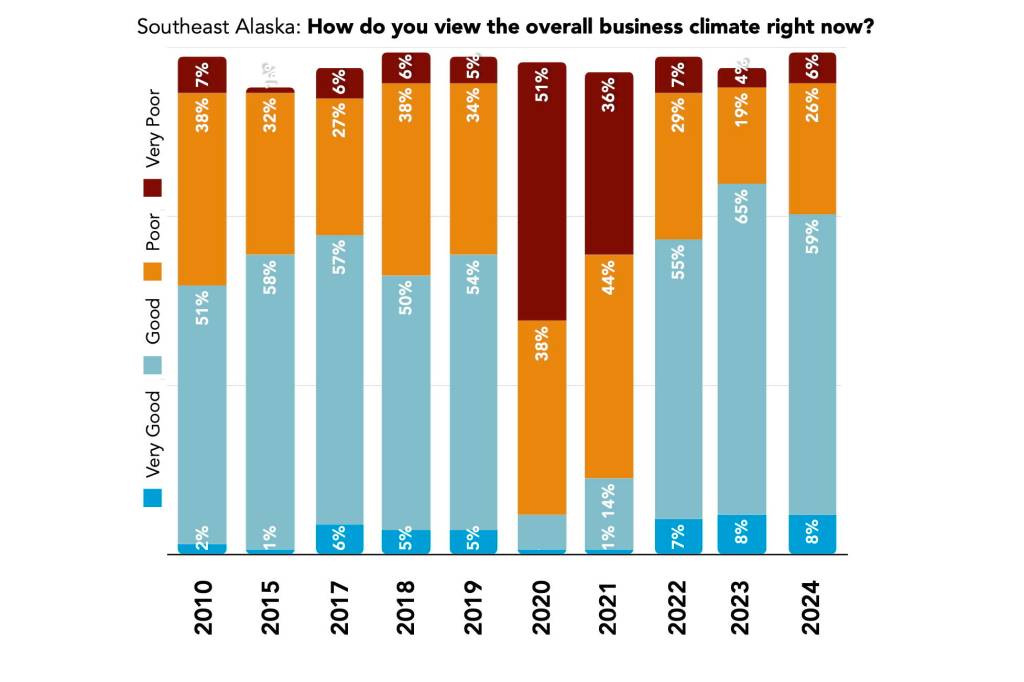


Optimism about Southeast Alaska’s business environment is down a bit this year after three straight years of large rises as the COVID-19 pandemic waned, but is still at its second-highest level since 2010, according to an annual survey presented Thursday to local leaders.
Perceptions are inconsistent by industry — with tourism up and seafood down — and there is considerable future uncertainty due to ongoing housing and workforce shortages, said Meilani Schijvens, owner of Rain Coast Data, while presenting the “Southeast Alaska Business Climate Survey 2024” her company conducted on behalf of Southeast Conference to a Greater Juneau Chamber of Commerce luncheon.
“Despite so many things, when our business leaders look at the business climate they say ‘You know we’re actually doing pretty well,’” she said. “So 67% of Southeast Alaska business leaders say that the economy in Southeast Alaska right now is good right now for them, the business climate is positive, where 32% have a negative current perspective of the business climate.”
The level of optimism varies widely by community, however, with Skagway, Yakutat and Sitka the most optimistic, according to the study. Petersburg, Wrangell and Haines are the most pessimistic, with Juneau at 69% positive ranking sixth of the 12 communities surveyed.
When measured by industry, financial activities topped the list with 85% of Southeast respondents optimistic, followed by tourism at 83% — although in Juneau that was the top-ranking industry, Schijvens said. Ranking lowest both in Juneau and Southeast was fishing, with 73% of respondents pessimistic.
“When we’re looking at the business climate surveys, tourism and seafood end up being our bookends,” she said. “We’re doing very well when it comes to tourism. And there’s a lot of concerns when it comes to our seafood sector.”
Cruise passengers are expected to spend a total of $381 million — or $232 per passenger — in Juneau this year, Schijvens said. The increase in annual passengers from 875,593 in 2010 to a record 1.67 million last year was projected in a 2019 study to continue increasing to 2.2 million by 2030 — but a just-signed voluntary daily passenger limit agreement between the city and industry representatives means the number will remain at roughly current levels.
“That means that within the next five years, 2025 to 2030, that’s going to be about 2 million fewer cruise ship passengers coming to Juneau and Southeast Alaska,” she said. “But it also means that for our tourism providers we’re going to be able to create a predictable, dependable supply of visitors. They’re going to be able to have business plans that they can work to. They’re going to be able to make hiring plans and make hiring decisions. So it’s very good in terms of long-term planning for our visitor sector providers.”
Conversely, the seafood industry is being hurt by several largely global factors that, among other impacts, are resulting in low salmon prices, Schijvens said. Those factors include a global downturn in seafood demand, a backlog of inventory, Russia flooding the market with low-cost seafood and uncertainty about fish processors operating in the region.
Two legal issues are also cited: lawsuits targeting the Southeast troller fleet and the National Marine Fisheries Service considering a petition to list king salmon as an endangered species.
A Juneau fishing boat captain quoted, but not named in the study, stated “the steep decline of the salmon market has made my commercial fishing business unviable. I will not be able to afford to pay deckhands to work with me on my vessel, and I will work all summer to break even without making a profit.”
Employment in Southeast Alaska, which dropped 13% in 2020 at the onset of the pandemic, rose 5% in 2021, 3.4% in 2022, 2% in 2023 and is expected to increase 1.2% in 2024, Schijvens said. On the other hand, the region’s population declined by 1,600 people during the past two years, 690 of them from Juneau, both representing a 2% drop.
The biggest overall future concern of business leaders is housing, “with 61% of business leaders saying it is critically important to focus on housing over the next five years,” according to the survey.
“The housing shortage is deterring young families and workers from relocating to, or remaining in, the region,” the survey notes. “Half of regional business leaders say that finding better ways to attract and retain workforce-aged residents to the region is critically important. This is most strongly expressed by Juneau, Wrangell, Petersburg, and Ketchikan businesses leaders, where three-fifths of respondents say the need to attract young professionals over the next five years is critical.
“Nearly half of business leaders say a continued focus on transportation remains a critical area of focus, a percentage that rises sharply in communities like Kake, Pelican, Gustavus, and Haines. The reduction of Alaska Marine Highway ferry service and lack of ferry reliability continues negatively impact regional businesses.”
One key finding of Juneau’s demographics in the study is that while Juneau has nearly 900 more housing units than eight years ago, there are 400 fewer people living in them, Schijvens said.
“We realized that in 2015 about a quarter of all households in Juneau were single-person households,” she said. “Eight years later one-third of all households in Juneau were one person living alone households. And we did dig a little bit deeper into the data and what we discovered is that it’s really a trend. We’ve got Baby Boomers that are aging in place. And it’s very common nationally for seniors to live alone — 42% of seniors live alone nationally.”
The trend is expected to continue in future years, Schijvens said.
With homelessness arising as a major local political issue during the past year, Schijvens presented a novel finding from her survey showing 39% of tribal households in Juneau (and 43% in Douglas) had opened their homes to a homeless person for at least one night during the past year. The findings presented for Southeast communities, which did not include non-tribal households, ranged from a high of 46% in Saxman to a low of 18% in Skagway.
In Juneau the average stay for a person who otherwise would be homeless was 88 nights, accounting for a total of about 75,000 nights with a lodging valuation of about $4.5 million, according to Schijvens’ data. Overall, she said 59% of the people taken in were related in some way to the home’s occupants and about 15% of them were kids.
“What we see is really tremendous social safety net that is built into our community,” she said. “But on the other hand, there’s sort of an absolute relation between those who have the most housing cost burden and did the most hosting.”
The survey included responses from people at 440 businesses employing 11,000 workers in 25 communities, including 106 businesses with a total of 4,000 employees in Juneau, Schijvens said.
• Contact Mark Sabbatini at mark.sabbatini@juneauempire.com or (907) 957-2306.