
By BECKY BOHRER
Associated Press
The major candidates in Alaska’s U.S. Senate race attacked each other’s integrity and clashed on issues of health care and the Supreme Court in a high-profile broadcast debate less than two weeks before the Nov. 3 election.
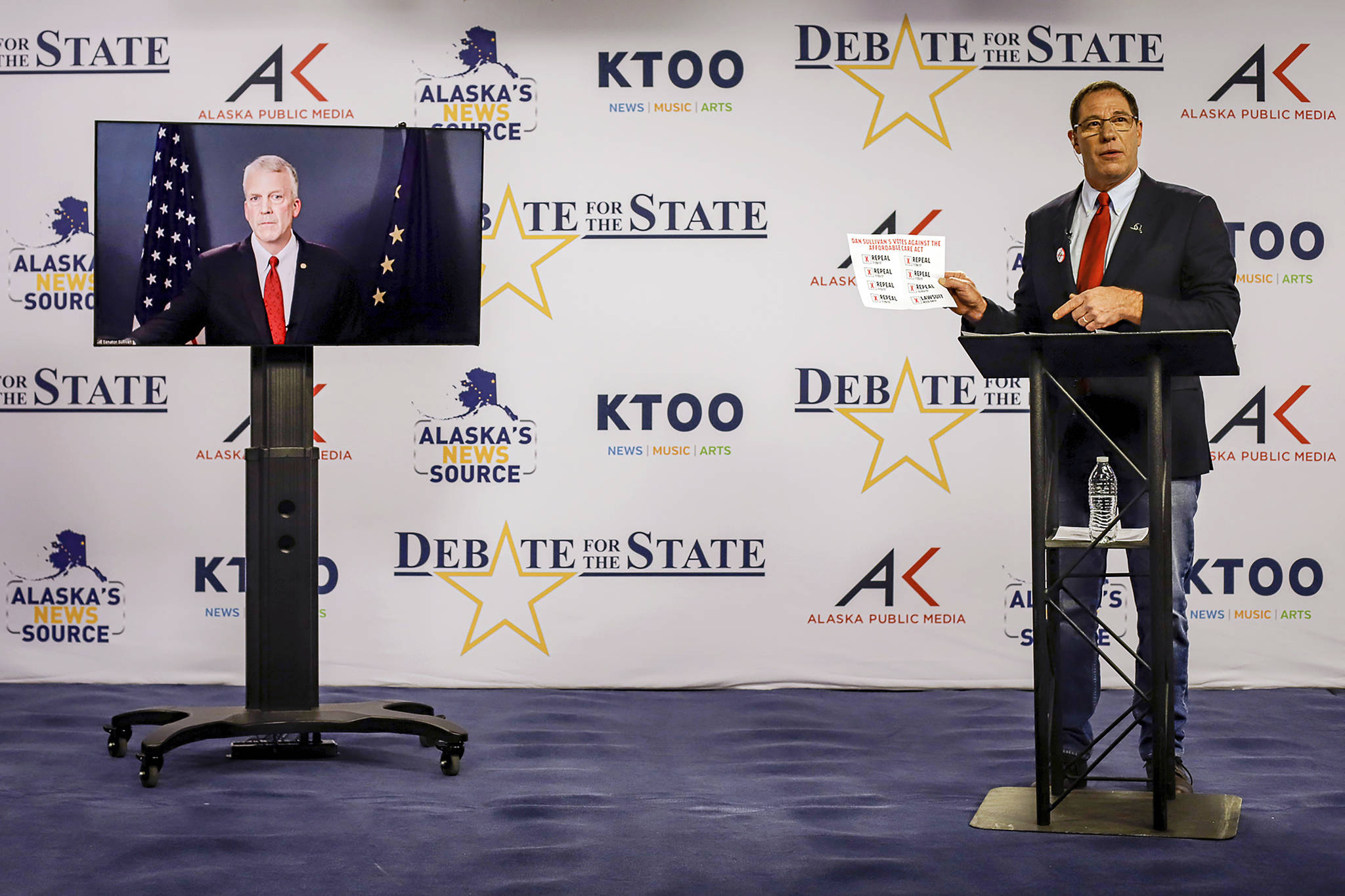
Republican U.S. Sen. Dan Sullivan and Democratic-supported independent Al Gross somewhat shared the Anchorage debate stage; Sullivan, who appeared on a monitor beside Gross, participated from Washington, D.C., where the Senate is preparing to vote on President Donald Trump’s nomination of Amy Coney Barrett to the U.S. Supreme Court.
[Eyes turn to Alaska’s senators amid Supreme Court vacancy]
Sullivan said he was proud to support Barrett and defended moving forward with her nomination, made in late September, saying there is precedent for the Senate to support an election-year nominee from a president of the same party.
In 2016, Sullivan joined fellow Republicans in refusing to advance then-President Barack Obama’s nomination of Merrick Garland to the court, made months before that year’s presidential election. Sullivan at the time said it was a matter of principle, with the U.S. “in the midst of an important national election.”
Gross said Sullivan showed a lack of integrity in his response. Gross opposes Barrett’s nomination, citing concerns with how she would rule on issues related to abortion and the Affordable Care Act, the health care law passed under Obama. Gross, an orthopedic surgeon, supports abortion rights.
Sullivan said Gross has “no credibility” on health care issues, accusing Gross of getting rich off Alaskans as a health care provider.
Gross has said he left his full-time practice in 2013 and increasingly got involved in health care advocacy. In the debate, he said he charged “the same or even less than” his peers. Gross said the problem is that costs in Alaska for specialists and hospitals are higher than in the Lower 48 and he wants to work on ways to address that, such as providing a public option for individuals and small businesses on the health insurance exchange.
“Al, you’re like the arsonist running for fire chief,” Sullivan said.
The race has drawn national attention as the parties vie for control of the Senate. While the largest bloc of registered voters in Alaska identify as independents, the state has long been considered a Republican stronghold. Since 1980, Alaska has sent one Democrat to the Senate, Mark Begich, who narrowly lost to Sullivan in 2014 after serving one term.
[Postal delays persist as by-mail voting is underway]
Gross wore a pin showing opposition to the proposed Pebble Mine. During the campaign, he has said Sullivan should have come out sooner against the proposed copper and gold mine in the Bristol Bay region and suggested Sullivan’s now-stated opposition is wishy-washy. Gross said he would take action in the Senate to stop the project.
The U.S. Army Corps of Engineers in August said discharges at the mine site would cause “unavoidable adverse impacts to aquatic resources” and laid out levels of mitigation that would be required. At that time, Sullivan said he supports the conclusion that a federal permit cannot be issued. He later came out more forcefully and has declared the project “dead.”
The corps has yet to make a final permitting decision. The Bristol Bay watershed supports the largest sockeye salmon fishery in the world, according to the U.S. Environmental Protection Agency.
Sullivan was asked by one of the moderators, Lori Townsend, what he could do to “make good” on his declaration. The debate was sponsored by Alaska Public Media and KTUU TV.
[Galvin, Young accuse each other of lying]
“If the corps of engineers doesn’t do their job, then the EPA shall do their job,” Sullivan said.
The EPA under the Obama administration proposed restricting development in the Bristol Bay region but never finalized the restrictions, and the mine developer applied for a permit with the corps. The EPA retains the ability to invoke the so-called veto process again if it deems that necessary.
