
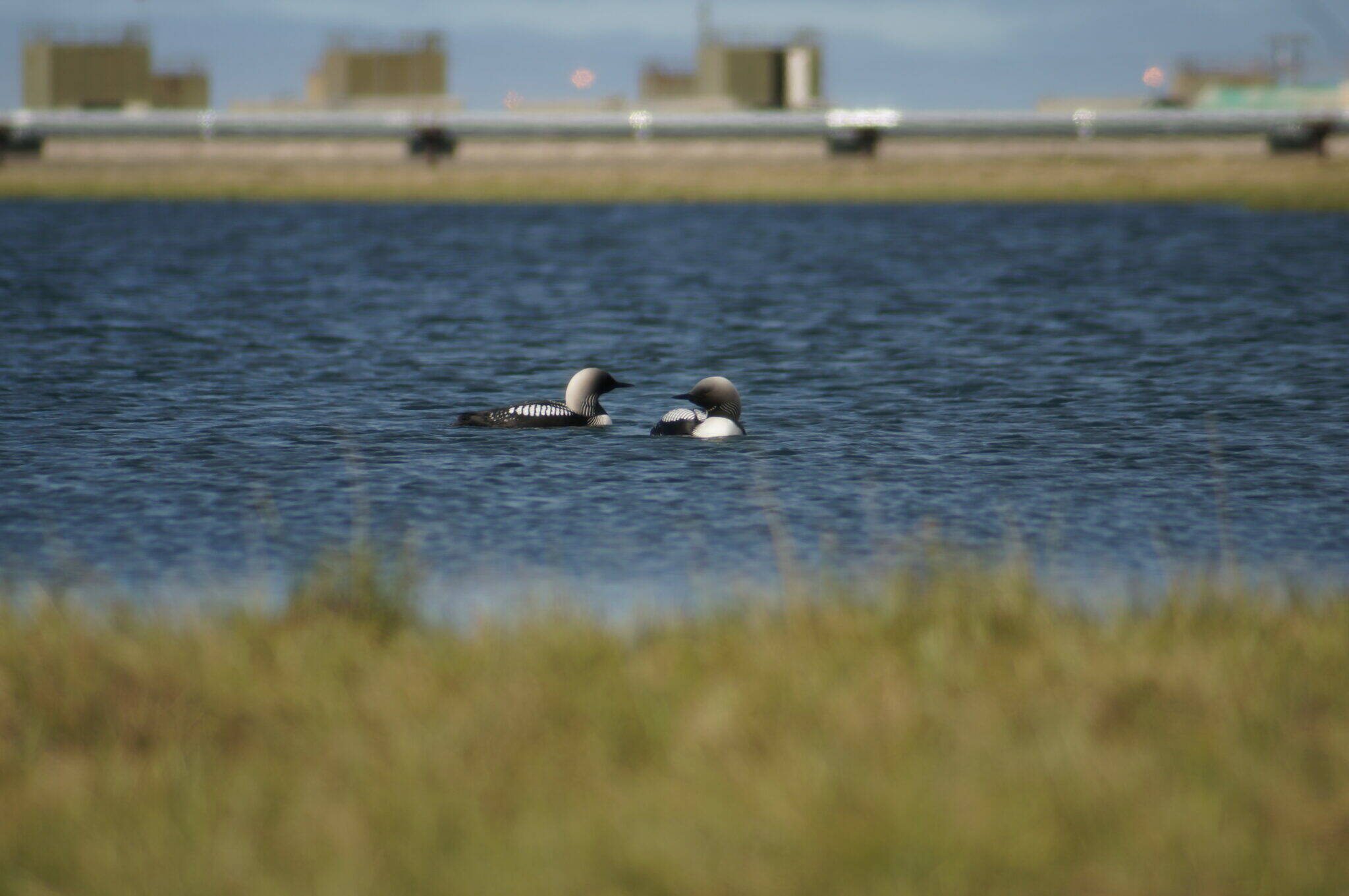
A long-term study of birds that summer around the Prudhoe Bay oil complex found that nest survival for all bird types decreased significantly the closer those nests were to high-use oil field infrastructure.
The study, by scientists with the nonprofit Wildlife Conservation Society and published in the Journal of Avian Biology, is a rare long-term analysis of nesting birds in the region that holds the nation’s biggest oil field.
It used observations taken from 2003 to 2019 of 1,265 shorebird nests, 378 passerine nests and 231 waterfowl nests
To the Wildlife Conservation Society, the study provides a cautionary tale about long-term impacts of oil development and lessons that are timely as development is continuing to spread west on the North Slope to ConocoPhillips’ recently approved Willow project and other sites.
There should be more protections for birds, John Calvelli, the organization’s vice president for public affairs, said in a statement. He pointed to the protected areas designated in the National Petroleum Reserve in Alaska.
“In the face of current uncertainty, to protect migratory birds, the U.S. Government should ensure the most important bird areas continue to be set aside, as has been done through the NPR-A’s Special Areas,” Calvelli said.
Passerines, perching birds that include songbirds like sparrows and commonly known as songbirds, had overall nest survival that declined over the 17-year study period. The trend was particularly notable for Lapland longspurs, the most abundant passerine on the North Slope.
For waterbirds and shorebirds, categories that include loons, ducks and geese, nest survival did not change with time even though proximity to heavily used infrastructure was consistently associated with lower survival over the study period.
Passerines appear to be more sensitive to habitat disturbances, said Martin Robards, a coauthor.
“They have to have territory that is available to them, or they’re not going to breed,” he said.
Just what is causing reduced nest survival closer to high-use infrastructure is yet to be determined.
Among the suspects are nest-raiding predatory birds that have become more numerous around the oil field infrastructure — glaucous gulls and ravens.
“Particularly the ravens have basically followed the infrastructure,” Robards said.
There is a belief that predatory birds are finding food in oil field garbage dumps and finding convenient perches on oilfield structures, the study noted.
While that seems to hold for ravens, the gull story appears more complicated. Glaucus gulls increased across the Arctic coastal area and not just in the oilfield sites, Robards said.
The study points to previous research that found increasing gull populations across the coastal North Slope, not just the oilfield areas. Further, oilfield operators’ garbage-management practices have improved steadily over the past two decades, making it yet more difficult to parse out the reasons for the increases in gull and raven populations, the study said.
Climate change may play a role, the study said. A 2018 study that surveyed bird populations globally found that tundra-nesting birds in the North American Arctic have been particularly affected by increased predation. That 2018 study cited an Arctic-wide decline in populations of small rodents, a normal source of food for predatory birds, and change to vegetation as shrubs spread north.
Other factors that could be affecting nest survival include industrial noise, pollution, hydrological changes and road dust, the new study said.
• Yereth Rosen came to Alaska in 1987 to work for the Anchorage Times. She has reported for Reuters, for the Alaska Dispatch News, for Arctic Today and for other organizations. She covers environmental issues, energy, climate change, natural resources, economic and business news, health, science and Arctic concerns. This story originally appeared at alaskabeacon.com. Alaska Beacon, an affiliate of States Newsroom, is an independent, nonpartisan news organization focused on connecting Alaskans to their state government.
