
“What makes this sound? What do you hear that makes you say that?”
We started our arts and science integrated lesson with these questions and a slideshow. The screen was dark as the room filled with the sounds of rhythmic squeaking. Third grade students were sitting on the floor in pairs, first quietly listening, then bursting into conversations: “That sounds like a rusty gate,” and “Creepy! A haunted house!” Several pairs picked up on the rhythm of the sound and predicted, “It’s a swing!” so when the picture of a playground came on the screen, all were satisfied.
“How does a swing work? What makes it start moving? What makes it stop?”
Several pictures followed — of children on playground swings and tire swings, and a skier and her tracks down a powdered slope, the slime trail left by a slug, and an artist’s circular paintbrush strokes. The images were chosen to stimulate class discussion and partner conversations about the concept of a pendulum and that when there is any kind of repeated movement — especially when it leaves a trail — then the next motions can be predicted. These are third grade science concepts from our district science curriculum and the national Next Generation Science Standards.
“What will the next motion be? What do you see that makes you say that?”
Each time the students encountered a new picture, they were asked to answer these questions with a partner, encouraging the habit of finding and sharing evidence for their speculations and opinions.
[STEM Corner: Growing career paths through science]
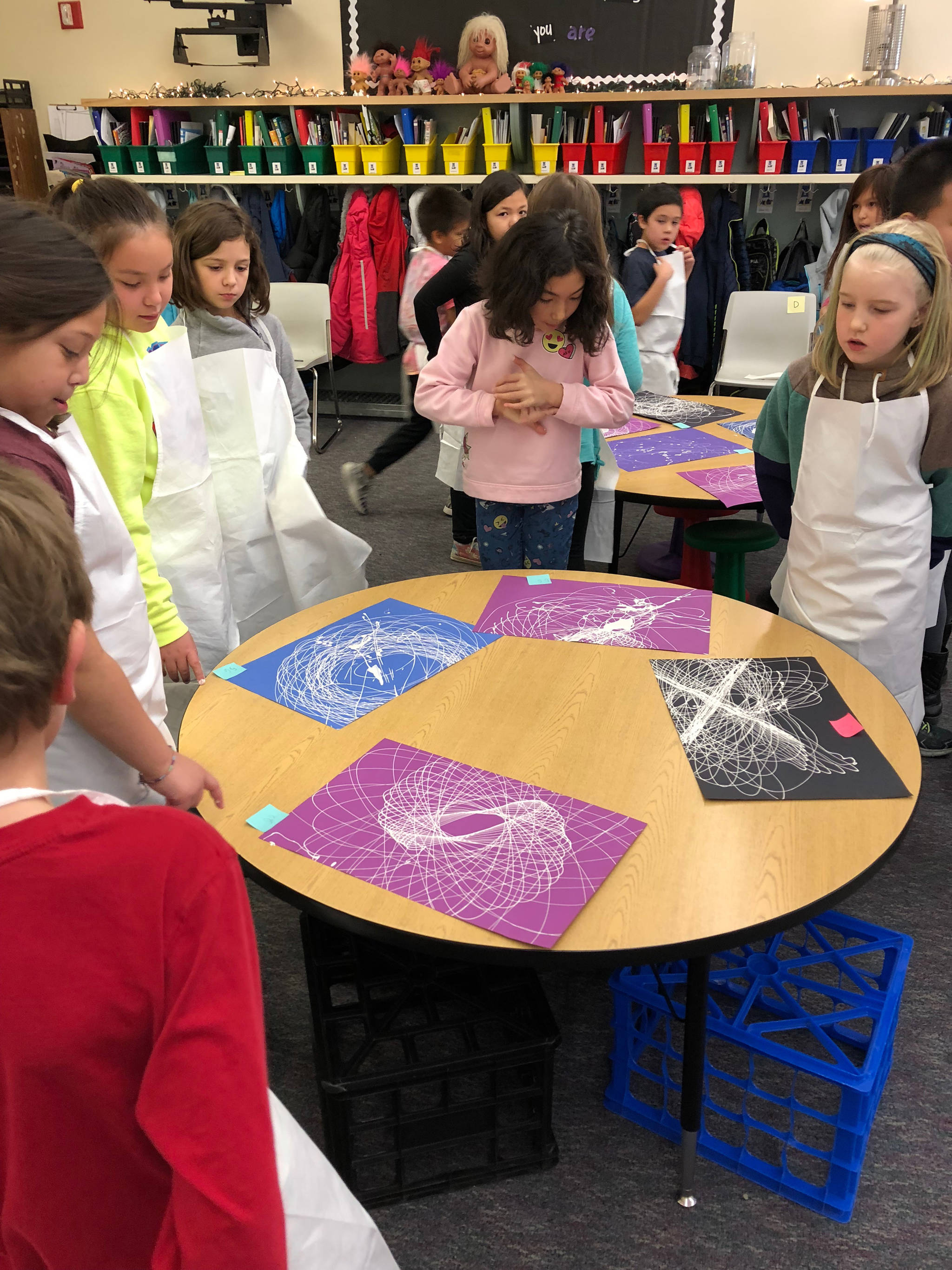
Viewing and discussing the images set the stage to explore our newly introduced science concepts through creating art with pendulum paintings. We set up our pendulum stations by spanning a yard stick across two chairs and attaching a string and washer to support a Dixie cup swinging freely from a paper clip hook. The Dixie cup, filled with contractor grade house paint, had a small hole in the bottom to allow a steady stream of white paint to flow out of the cup and onto the colored paper. When asked to predict what kind of a paint “trail” a pendulum would leave, all kinds of inferences were made, but no one guessed the beauty that we would see in the actual pendulum paintings.
The class observed with rapt attention and gasps when I demonstrated the first painting. They were eager to give it a try. I explained how they would work in teams of three at their own pendulum stations, each taking turns being the “artist” who swung the cup with their paper underneath, the “clean up crew” who was ready to put the cup when finished in the slop bucket (a small tray placed under their chair), and the “data counter” who counted the rotations.
Giving them each an apron and releasing them for the work in their teams was a breathless moment, but the hum and tone of the room — both seriousness and joy — was soon palpable. As the classroom teacher and I circulated around the small groups, coaching and facilitating, we observed all kids — 100 percent — fully participating, successful and motivated to help each other. When one young artist would deposit their masterpiece on their desk, they would scurry back to their station to take their next role and help their team. After aprons were off and drips were wiped up, children and teachers had a moment to sit and reflect.
“What surprised you about the pendulum paintings? What did you learn about the motion of a pendulum?”
Kids were able to articulate what they had liked about the past hour together and what they had learned. Many reflected the good feeling we get when working as a needed member of a team, saying, “It was fun to help my team!” Other reflections were surprise at the beautiful patterns naturally created by the motion of a pendulum.
“I thought it was just going to be lines going back and forth, but mine looks like a planet orbiting!”
“Yeah, the circles moved a tiny bit each time, making a cool pattern.”
[JDHS graduate named university’s outstanding senior]
When I reflected about my own experience teaching this lesson in all our district third grade classes — the effort required prepping and facilitating this complex lesson with, in some of our largest classes, 30 8- and 9-year olds at a time — I asked myself, was it worth it? If what we’re looking for is student engagement and joy, student teamwork and effort, and creating memorable learning with their own hands, then I think the answer is yes, 100 percent.
This project was part of a district-wide emphasis on integrating art with science. As the elementary art specialist, I taught a STEAM (Science Technology Engineering Art and Mathematics) lesson connected to specific grade-level science standards for students in grades K-5. The pendulum painting lesson is now one of our district third grade “art kits.” After watching me model it this year, teachers can check the kit out and teach the lesson themselves in years to come.
STE(A)M Activity:
Do pendulum painting at home. There are lots of videos online about how to set it up — some more and some less complicated than what Nancy did with the third graders. If you study the photos here and at juneauempire.com, and reread Nancy’s description in the text above, you can recreate her lesson. You can also email juneaustemcoalition@gmail.com with questions. Send us a photo of what you make. Here’s one video to get you started: https://www.youtube.com/watch?v=2t20vL9HU
• Nancy Lehnhart is the elementary art specialist for the Juneau School District. STEM Corner is a monthly column about Science, Technology, Engineering, and Math in Juneau, written by a rotating group of Juneau STEM Coalition members.
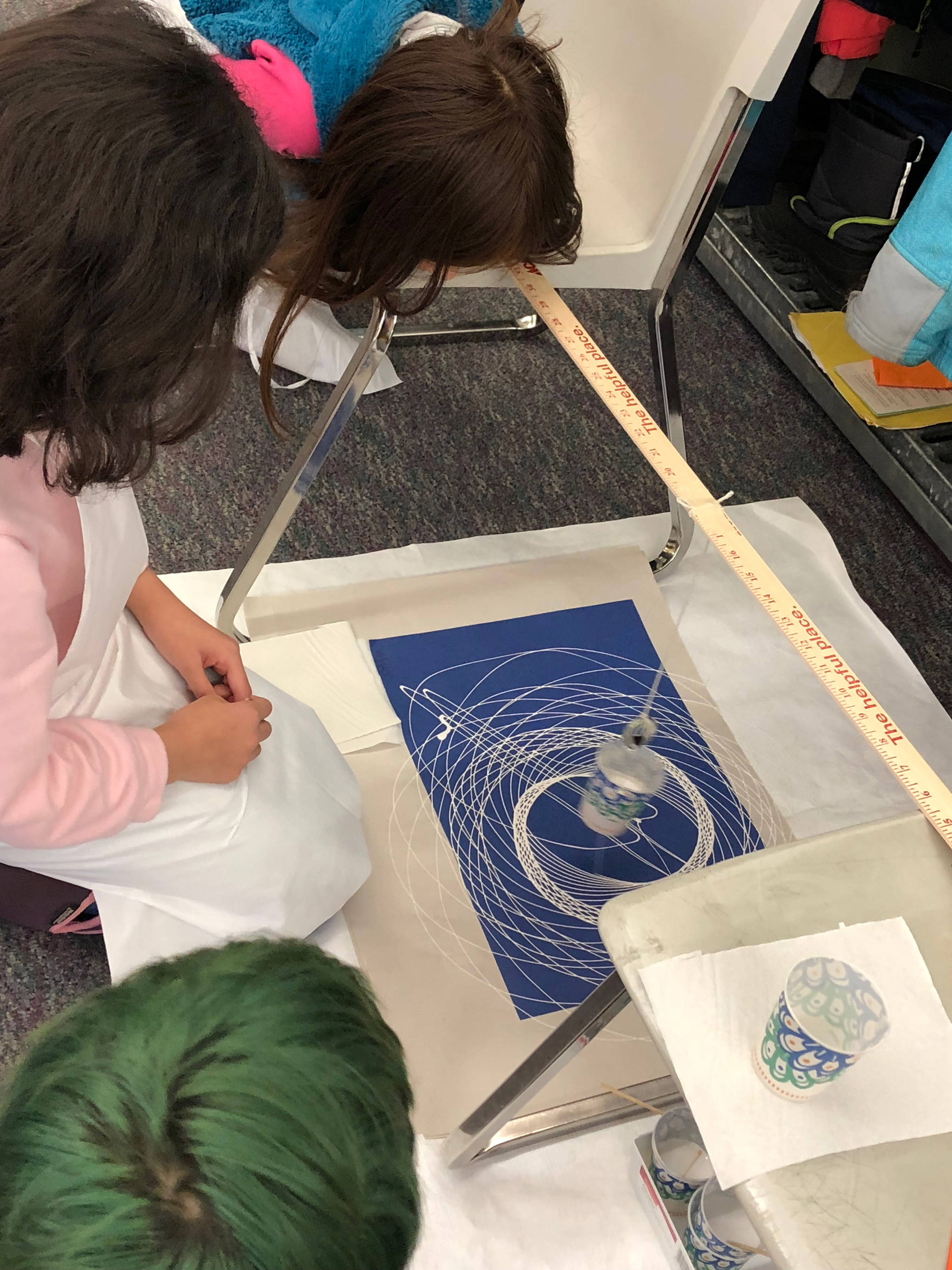
Students in Shawna Puustinen’s third grade class at Riverbend Elementary school participate in a STEM activity taught by Nancy Lehnhart in fall 2018. (Courtesy Photo | Shawna Puustinen)
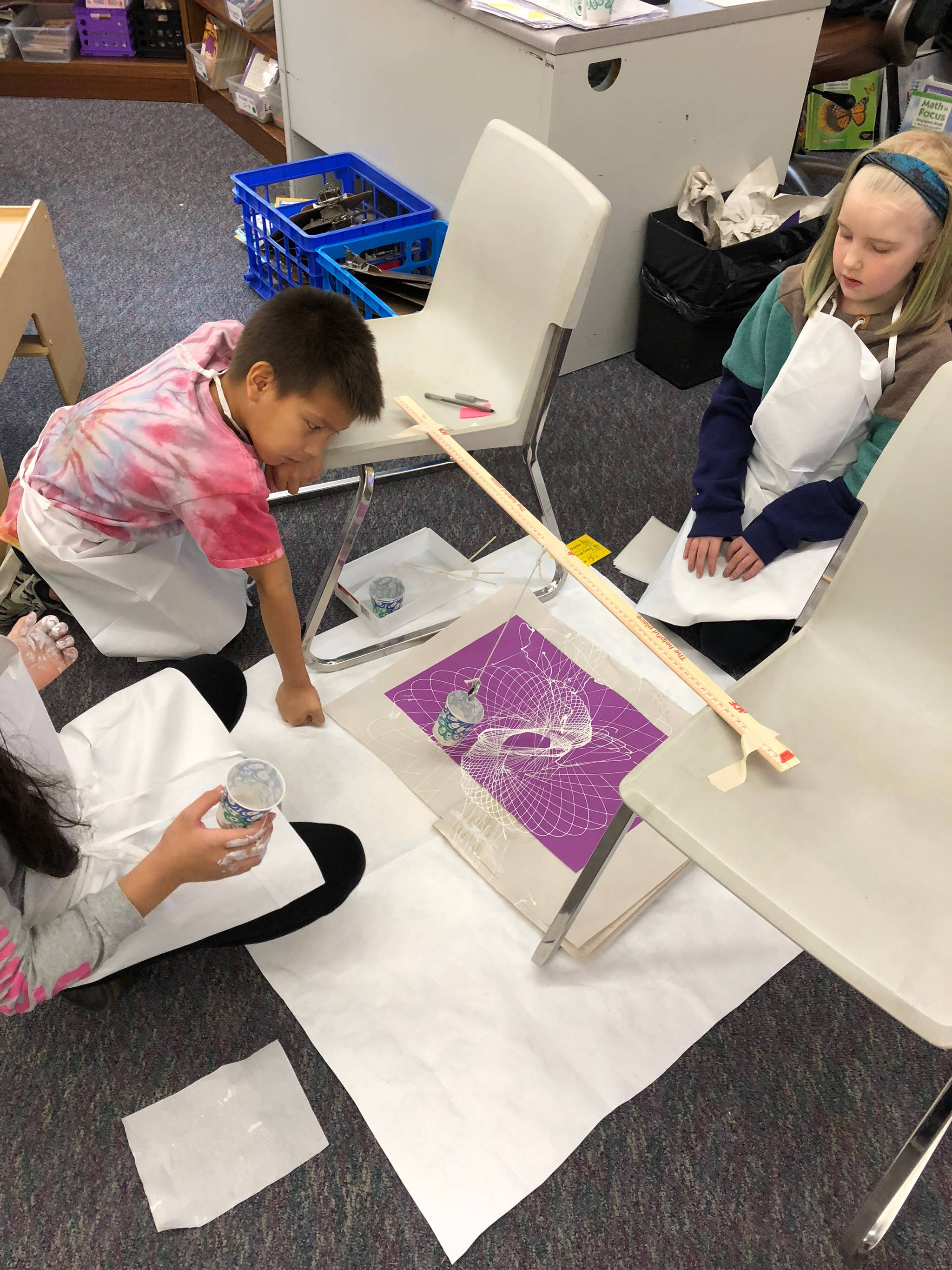
Students in Shawna Puustinen’s third grade class at Riverbend Elementary school participate in a STEM activity taught by Nancy Lehnhart in fall 2018. (Courtesy Photo | Shawna Puustinen)
