
As statewide public safety officials unveiled crime statistics Wednesday, they expressed optimism in one main category: the state’s reaction to the opioid crisis.
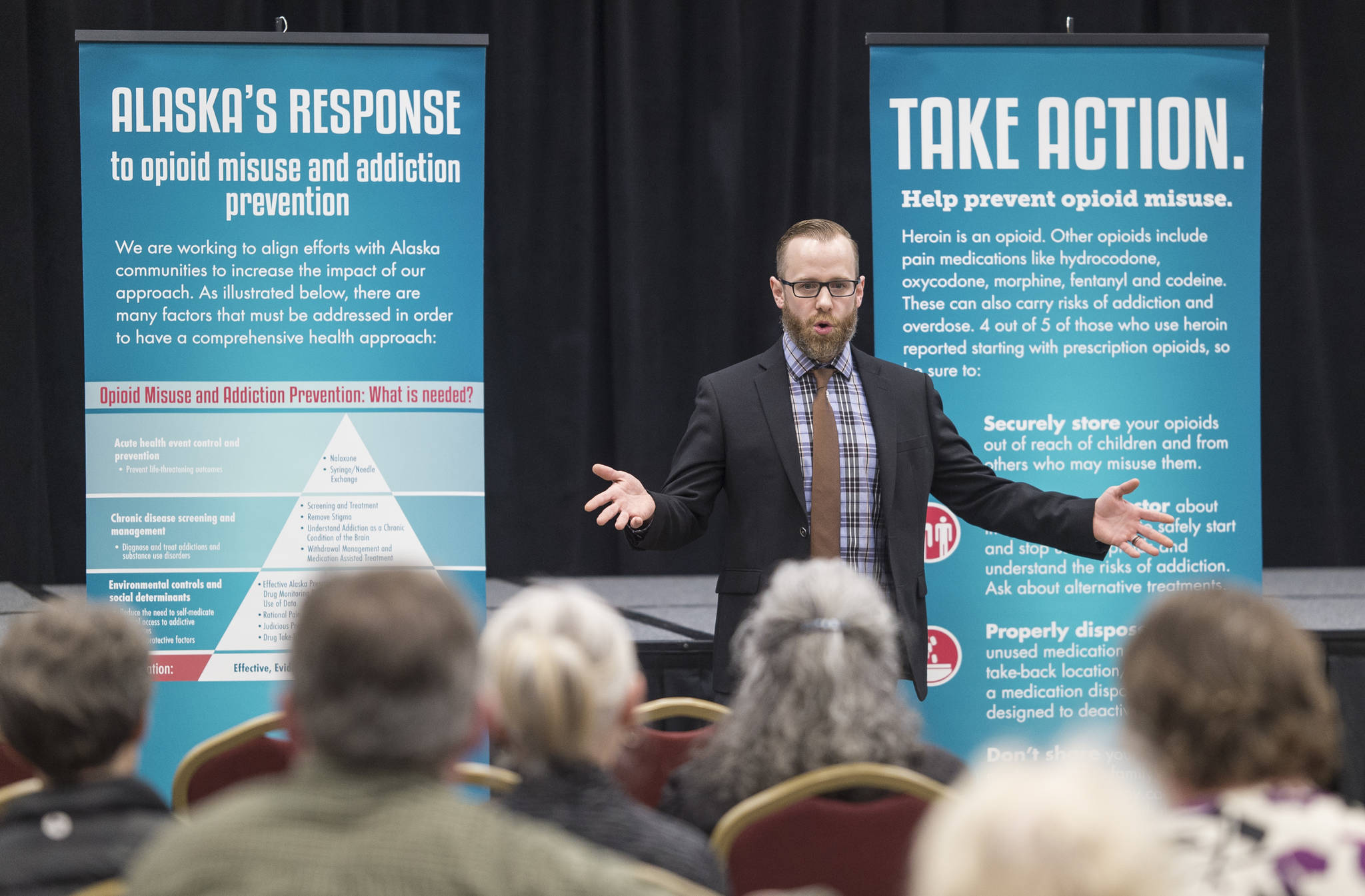
Since Gov. Bill Walker declared the opioid crisis a public health disaster in February 2017, state agencies have coordinated their efforts in fighting the spread of addiction throughout the state. Andy Jones, director for the Office of Substance Misuse and Addiction Prevention (OSMAP), spoke at a press conference Wednesday and said there are reasons for optimism. The press conference was in reference to the Department of Public Safety’s annual Uniform Crime Report, but Jones was focused on the state’s battle against opioid addiction.
First, Jones pointed at the fact that the number of high school students who have reported using heroin is dropping. He said that number has been dropping since 2013.
“Our children are becoming more and more educated on this topic,” Jones said in the press conference, “so they can make the best decision possible as they grow and mature.”
Education has been vital to the state’s approach toward this issue, Jones said, and the teaching goes both ways. Jones and other state officials have toured the state since last year, holding 15 so-called “community cafés” where people from local organizations and members of the public can meet and share ideas on how to best address the spread of addiction.
Juneau’s three-hour community meeting, entitled “Your Voice, Your Community,” took place in March and drew about 50 people. Breakout groups addressed community education and prevention, screening and treatment, alternatives to incarceration and recidivism, and other topics.
During Wednesday’s press conference, Jones said these meetings helped inform OSMAP officials as they put together a long-term action plan to address the crisis. Jones said they also invited 100 experts from around the state for a series of meetings just this week to start putting together that long-term plan.
There’s still quite a bit of work to be done, and the opioid epidemic has been particularly harmful in Juneau, according to the Alaska Department of Health and Social Services. From 2013 to 2017, there have been 25 opioid overdose deaths in Juneau, which is an age-adjusted rate of 15 opioid overdose deaths per 100,000 people.
That’s above the state average (11.3 opioid overdose deaths per 100,000 people) and the average in Anchorage (12.6 opioid overdose deaths per 100,000 people), according to DHSS numbers. The total opioid overdose death rate increased by 77 percent from 2010 to 2017, according to a State of Alaska Epidemiology Bulletin released earlier this month.
The federal government has taken notice of those increases, and the Office of National Drug Control Policy designated Anchorage, Fairbanks and Juneau as High Intensity Drug Trafficking Areas (HIDTA). That means Alaska has access to $250 million in federal anti-trafficking funding. That designation came in May, but Juneau Police Department Lt. Jeremy Weske said via email recently that the HIDTA designation is very new and there have not been any major developments on that front yet.
Even without HIDTA money coming in quite yet, Jones said the efforts within the state have begun to pay dividends. Jones pointed to a statewide effort to cut down on prescribing opioids and responsibly disposing of unused medications. According to recent numbers from the Alaska Prescription Drug Monitoring Program (PDMP), the number of total opioid prescriptions in Alaska decreased by 10 percent from 2016 to 2017.
Specific numbers from this year aren’t official, Jones said, but he said that across the board there are reasons for optimism.
“Current 2018 data is extremely encouraging,” Jones said. “Yes, there are a few months to go, but we are seeing drastic declines at this point in all categories. That is very, very encouraging.”
• Contact reporter Alex McCarthy at 523-2271 or amccarthy@juneauempire.com. Follow him on Twitter at @akmccarthy.
