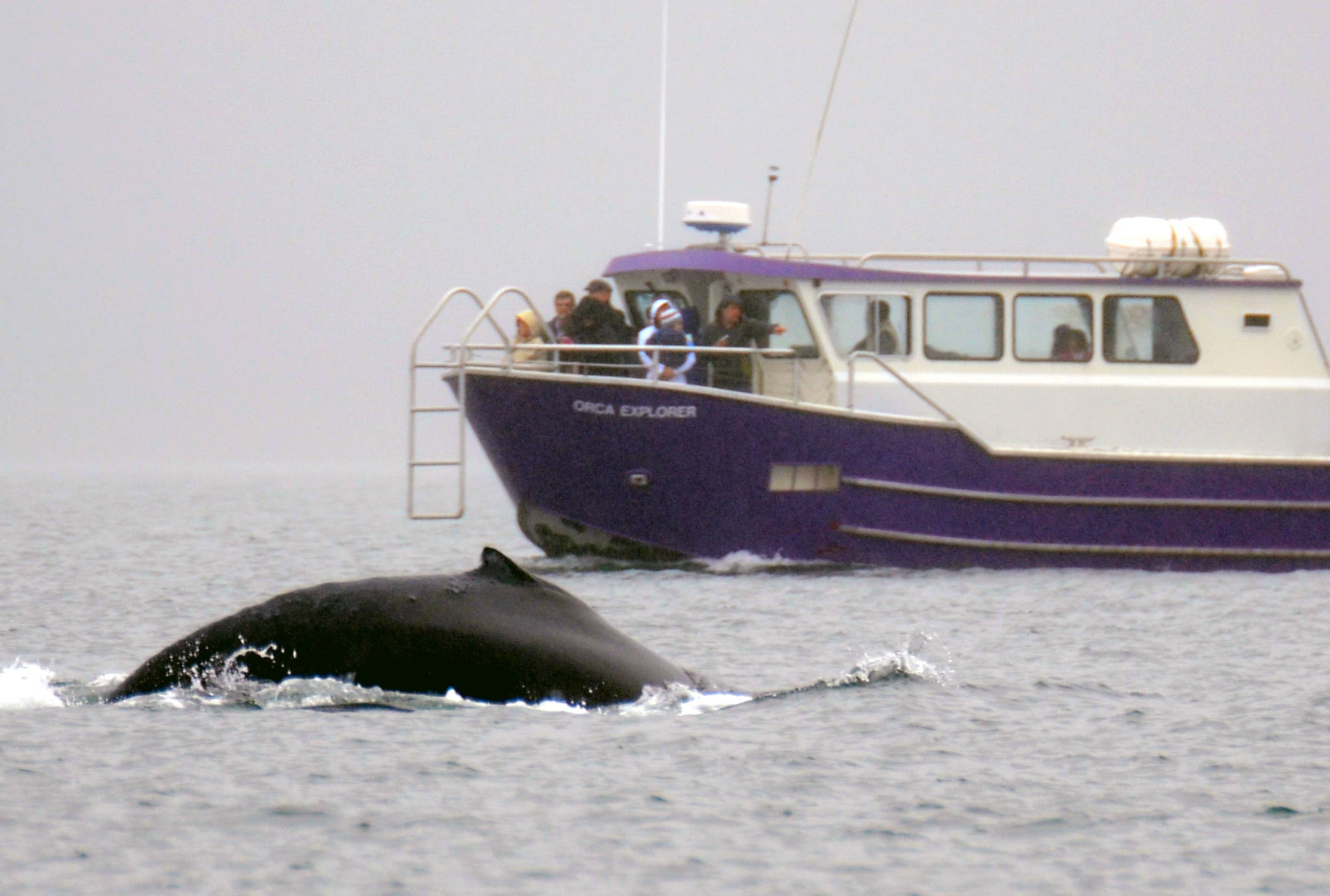
The nutrient rich waters of Southeast Alaska have drawn whales for years, and they continue to attract the animals that come to feast and fatten on the rich coastal bounty.
Where there are whales close to shore, so too will there be tourists. Members of organizations involved in the whale watching industry came together at the Juneau Chamber of Commerce’s weekly luncheon at the Moose Lodge to talk about some of the business’ growing issues and the future of Juneau’s expanding whale watching tours.
“Juneau’s whale watching fleet is more than 50 vessels,” said Sierra Gadaire, operations manager for Gastineau Guiding, on Juneau’s many tour companies. “On busy days, there may be more than 20 boats following a single group of whales.”
Between 2,000 and 3,000 people can go out on whale watching tours each day, based on the number of available hulls. said Gadaire.

Ally Schuler speaks to members of the Juneau Chamber of Commerce about whale watching tours during a luncheon Jan. 16.
But this has led to issues. Concern has grown over the effects whale watching tours may have on Juneau’s harbors, waterfronts, and the whales themselves.
Matt Creswell, assistant harbormaster for City and Borough of Juneau Docks and Harbors, said congestion from the whale watching tours in Don D. Statter Harbor at Auke Bay will be addressed by construction currently happening in the inner basin of the harbor.
“We’re adding 1,300 linear feet of moorage that can be added specifically to the passenger for hire vessels,” Creswell said.
Construction in the harbor will eventually add designated whale watching piers, a bus pick-up and drop-off point and public restrooms to the inner basin. That’s expected to ease congestion and adding more mooring space to the harbor.
“The industry in Juneau is one of a kind,” said Suzie Teerlink, a member of NOAA’s marine fisheries service. “The marine wildlife here is unlike other areas.”
The marine wildlife here is protected by guidelines, including a federally mandated minimum safe distance of 100 yards for all boats. Whale watching boats are also forbidden from remaining on station watching a single whale or group of whales for more than 30 minutes, and have specific speed limits and traffic corridors that they operate in to reduce wake and disturbance, Teerlink said.
Teerlink, who has a Ph.D. in marine biology from the University of Alaska Fairbanks, focuses primarily on humpback whale research. Studies she has conducted on the whales here near Juneau include observing their response to boats — how the animals react course deviations and speed changes — as well as conducting blubber hormone analysis to see if there are measurable long term effects on the whales from being observed so closely.
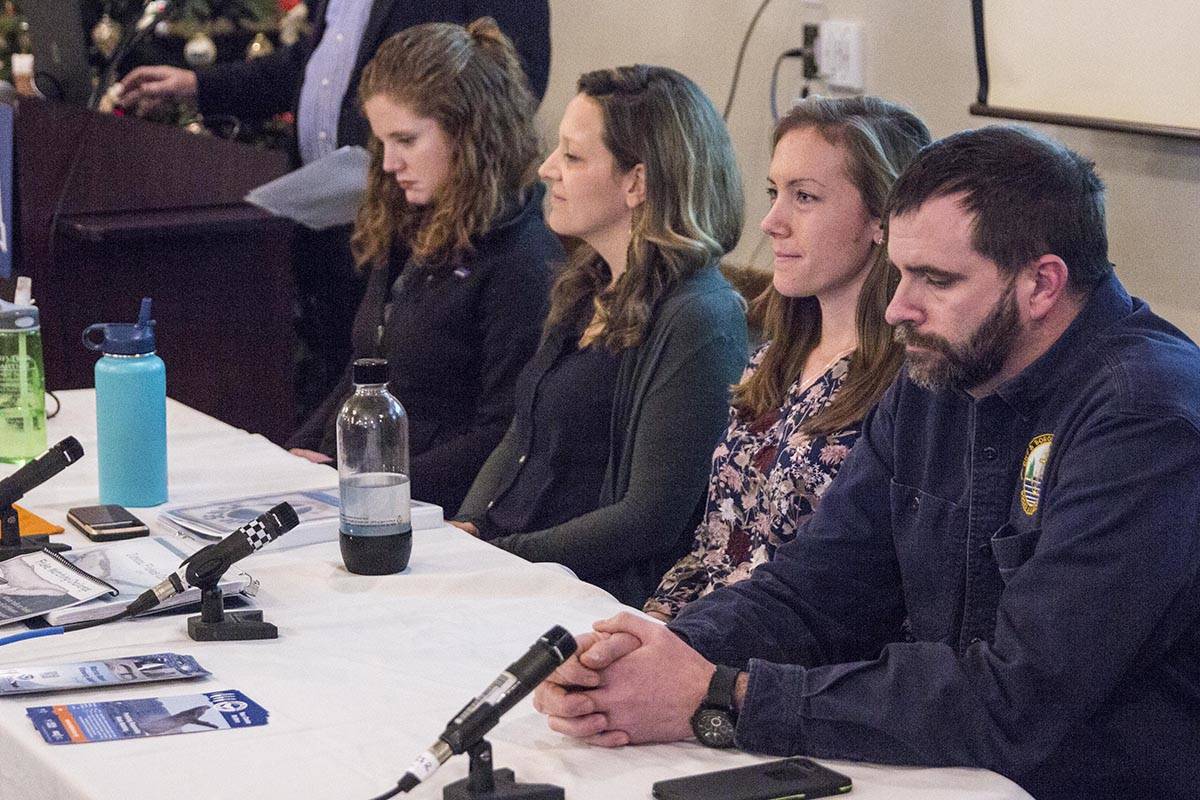
photos by Michael S. Lockett / Juneau Empire Stakeholders prepare to speak to members of the Juneau Chamber of Commerce about whale watching tours during a luncheon Jan. 16.
Teerlink said the whales definitely respond to the presence and number of boats in their vicinity with defined changes to course and speed. The data on hormone analysis has not yet definitively proved or disproved long-term effects to whales’ physiology.
Increasing numbers of whale watching tours, ships and passengers interested in getting close to the whales seem to suggest that the number of whale watching tours will only grow. But presenters and their organizations are looking to keep the industry sustainable and the harm to the whales nonexistent, with or without laws in place to regulate it.
“We’re just at the beginning of the timeline and when we talk about legal enforcement, we’re talking 5-10-15-year timelines,” Gadaire said. “As an industry, we’re thinking, how can we make a change today?”
Proposed changes to the operating models of the whale watching tours include the adoption of a “creed” like wildlife watching companies in Hawaii and Costa Rica have done, Gadaire said. Other ideas being considered include adopting a phone app used by wildlife watching companies in British Columbia that allows captains to log their on-station time and the location of whale pods, so that the companies can keep each other honest, Gadaire said.
Either way, interest in Juneau’s migratory marine denizens isn’t going away time soon, Gadaire said.
“Our whale populations are unique,” Gadaire said. “They’re uncommon. They’re strong.”
• Contact reporter Michael S. Lockett at 757-621-1197 or mlockett@juneauempire.com.