
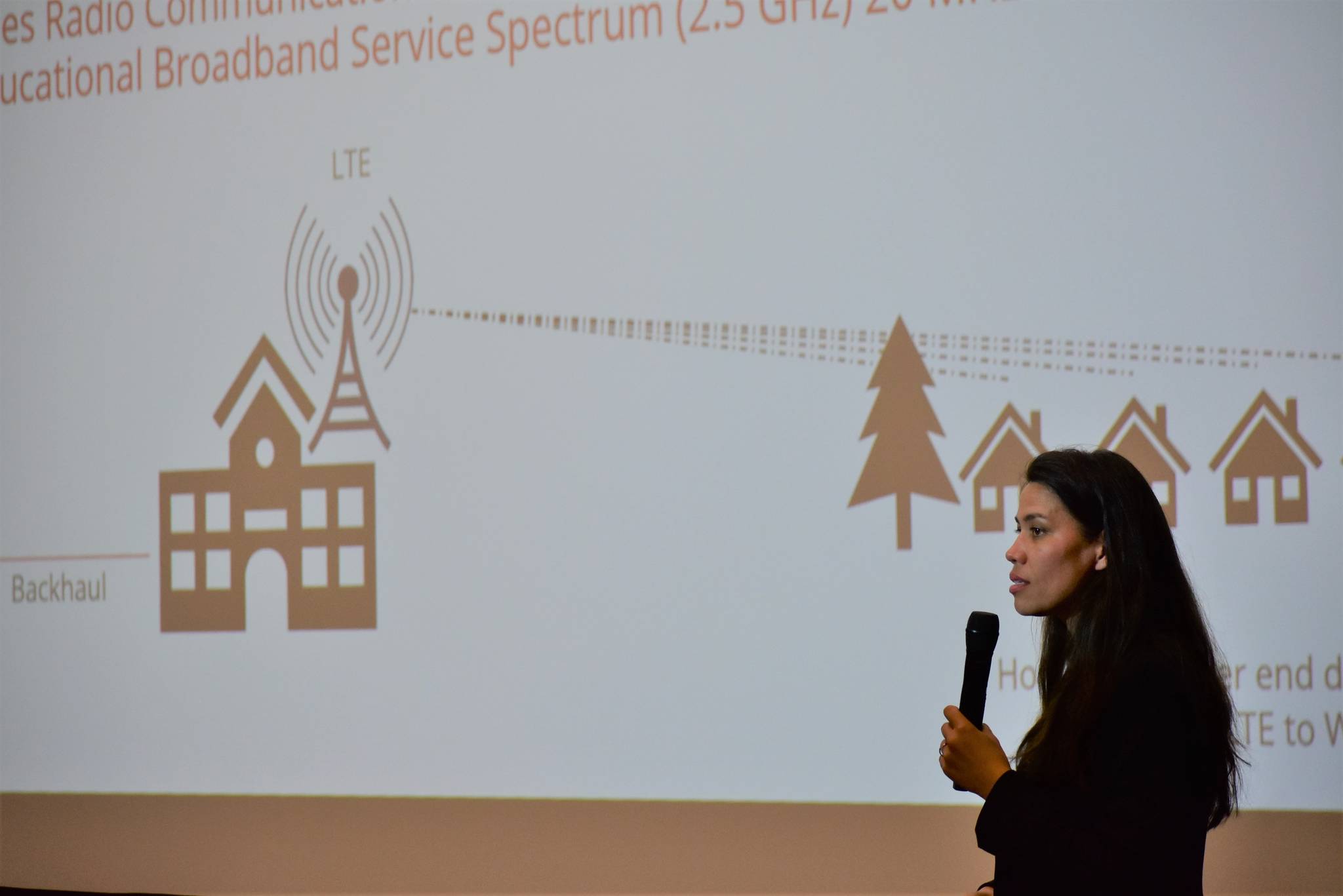
Federally recognized tribes have an opportunity to get radio broadband for their communities. That could allow for better internet access in rural and remote parts of the state.
In July 2019, the Federal Communications Commission announced it was accepting applications from tribes for a portion of the 2.5 GHz band of radio spectrum that can be used for things like broadband internet connection and other communication needs.
Under the FCC’s allocation program, tribal governments would be able to receive bandwidth allocation free of cost. The catch is that tribal governments can only apply for a portion of the broadband that is currently unlicensed.
“What’s unique to Alaska is all (2.5 GHz) spectrum is unassigned,” said Will Micklin, third vice president of the Central Council of Tlingit and Haida Indian Tribes of Alaska. “So eligible tribes may make applications for all of the spectrum. It’s more than sufficient for a radio broadband spectrum.”
So Alaskan tribes would be able to control the right to broadcast over an entire spectrum of radio broadband. Tribes would then be able to use that spectrum however they see fit. According to the FCC, the 2.5 GHz spectrum is suitable for a number of applications and is currently used by both commercial and educational providers.
“You can use it, you can lease it, you can sell it if you want to because that spectrum is the sweet spot,” Micklin said.
The spectrum isn’t necessarily an internet connection, but it can be used from that. With relatively lost-cost infrastructure a community could deploy just a few small antennae and provide communication services within a radius of several miles, depending on the positioning of the device.
To get internet service, a community would still have to tap into an existing internet network, whether through satellite or fiber-optic cable. But even without internet service communities could communicate internally, sharing things such as health care data, Micklin said.
These communication networks can be installed in small communities for about $15,000, according to Mariel Triggs, CEO of Mural Net, an Oakland, California-based nonprofit that helps to bring internet connections to tribal communities.
In 2018 Mural Net worked with the Havasupai Tribe in Arizona to bring these connections to their community on the floor of the Grand Canyon. According to Triggs, installing the access points (things like radio receivers and routers,) took $15,o00 and less than a day of labor.
Those local receivers were then able to connect with local internet service providers to bring strong enough broadband internet service to support streaming video to 90% of the village, according to Triggs.
That presents a problem for Alaska, because even with the local communication networks there’s not always an existing internet infrastructure for rural communities to tap into. Because laying fiber-optic cable would cost far too much, Micklin said, tribes were looking at providing internet via satellite.
But, he said, establishing these networks would allow for those connections in the future and for other uses such as geo-tagging fishing boats or hunters.
Micklin said Tlingit and Haida wanted to bring regional tribes together to collaborate on ways using the spectrum could benefit rural communities. The window for tribes to apply for spectrum allocation is Feb. 3 to Aug. 3, 2020. After that, the remaining spectrum will be auctioned off to the highest bidder.
There are use requirements and concerns about finding ways to make ownership of the spectrum sustainable. But, Trigg said, those requirements are fairly easy to meet, and there are a number of opportunities to monetize the networks.
“Grab it, you’ll figure it out later,” Triggs said.
