
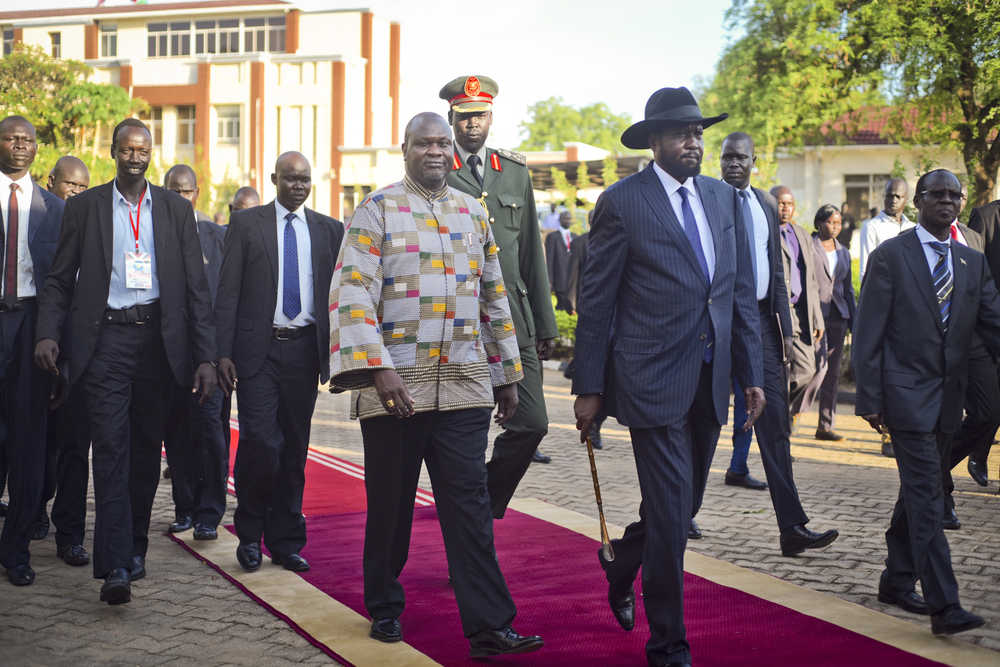
JUBA, South Sudan — South Sudan’s rebel leader Riek Machar returned to the capital Juba on Tuesday afternoon, to become vice president and to try to end the civil war that in two and a half years has killed tens of thousands of people and forced more than 2 million from their homes.
After landing at Juba International Airport, where doves were released and a welcoming crowd ululated, Machar briefly addressed the press before driving to the presidential palace to be sworn in as First Vice President to President Salva Kiir, according to a peace deal signed eight months ago under intense international pressure.
Machar flew from Gambella, Ethiopia, just across the border from his rebel headquarters in South Sudan, on a U.N. plane.
“I’m happy to be back,” Machar told reporters at the airport. “The war was vicious. We have lost a lot of people in it and we need to bring our people together so that they can unite, reconcile, heal the wounds, the mental wounds that they have.”
“There will be challenges ahead, there will be obstacles but as long as there is political will we can overcome all these challenges, all these obstacles,” he said.
After the swearing in ceremony, Kiir said, “Peace is the only choice for us to relieve our people the undeserved suffering associated with armed conflict enforced upon them. I believe this is the only way to return South Sudan to the path of peace, stability and prosperity.”
The August peace deal calls for a two-year transitional government of ministers and parliamentarians from the two sides before new elections.
Machar’s return is one of the biggest steps toward realizing the peace deal meant to end the fighting, but should not be met with “huge optimism,” cautioned Jacob Chol, dean of Juba University’s political science department.
“It doesn’t mean that the implementation of the peace deal is fully on board or fully implemented, because a lot of issues are yet to be sorted out in the agreement,” Chol told The Associated Press.
At the United Nations, the Security Council welcomed Machar’s return and swearing-in and strongly urged both leaders to quickly form the transitional government, fully implement the peace agreement, respect human rights and deal with the “dire humanitarian situation.”
Sudan’s deputy U.N. ambassador, Joseph Moum Malok, told the council the national unity government will be formed “in a day or two” after consultations with different parties.
U.S. Ambassador Samantha Power hailed Machar’s return.
“This is clearly an important step for South Sudan. After months of delay and obstructionism, both sides compromised to make this happen. It’s the best hope that South Sudan has had in a very long time,” said Power, who warned that significant problems remain and urged the international community to maintain pressure on both sides to implement the peace deal.
Despite Machar’s return, U.N. peacekeeping chief Herve Ladsous called the situation in South Sudan “very worrying,” saying it’s vital to change the political and security trends in the country “if we wish to see a possibility for the peace process to succeed.”
Many in South Sudan worry that Machar’s return will only return the bitterly divided country to its pre-war status quo. The war started when fighting began in Juba between Dinka and Nuer soldiers, before government troops massacred Nuer citizens in the city, sparking revenge attacks against Dinka elsewhere in the country, according to an African Union commission of inquiry.
Machar, an ethnic Nuer, was Kiir’s vice president before the war. Kiir, a Dinka, fired him in mid-2013. Machar then vowed to run against Kiir for the presidency, sparking a chain of events that led to the outbreak of conflict in December that year which ripped open deeply ethnic hatred and pushed parts of the country to the edge of famine as fleeing civilians fled their fields to hide in forests and swamps.
Now the transitional government must end the fighting, resettle millions of displaced, stabilize the country’s collapsing economy, reintegrate the split army, and cooperate with a court to be set up by the African Union to try perpetrators of atrocities.
Both men’s troops are accused of horrific human rights abuses, including gang rape and murder of civilians along ethnic lines. A U.N. panel of experts said Kiir and Machar themselves bear command responsibility for troops who allegedly committed crimes.
“Those shown to be responsible for particularly outrageous atrocities should be brought to justice, but it is also very important that truth is established in a much broader sense,” British Ambassador to South Sudan Tim Morris told the AP. “Reconciliation is not simply an event, this is something which will take generations.”
There are serious doubts that the transitional government can do all that is asked of it due to deep mistrust between the two sides. Machar’s return was repeatedly delayed over the last week as the two sides made last minute excuses and accusations.
Despite the peace deal, fighting has continued with some of the worst atrocities taking place after the signing last August. On Monday night, clashes broke out in the government-controlled town of Bentiu. Rocket propelled grenades and bullets landed inside a UN base where over 100,000 people are sheltering, injuring a child, according to the U.N. and aid workers.
Nearly 200,000 mostly Nuer people shelter in overcrowded U.N. bases around the country which have repeatedly come under deadly attack by soldiers. The residents of a camp in Juba where 28,000 Nuer shelter will not go home until the peace deal is fully implemented including provisions to take suspects of crimes to court, camp leader Thod Mayei told AP.
“We cannot go just randomly,” he said. “We need to know the leaders of South Sudan can show us that this peace is a real peace.”
___
AP writer Edith M. Lederer at the U.N. contributed to this report.
