
Spring is officially here. The vernal equinox has gone by and the days are rapidly lengthening. There are much livelier signs of spring as well. Sapsuckers have arrived in force, rat-atat-tating on rain gutters and stove pipes (and trees). Juncos trill at the forest edge and song sparrows are tuning up in the brush above the beaches. Pacific wrens sound off from invisible lookouts in the understory. Best of all, ruby-crowned kinglets can be heard, high in the conifers, calling “peter-peter-peter” or singing their full, cheerful song. That’s when spring is really here, for me.
A walk on a favorite beach on Douglas Island was focused on finding mermaids’ purses — the egg cases of long-nosed skates. Every year, about this time, we find them washed up in the wrack at the high tide line — there must be a nursery just offshore. On this day, we found 16 egg cases, mostly black, dry, and in various stages of decrepitude. Just a few were still mostly whole and khaki-colored, and two had natural openings at one end, where perhaps the young skate had exited. All the egg cases had sizable holes punched into them. I would love to know if marine predators had nabbed the developing embryos or if the holes were made by a tardy, would-be predator just hoping that an embryo was still inside.
[The colorful evolution of moths and butterflies]
A good find in the rolled mats of rockweed at the high tide line was the body of a sea star, entirely eviscerated. All the gonads and digestive parts had been cleanly removed, neatly exposing the calcareous skeleton of the water-vascular system that runs from the center of the star out into each arm. In a living sea star, the canals of this hydraulic system are filled with fluid, mostly sea water. Numerous branches of the main canal lead to the tube feet (often visible in a live star, in rows under each arm) that function in locomotion and in opening clams. When the tube feet are extended, their ends stick to the rocks or the clam shell, and muscles in the feet contract, pulling the animal forward or pulling the clam shell open. We sometimes see a sea star humped up over a partly open clam while the star is having dinner.
A stroll on the Boy Scout/Crow Point Trail led to the goose-flat covered with hundreds of crows fossicking in the dead, brown vegetation. Lots of searching and probing. Sometimes half a dozen crows would suddenly converge on another one, everybody poking at something. Apparently, successful hunts were not very common and the gang thought that sharing was appropriate.
[Wild Shots: Photos of Mother Nature in Alaska]
Lots of Canada geese were scattered in small groups on the flats, in the river and in the vegetation by the river. There were mostly head-down, intent on foraging — grubbing for roots and such, and of course talking to each other. Occasionally, two of them would take off and wing around in a wide circle before landing back where they started. One of these duos took off upstream — perhaps a mated pair about to look for a nest site in the forest.
As we often do out there, we encountered a fellow we call the Raven Man, who carried a big bag of dog biscuits to feed the ravens. He does this from time to time, and the local ravens recognize him. As he passes through each raven territory, the residents come to greet him and cadge some biscuits. We watched some of these ravens carry five biscuits at a time, first stacking them up in a neat pile so they could be held in the bill. A dog, with some hikers, came along later and sniffed out places where ravens had cached their loot, covering it with grass or moss — surprising the hikers who were not expecting to see dog biscuits in the moss.
Most folks in Juneau are glad to see the snow disappear, at least at the lower elevations. But I loved the good snows we had in February, and here are a few flashback memories.
[Arctic terns at Mendenhall seem to be decreasing in numbers]
• Weasels had been very active in the Peterson Creek meadows and Amalga meadows. They bounded over the clean snow, ranging widely. Every so often, the trail dove straight down under the snow and reappeared a few feet beyond or disappeared under the overhanging edge of a frozen slough. I think they were hunting voles, whose tunnels run under the snow; did they dive down in response to the sound or fresh smell of vole or were the dives just exploratory? Another treat in one meadow were well-defined trails of mice, showing a good tail-drag.
• On the west side of Mendenhall Lake, one day I found a set of tracks running way out onto the snowy ice and right back again. It was clearly a member of the weasel family, probably a mink. What was it doing?
• A snowshoe trek up a creek out the road was a bonanza of tracks (and no recent human tracks). In the woods on the way up the hill, there were tracks of deer, mouse, weasel, squirrel and maybe a marten. Big excitement of some large tracks that were surely those of a wolverine — the toes and the gait gave it away. The most fun was seeing a set of wolf tracks coursing over a frozen pond that sparkled with sun-struck hoarfrost.
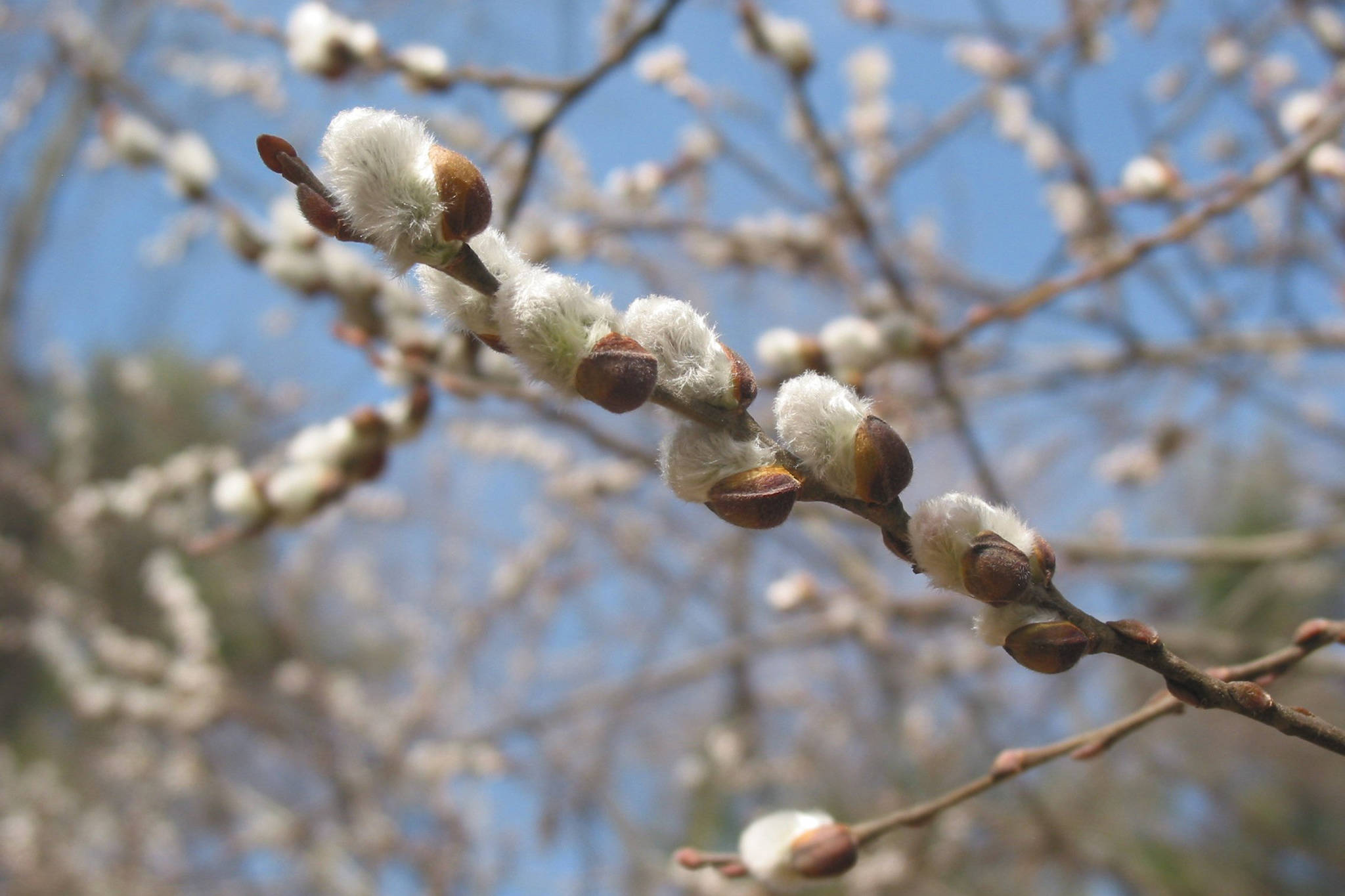
Now the fun in the snow is finished for the year, and the fun of spring begins. Juneau folks typically love to note the progress of spring, as the season unfolds. Skunk cabbage emerging, pussy willows appearing, blueberry buds expanding, the gradual arrival of more kinds of birds, ravens carrying sticks for a nest — they all mark the progress of a favorite season.
• Mary F. Willson is a retired professor of ecology. “On The Trails” is a weekly column that appears every Friday. Her essays can be found online at onthetrailsjuneau.wordpress.com.
