
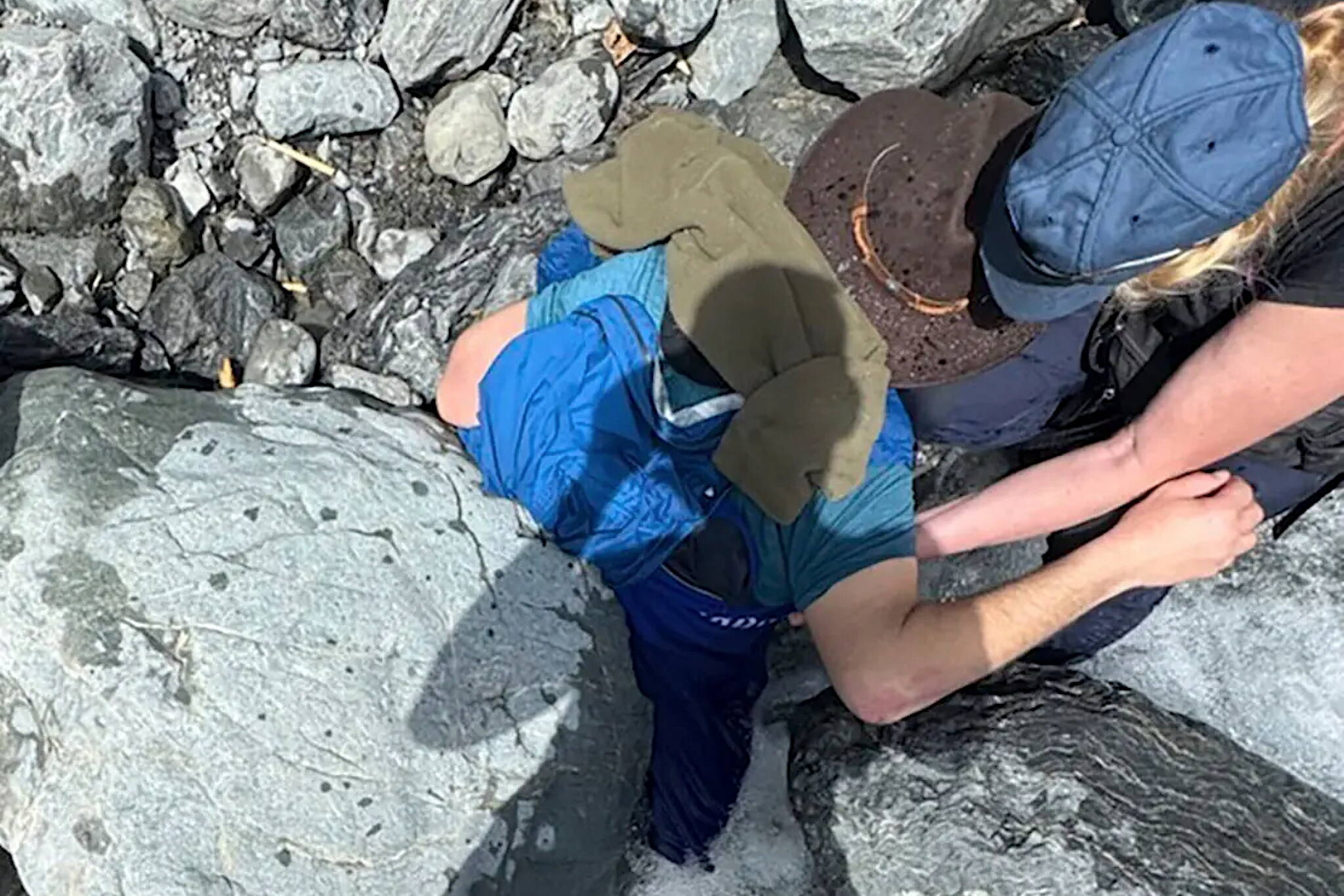
Kell Morris does not remember exactly how he started tumbling or how he ended up on his stomach, but he remembers when a 700-pound boulder hit his back — the jolt of pain it caused as it pinned him down, and how instantly he knew he was in trouble.
Morris, 61, said it was a “beautiful, beautiful day” on May 24 in Seward, Alaska, where he lives with his wife, Joanna Roop.
Wanting to avoid the Memorial Day weekend crowds that clog up popular trails, the pair decided to hike near a remote glacier more than 120 miles south of Anchorage. It was a route they had taken before, and it was one they knew would be empty.
They had been looking for a spot to cross a creek when the earth holding a group of boulders gave way and began sliding down. Morris, who had been standing there, started sliding, too. He said he tried to almost surf the sliding gravel but lost his footing and tumbled down.
“The next thing I know, I’m face down in the creek and you can still hear these rocks,” he said, describing the clattering of falling rocks as “kind of a scraping and hitting at the same time, but it’s much, much deeper.”
Roop, 61, who was several yards away looking for a good spot to cross the creek, also heard that distinctive sound.
“It’s like the mountain just groaning,” she said. “Low, and slow, and falling, and horrible.”
Having spent her life in the mountains, Roop knew that sound.
She had heard it before “but never that close, never with knowing someone was there.” She ran to the area of the slide, calling for her husband but there was no answer.
“That was the longest, slowest 100-yard-dash ever,” Roop said. “My body felt like it was moving in superslow motion.”
When she saw him, Roop said, it felt like the situation went from “worse to worse.”
Trapped under the massive boulder (which responders later measured to get an approximation of its weight), Morris was just about holding himself out of the cold glacier water that feeds the creek.
Roop, a retired Alaska state trooper and a current Seward police officer, began doing what she could to move the boulder off Morris, like placing rocks underneath to get some leverage.
But these are glacier boulders, Roop said. They’re round and kept sliding out of place. At this point, Morris began shivering.
“We kind of assessed that I’m not going to last long in this cold water,” Morris said, and he sent his wife with both their cellphones off in search of a signal.
After walking around 300 yards, Roop connected to a 911 dispatcher.
Relying on her law enforcement background, Roop said she was able to give the dispatcher the information needed to find them in the remote spot where Morris was pinned and inform rescuers what they needed to bring, including ropes, pry bars and a helicopter.
Rescue crews from several agencies, including the Seward Fire Department and the Bear Creek Volunteer Fire Department, mobilized.
But the extreme terrain of the area where Roop and Morris had been hiking meant progress was slow — even the firefighters’ all-terrain vehicles were struggling. Then, a Bear Creek volunteer who works for Seward Helicopter Tours heard the 911 dispatch call.
The volunteer and a pilot offered to pick up six firefighters and take them to where Morris was pinned, saving 45 minutes of travel time, the Seward Fire Department said in a news release.
The helicopter ferrying the rescuers could only hover over the boulder field where Morris was trapped so firefighters had to jump a foot or two from the aircraft upon arrival.
Rescuers found Morris suffering from hypothermia and wavering in and out of consciousness, face down in a creek with the boulder on his back, and Roop holding his head out of the water, the news release said.
Rescue crews used air bags, ropes and “brute force” to free him, the department said. After he was warmed up, Morris “became more alert, and his vitals improved,” the department said.
He was then airlifted out of the canyon and placed into an ambulance that took him to a hospital. He came away with only scratches and some nerve damage.
“It is no doubt that without the help from Seward Helicopter Tours this incident could have had a much different and potentially fatal outcome,” the Seward Fire Department said.
“The stars completely aligned for Mr. Morris for all things,” said Clinton Crites, chief of the Seward Fire Department.
Seward Helicopter Tours said on social media that it was “incredibly proud” of Neo Martinson and Sam Paperman, the two people who responded to the call for help.
Roop said she was beyond grateful to everyone involved who made it so she could “still have a husband.”
“That we’re absolutely fine is a gift,” she said.
For Morris, the three hours he spent pinned face down in a creek is yet another wild story in what he described as a wild life. Decades ago, when he was involved in a rodeo, a bull broke his hip. He then performed with the broken hip because “we needed enough money to make it to the next town.”
Morris, who works as a foreman at Catalyst Marine Engineering, was back at work by May 27, he said, and the couple have already talked about planning their next hike.
“We’re both 61 years old,” Roop said. “It’s no time to start changing now. Of course we’re going to be in the back country.”
• This article originally appeared in The New York Times.
