
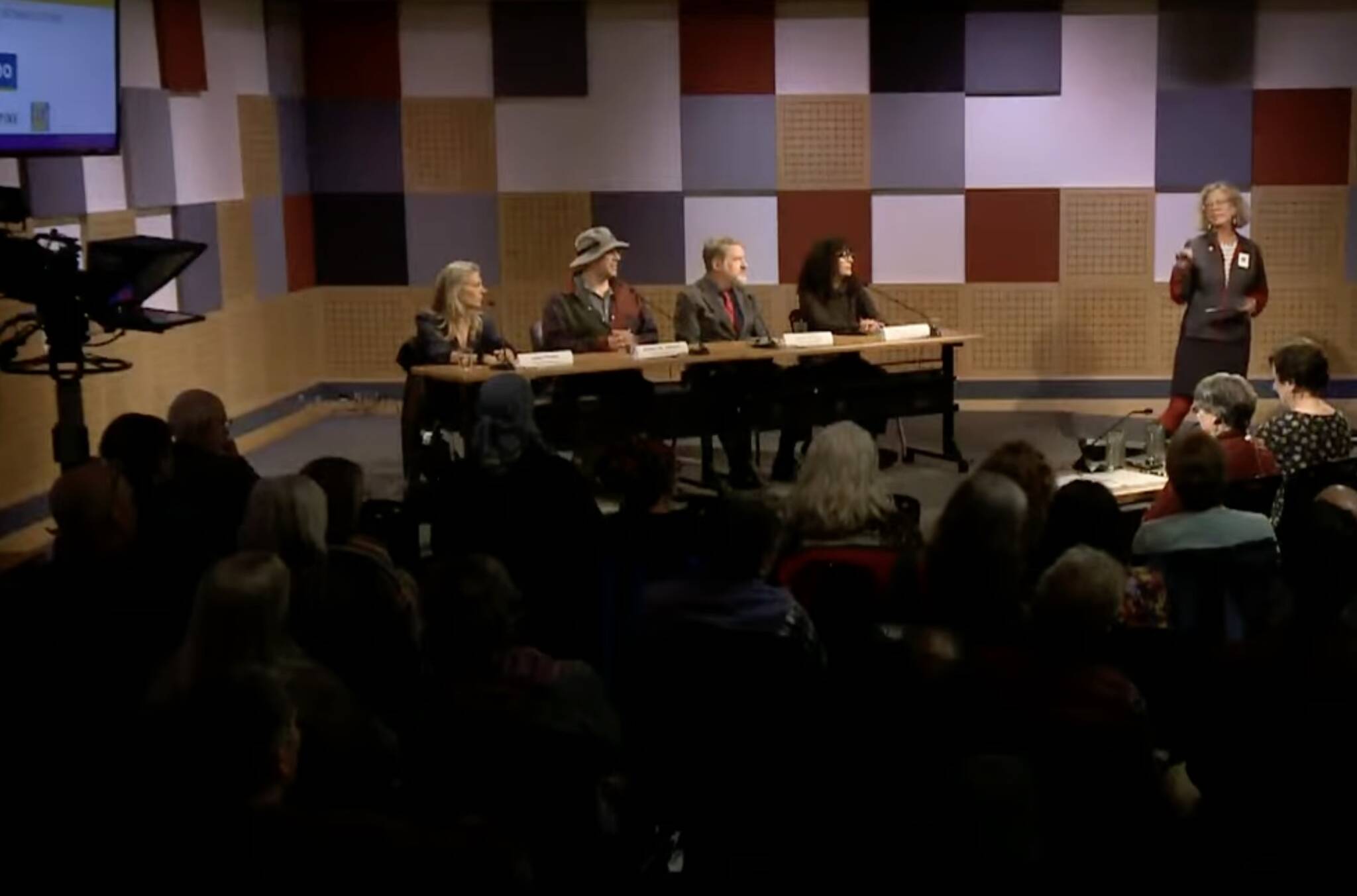
With municipal elections two weeks away, candidates for the Board of Education and City and Borough of Juneau Assembly gathered Friday for a forum.
The event was hosted by Juneau League of Women Voters, with opening remarks by member Sally Saddler. Judith Mitchell and Patricia Turner Custard served as moderators.
Board of Education
Jenny Thomas, Jeremy Johnson, Steve Whitney and Melissa Cullum are running to fill two full-term seats and one part-term seat on the Board of Education.
Funding dominated the discussion.
Lawmakers in August narrowly overrode Gov. Mike Dunleavy’s veto of $50 million in education funding, part of an increase in the state’s per student funding passed earlier this year by legislators.
“Most of our funding originally comes from the state, and when we govern by veto overrides, that’s not a normal functioning scenario,” Whitney said. “Our job now is to survive for two more years and hopefully rebuild.”
The long-term impact of consolidating Thunder Mountain High School was another key issue in the discussion. While extracurricular participation held steady in the first year after the merger, it has since declined.
Whitney stressed the importance of after-school activities. Thomas suggested building stronger ties with Parks and Recreation programs. Johnson proposed more community fundraising, while Cullum warned that community fundraising may already be stretched to its limits.
All four candidates noted that their experiences as parents motivated them to run.
Assembly
Greg Smith and Ella Adkison are running unopposed for the District 1 and areawide seats, respectively. Nano Brooks is running against incumbent Wade Bryson for the District 2 spot.
Affordable housing was a central topic. Candidates highlighted measures the Assembly has already taken, such as the Affordable Housing Fund and zoning changes under Title 49 to allow higher density development.
But financing remains challenging, Smith said, and the Assembly needs to continue to have funds. Brooks said that projects like Ridgeview and Pederson Hill cost millions without fully addressing the need.
The candidates also weighed in on the three ballot propositions.
Proposition 1 would cap the local property tax rate, or mill rate.
Adkison, Smith and Bryson all opposed the measure, arguing it would strip the Assembly of revenue without offering meaningful savings to most homeowners.
“A mill rate cap would reduce our flexibility,” Bryson said. “It would benefit the wealthiest land owners of the community. That’s why I’m a no.”
Brooks said he will be voting yes on Proposition 1.
“Think of the demographics of people who are buying homes these days, a lot of young families, young individuals trying to get their first home,” Brooks said. “This would be a benefit to them.”
Proposition 2 would exempt essential food and non-commercial utilities from the local sales tax. Proposition 3 would replace the current year-round sales tax rates, making sales taxes higher in the spring and summer and lower in the fall and winter.
In their closing remarks, some candidates returned to the propositions.
Brook believes the financial burden of Proposition 3 will actually fall on local residents. He emphasized that Juneau residents already face high costs, especially with seasonal spending and online shopping, and cannot afford the added strain.
Smith emphasized the important aspects of life for Juneauites: priorities such as housing, child care and education, and quality of life benefits, like aquatics and Eagle Crest.
“Should some of those ballot measures in certain combinations go to pass, especially if we lose eight to 10 million in recurring revenue every year,” Smith said. “I’m very concerned at what that would do to our community and our ability to invest in those key priorities.”
All ballots must be returned or postmarked by Election Day, Tuesday, Oct. 7, at 8 p.m.
