
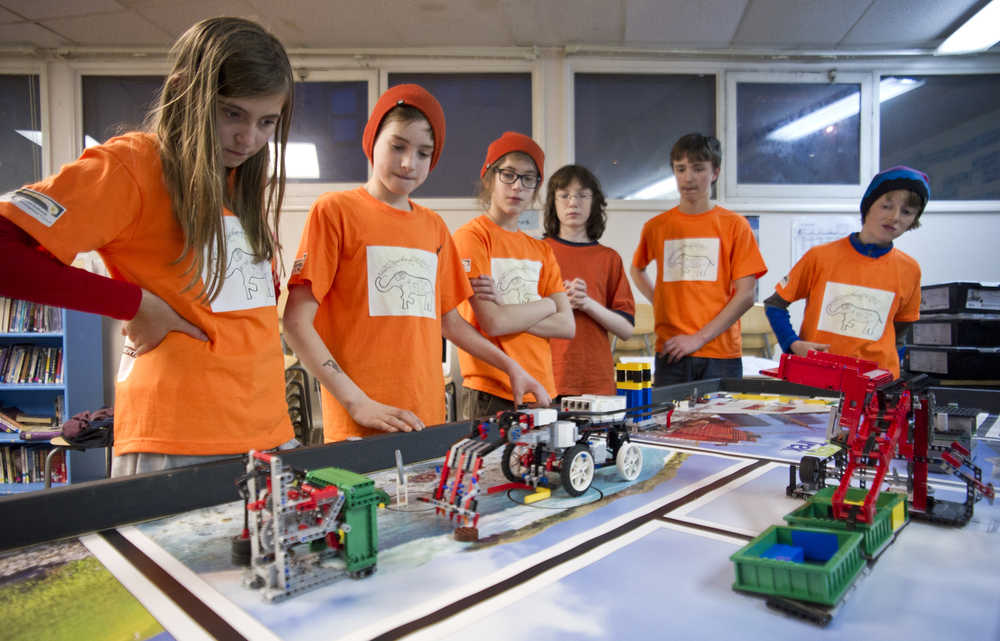
From afar, the kids hanging out after class on the second floor of the Juneau Community Charter School are just playing with Lego pieces — it takes a second glance to realize they’re doing something more.
“Our project could save the world,” 12-year-old Nakenna Kotlarov earnestly said Tuesday night, working alongside teammates who talked about a recycling concept that uses Legos to model part of the idea.
Nakenna and five other students make up the robotics team A2Z — comprised of students from Juneau Community Charter School, Thunder Mountain High School and Dzantik’i Heeni Middle School — that first qualified at a Juneau Robot Jamboree before taking home second place in the statewide FIRST LEGO League Championship.
“We met every Tuesday for three to four hours, sometimes we had extra sessions,” 14-year-old Zander Kotlarov said while holding the teams pride and joy, “Clyde the Elephant Mark III.”
At the state competition in Anchorage, the team presented Clyde, which is made with hundreds of Lego pieces and programed to moved by a small computer. It’s one part of a larger competition that encourages children to think as a team to solve challenges, such as getting the robot to rescue a Lego Man from one area of a billiard-sized table and move him to another.
The kids share similar smirks when they see their robot accomplish a task, but still talk about how the robot could move more efficiently next time if pieces where added to one side or another. Their amusement and sense of achievement is obvious, but they’re quick to remind anyone who asks that the part of the Lego competition that matters most is the Trash Trek Challenge.
For the challenge, teams across Alaska researched solutions to excess trash. A2Z team member Ambrose Bucy, 13, came up with a possible idea for his team to explore after finding a hole in one of his books.
“I was reading one of my Pogo books that my mom got me for Christmas and I saw this hole going through it right there,” Ambrose said, pointing to the bottom right corner of the book.
“Then this little larva-thingy fell out, and I kept it in a jar.”
A family friend of Ambrose’s who is an entomologist told him that he had found a beetle that can eat paper. A light bulb turned on for Ambrose and the rest of the group. What if a similar bug could eat the plastic that builds up in the world?
Like an eager scientist, 12-year-old Finn Morley lists professors across the nation that the group has corresponded with — minds from Stanford University, Harvard Medical School and Duquesne University, to name a few. The professors have sent the children articles to further their research.
Finn, Zander and 13-year-old Aaron Blust talk about how their microbial mats, the necessary archaea (a type of bacteria) and plastic diets for mealworms all work to reduce the amount of polyethylene discarded in the environment.
It seems like a complex idea for anyone without a scientific background, but as Aaron puts it simply: “We knew about microbial mats, and we knew about mealworms; we just kind of put the two together.”
JCCS teacher Steve Morley is Finn’s father and the official team coach. He said all the parents are coaches to some degree, but added that parent involvement is minimal because the students are self-driven.
That drive is evident as the team wrapped up a Tuesday night session. They talked about how to strengthen the science behind their microbe project before heading to another tournament. They were invited to three — one in San Diego, Arkansas and Australia.
Morley said the most realistic trip the group can expect to make is the one to San Diego. But the airfare alone costs more than $4,000. Fundraising will be key — for the state trip, the team was able to garner sponsorship from six local businesses — but that’s a matter for the adults to mull over.
The kids have bigger problems, like saving the world.
For information about the A2Z team or to find out how to become a team sponsor, contact Steve Morley at steven.morley@juneauschools.org.
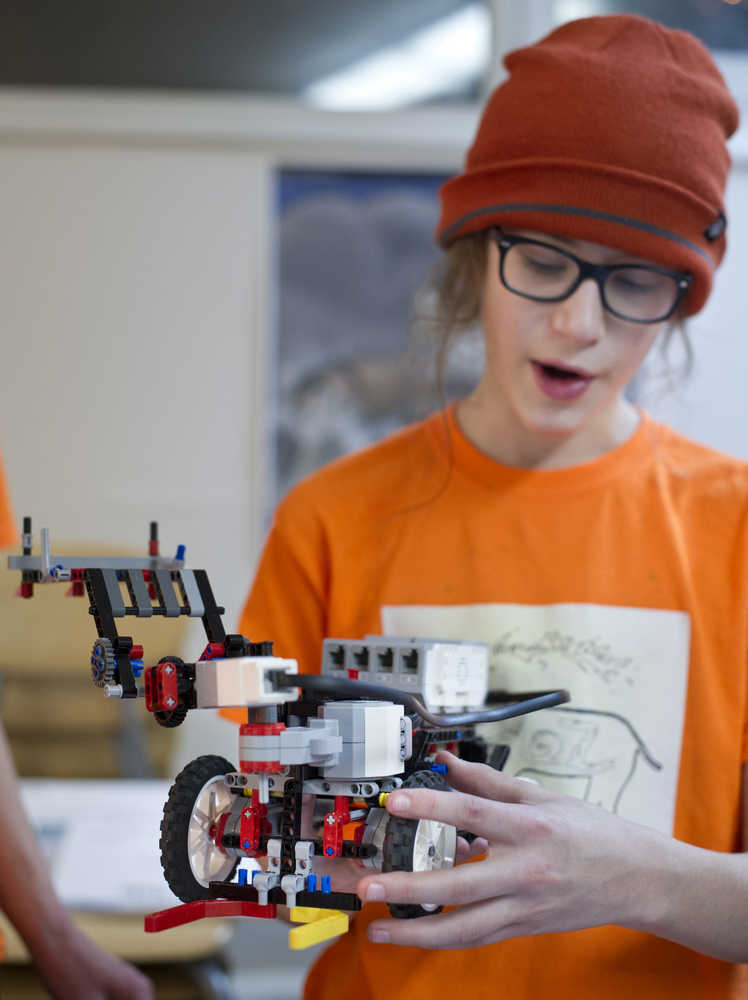
Ambrose Bucy, 13, explains how he built the main body of the robot for his team’s recent Lego League competitions.
