

The contrast of white cemetery crosses against the greens and browns of the surrounding forest in the distance is the first sign one has entered Kalifornsky Village.
Walking a few hundred feet from the cemetery reveals the outline and indentation left by a historic log house, coated in moss but clearly identifiable.
The bluff drops off just past the cemetery, and air occupies the space where another 100-200 yards of the village used to stand.
“The tribe did an evaluation a number of years ago,” said Alan Boraas, a professor of anthropology at Kenai Peninsula College. “Based on current erosion rates, it will probably erode back to another 15-20 feet and then it should stabilize.”
Boraas has been taking students to the site, which he and others described as sacred, with the permission of the Kenaitze Indian Tribe for about 30 years.
This time, students, tribe members and Kenai Peninsula College faculty were joined by Max Chickalusion Jr., a Dena’ina elder from Tyonek, during a trip to the village last Thursday.
Peter Kalifornsky, the great-great-great-grandson of the man for whom the village was named, was Chickalusion’s uncle.
“I feel honored to be here,” Chickalusion said after performing an opening prayer to bless the space and the outing.
He and Boraas spoke to the 20 or so visitors about the village, how it originated, the people who inhabited it and its importance to Dena’ina people today as they continue to heal and pass down information and traditions.
“This is part of my healing journey, being here,” Chickalusion told the group.
Kalifornsky Village is a registered historical site. Boraas told the group during the visit that there has only been one act of vandalism in recent history — a stolen sign for the cemetery — and added in a later interview that tampering with the site can result in a felony charge.
Rather than a strictly educational tour, Borass said the point of visiting is to tell a story or reveal an attitude about the place that might make people consider their community and natural surroundings on the Kenai Peninsula differently.
“There are sort of the official historic places in Alaska, and everywhere, but there are also those special places, which include sacred places, which often aren’t on the map, often aren’t talked about in history books but have a special significance because of the events that happened there,” Boraas said. “And I think it’s important to go to those places with people who have a sensitive perspective to talk about events and talk about why they’re sacred and therefore to see the landscape in a different way.”
The village is just a few hundred yards off of Kalifornsky Beach Road between Kenai and Kasilof, but Boraas said many people who have lived in the area for years have probably driven by it without knowing the history and meaning the place holds in the community.
Visiting Kalifornsky Village and sharing its history with both Native and non-Native people is important to reinforce the idea that the community needs it there, Boraas said. When trying to heal from past events or to think about how to balance traditional values with modern living, it helps for people to have a physical place to go to reflect on those ideas, he told the group.
Raven Willoya-Williams is president of the tribe’s Gganiłchit Dena’ina Youth Council. She has visited the village before, and said she always gets the same feeling that it’s an important place to be.
“I love that Max was out there and everything they had to share was so valuable,” Willoya-Williams said. “I think, like, being part of Dena’ina, you really need to remember to reconnect to the land because that’s really a big part of who we are. Connect with the land and the water and just remember your history and where you came from.”
The balance between modern life and living according to indigenous traditions and values was an idea brought up several times throughout Thursday’s visit.
Continuing to pass those traditions, histories and values down to young people is key in maintaining them, Chickalusion told the visitors.
Some such practices include the respectful treatment of animals during hunting and the way people care for the land, things Boraas explained to some members of the group who gathered around the site of one of the village’s houses.
He invoked a Dena’ina word to describe this type of stewardship: engii, which he said means “doing things the right way.”
“When you do things a good way, it flows like water,” Chickalusion said.
Boraas talked about whether it is likely that the world and its current practices will be sustainable in the long term, pointing to the continuance of indigenous traditions and ways of life as something Native Alaska can teach non-Native Alaska.
“Nobody is saying go (to) back and live as it was,” Boraas said. “We live in the modern world, but there are traditions and practices for indigenous people, and maybe for others too, that help make sense of why we live like we do.”
• Contact Kenai Peninsula Clarion reporter Megan Pacer at megan.pacer@peninsulaclarion.com.
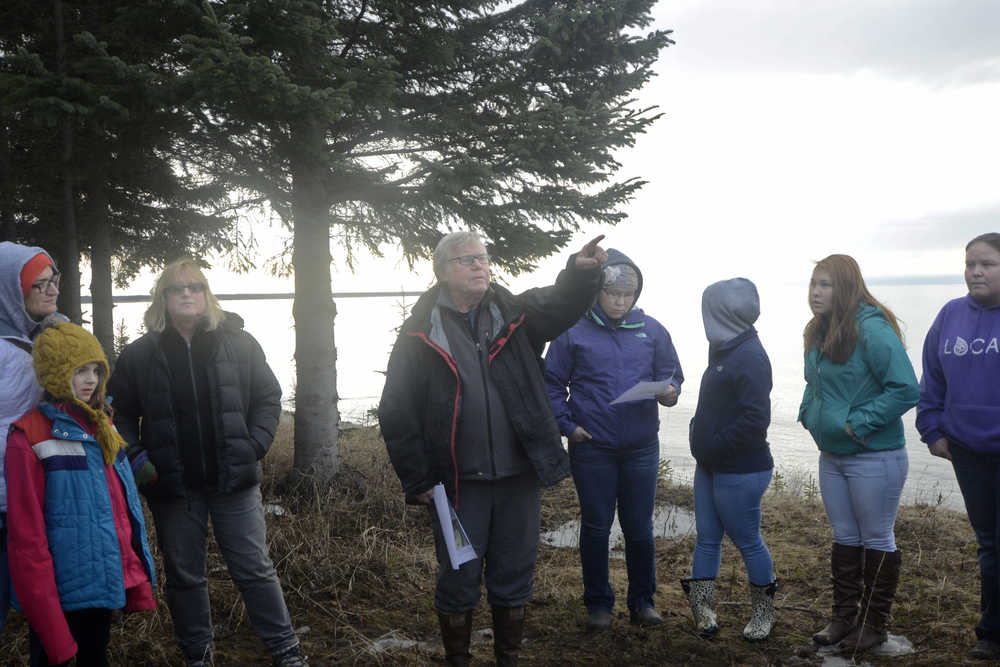
Alan Boraas, a profossor of Anthropology at Kenai Peninsula College, orients a group of Kenaitze Indian Tribe members, students and other college faculty at Kalifornsky Village on March 24.
