
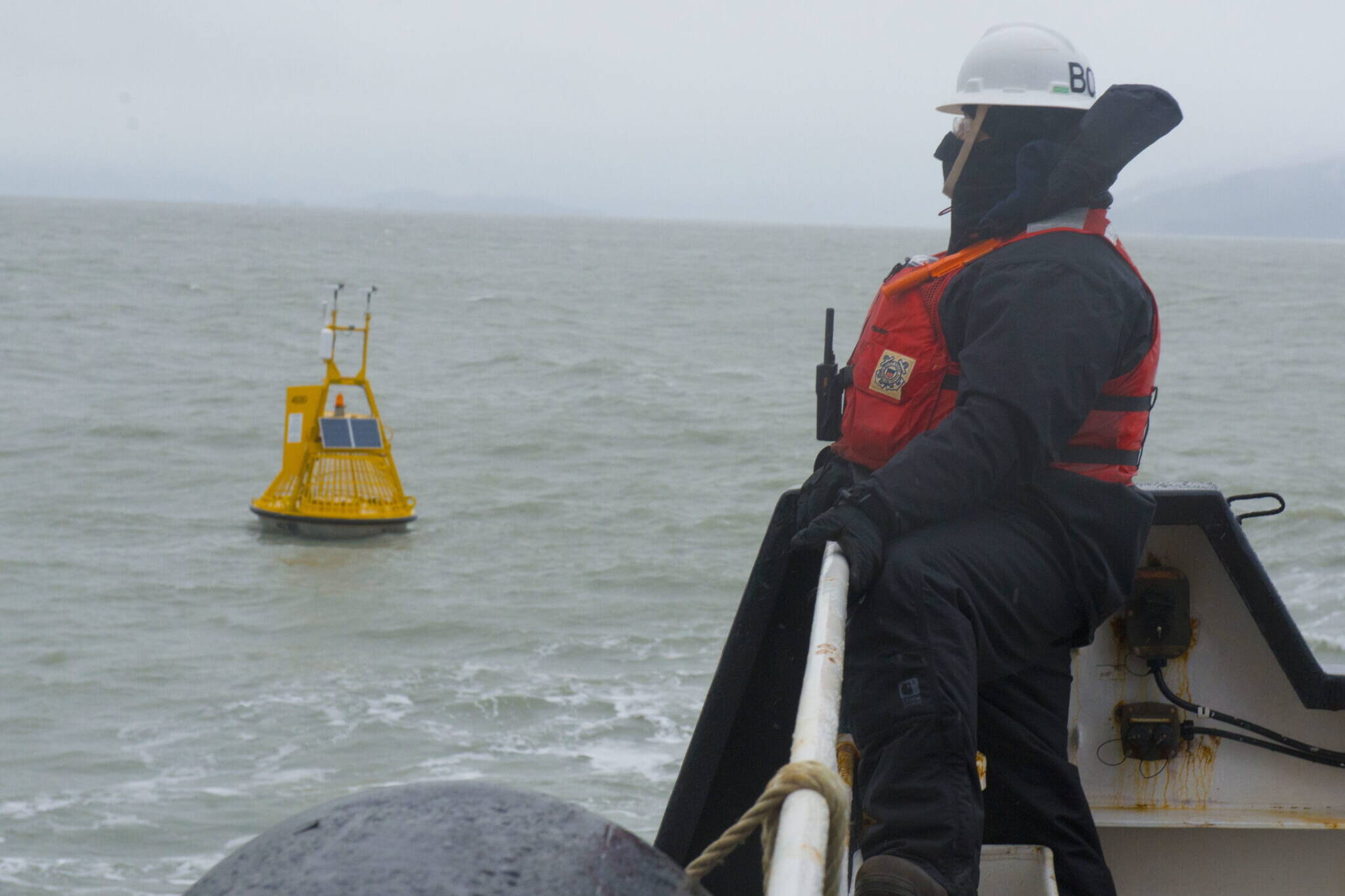
Too many of the weather buoys floating in the waters off Alaska are out of service and the federal government should devote more resources to the National Oceanic and Atmospheric Administration in the interest of marine safety, according to a resolution pending in the Legislature.
The measure, Senate Joint Resolution 12, calls for Congress to “take actions necessary to restore the full functionality,” of the NOAA’s National Data Buoy Center meteorological sites in Alaska, which relay real-time weather information important to mariners.
The resolution calls for the state’s three-member congressional delegation to work to secure federal funding for that NOAA program, even as the Trump administration is slashing NOAA’s workforce and operations. And it points to Alaska’s vast size, harsh weather and heavy reliance on maritime operations.
Sen. Forrest Dunbar, D-Anchorage, the resolution’s sponsor, said Alaskans depend on the weather buoys and the information they provide to a degree that policymakers in the Lower 48 might not appreciate.
“These are serious life safety issues,” he said.
But the resolution is about more than buoys, Dunbar said. It is a defense of a federal agency and federal scientists currently enduring an onslaught of mass firings and budget cuts, he said.
“This is a good argument for preserving National Weather Service and NOAA funding,” Dunbar said, listing one of NOAA’s best-known divisions.
Of the 27 National Data Buoy Center meteorological/ocean stations deployed in Alaska, seven are currently out of service, according to the center.
There is particular concern about outages at a Prince William Sound site called Seal Rocks. The buoy there is supposed to be transmitting critical information about winds, wave heights and other conditions that affect the safety of oil tankers using the Trans Alaska Pipeline System terminal in Valdez.
That Seal Rocks buoy, an important source of weather data for marine-safety studies, has had intermittent outages for several years and is currently out of service.
It is at Hinchinbrook Entrance, the passageway between islands that connects Prince William Sound to the wider Gulf of Alaska. The area from Hinchinbrook Entrance to the Valdez terminal – which includes Blight Reef, site of the1989 Exxon Valdez disaster, is of special concern for tanker safety. Under post-Exxon Valdez rules, oil tankers are escorted there by safety tugs, and shipments by loaded tankers are stopped when winds exceed 45 knots or waves are above 15 feet at Hinchinbrook Entrance.
The Prince William Sound Regional Citizens’ Advisory Council, a marine safety watchdog created by Congress after the Exxon Valdez spill, raised concerns about the outages as early as 2018.
Those outages continue.
John Guthrie, the council’s maritime operations project manager, told lawmakers at a recent hearing that the buoy has been operating for only about 35 days during the past year and a half. That hampers the U.S. Coast Guard, he said, because it has to make decisions about tanker traffic based on less-reliable information from more distant buoys, weather forecasts or chance observations by other mariners, he said.
While subsistence fishers, commercial fishers and others on the water depend on the real-time weather information relayed by the buoys, “the Seal Rocks buoy, in particular, is a key component of the oil spill prevention system in Prince William Sound. The risk of another oil spill increases whenever it is not working,” Guthrie said at a March 20 hearing of the Senate Transportation Committee.
Dunbar said the Seal Rocks buoy situation should be compelling.
“Here’s a concrete example where National Weather Service and NOAA funding is absolutely essential to the safety of the environment in Prince William Sound but also to the economy in the state and, frankly, the nation,” he said.
Legislative resolutions do not create laws, but they express lawmakers’ sentiments. Resolutions directed at federal agencies or at Congress, such as the pending resolution on NOAA buoys, are intended to persuade federal policymakers and influence their actions.
The sentiment expressed in SJR 12, however, conflicts with Trump administration policies concerning NOAA and its divisions.
Already, the Trump administration has fired hundreds of NOAA employees around the nation, including many in Alaska. The National Weather Service has lost about 10% of its workforce. Another 1,000 NOAA employees may be fired next. The agency is among those targeted by the administration’s “Department of Government Efficiency,” or DOGE, which is led by billionaire Elon Musk.
The Trump administration’s objections to NOAA appear to be related to the agency’s work on climate change.
Project 2025, a preelection blueprint for a second Trump administration produced prior to the 2024 election by the conservative Heritage Foundation, cited that work in its conclusion that NOAA “should be broken up and downsized.”
NOAA’s divisions, including the National Weather Service and National Marine Fisheries Service, “form a colossal operation that has become one of the main drivers of the climate change alarm industry and, as such, is harmful to future U.S. prosperity,” the Project 2025 “Mandate for Leadership” document said.
Though Trump attempted to distance himself from Project 2025 before the November election, many of the plan’s authors have high-level positions in his administration. Those include Russell Vought, director of the Office of Budget and Management, who was Project 2025’s lead author.
Impacts to NOAA of the DOGE-imposed cuts and restrictions go beyond lost jobs and workers.
NOAA just canceled a scientific conference that has been held annually for half a century. The 2025 Global Monitoring Annual Conference would have focused on information about greenhouse gas emissions, carbon cycle feedbacks and other atmospheric science subjects. The 2024 conference was the 52nd held by NOAA.
Senate Joint Resolution 12 was pending in the Senate Rules Committee as of Friday.
• Yereth Rosen came to Alaska in 1987 to work for the Anchorage Times. She has reported for Reuters, for the Alaska Dispatch News, for Arctic Today and for other organizations. She covers environmental issues, energy, climate change, natural resources, economic and business news, health, science and Arctic concerns. This article originally appeared online at alaskabeacon.com. Alaska Beacon, an affiliate of States Newsroom, is an independent, nonpartisan news organization focused on connecting Alaskans to their state government.
