
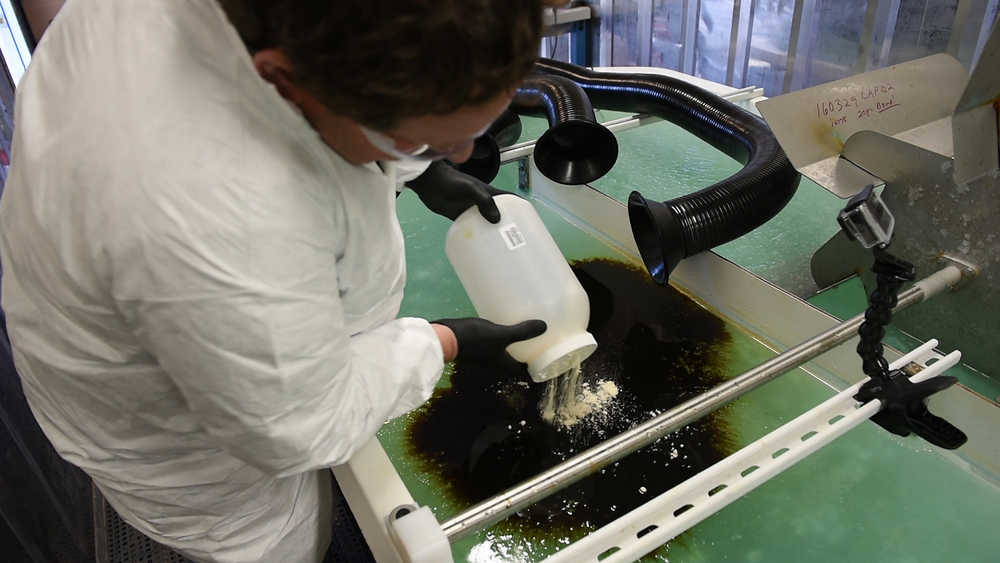
In this Dec. 9 photo, Pacific Northwest National Laboratory microbiologist Robert Jeters sprinkles PNNL's chemically modified sawdust onto a small oil spill inside the Arctic simulation lab, where researchers mimic extreme freezing conditions and make icy slush that is similar to what is found on the surface of the Arctic Sea.

In this Dec. 9 photo, Pacific Northwest National Laboratory microbiologist Robert Jeters sprinkles PNNL's chemically modified sawdust onto a small oil spill inside the Arctic simulation lab, where researchers mimic extreme freezing conditions and make icy slush that is similar to what is found on the surface of the Arctic Sea.

Researchers modify sawdust as possible tool in an Arctic oil spill

ANCHORAGE — Federal researchers looking for ways to contain petroleum spills in frigid Arctic waters are investigating whether a powder form of humble sawdust can provide a solution.

Researchers at the Department of Energy’s Pacific Northwest National Laboratory are testing chemically modified wood flour to determine whether it can enhance burning of crude oil after a spill.

Tests of small batches treated with components of vegetable oil indicate the material, will grab onto crude oil and help keep it near the surface. PNNL senior research scientist George Bonheyo, who is also a research professor of bioengineer at Washington State University, calls the material “incredibly buoyant, ice repelling and water-repelling.”

“It really, really loves oil,” Bonheyo said. “It absorbs at least five times its weight in oil.”

Environmental groups say challenges with cleaning an oil spill are amplified in the Arctic and it’s one of their primary objections to drilling off Alaska’s northern coast. The location is far from ports and other infrastructure taken for granted at drilling sites such as the Gulf of Mexico. Storms are fierce and Arctic waters can be open, frozen or partially covered with ice ranging from floes to slush.

Mechanical recovery has not proven effective because ice can jam skimmers. Researchers at the PNNL lab have focused on burning and bioremediation.

“The point with doing a burn is that it allows you within a matter of minutes to remove upward of 90 percent of the oil from the water,” Bonheyo said.

To burn, he said, untreated crude oil must be fresh and at least 3mm thick, a little more than two stacked dimes. Early results from lab tests of the chemically treated sawdust indicate the material will help keep an oil slick together in the face of buffeting by wind, waves or ice, Bonheyo said, and allow it to burn in thinner amounts.

“We know we can get below 1mm,” he said. “We don’t know exactly what the minimum thickness is.”

Crude oil weathers when absorbed by the material but remains buoyant for at least four months.

“It works very well at holding a spill together. It seems to act kind of like a wick, allowing the volatile, flammable components to rise up to the surface to facilitate an efficient burn,” Bonheyo said.

Bonheyo has a background in research on ship hulls to preventing fouling by organisms. Researchers are looking into adding a bioremediation element to the chemically modified sawdust. Mixtures of organisms adapted for different hydrocarbons, and adapted for different environments, could be added to the wood-based product.

“The idea there is, if any of the oil with the sawdust escaped a burn site, the microbes would be there to consume the escaped oil,” Bonheyo said.

Researchers have conducted burn tests of Alaska North Slope crude oil and Gulf of Mexico crude in warm water at the Navy and Coast Guard Joint Marine Test Facility near Mobile, Alabama. Cold water testing is underway. Researchers also are analyzing residue of material that remains after burning.

Researchers during tests have shaken the powdery material onto water surfaces or spread it with a modified leaf blower. In the real world, Boyheyo suggested, it might be dispersed the way powdery materials are distributed by crop dusters.

More in News

The northern lights are seen from the North Douglas launch ramp late Monday, Jan. 19. A magnetic storm caused unusually bright northern lights Monday evening and into Tuesday morning. (Chloe Anderson/Juneau Empire)
Rare geomagnetic storm causes powerful aurora display in Juneau

The northern lights were on full display Monday evening.

City and Borough of Juneau City Hall is photographed on July 12. (Juneau Empire file photo)
‘Challenging budget decisions ahead’: CBJ seeks feedback facing loss of revenue

The city expects a $10-12 million reduction in general fund revenue following tax cuts approved in October’s elections.

The Alaska State Capitol building stands on Tuesday, Jan. 20, 2025. (Mari Kanagy/Juneau Empire)
Alaska State Legislature convenes for second year of 34th session

Lawmakers agreed to hold two joint sessions later this week.

The K-6th playground design is rendered for the proposed Dzantik’i Heeni playground (Juneau School District image)
Juneau school board approves funding for Dzantiki’i Heeni playground

The Dzantiki’i Heeni campus used to be a middle school, and had no dedicated playground.

Guests ride the Porcupine chairlift at Eaglecrest Ski Area. (Eaglecrest Ski Area photo)
Eaglecrest opens Westside, offers $7 lift tickets Saturday

After a rocky start to the season, the ski area is celebrating its 50th birthday.

Thomas Hatley stands before a helicopter. He was announced the new fire chief for Capital City Fire and Rescue on Friday, Jan. 16, 2025. (Thomas Hatley photo)
Hatley appointed new Juneau fire chief

Former Fire Chief Rich Etheridge announced his retirement in September.

Salvage captain Trevin Carlile, left, and diver Phil Sellick at Melino’s Marine Service re-float a sunken boat in Harris harbor on Jan. 8, 2026. Record-breaking snow at the beginning of the month caused at least eight boats to sink in Harris, Douglas and Aurora harbors, resulting in oil spills. (Chloe Anderson for the Juneau Empire)
A historic storm in Juneau: 10 sunken boats and what it takes to re-float them

Sunken boats don’t become wrecked relics. Left underwater, they can damage vessels overhead and threaten the environment

The Department of Environmental Conservation helped a Nikiski resident dispose of over 43 tons of contaminated soil after a home heating oil spill in November. DEC on Friday launched a program to help eligible homeowners cover cleanup costs relating to home heating oil spills. (Photo courtesy of DEC)
State launches program to help homeowners cover heating oil spill cleanup costs

The Department of Environmental Conservation announced the program on Friday, Jan. 9.

Most Read