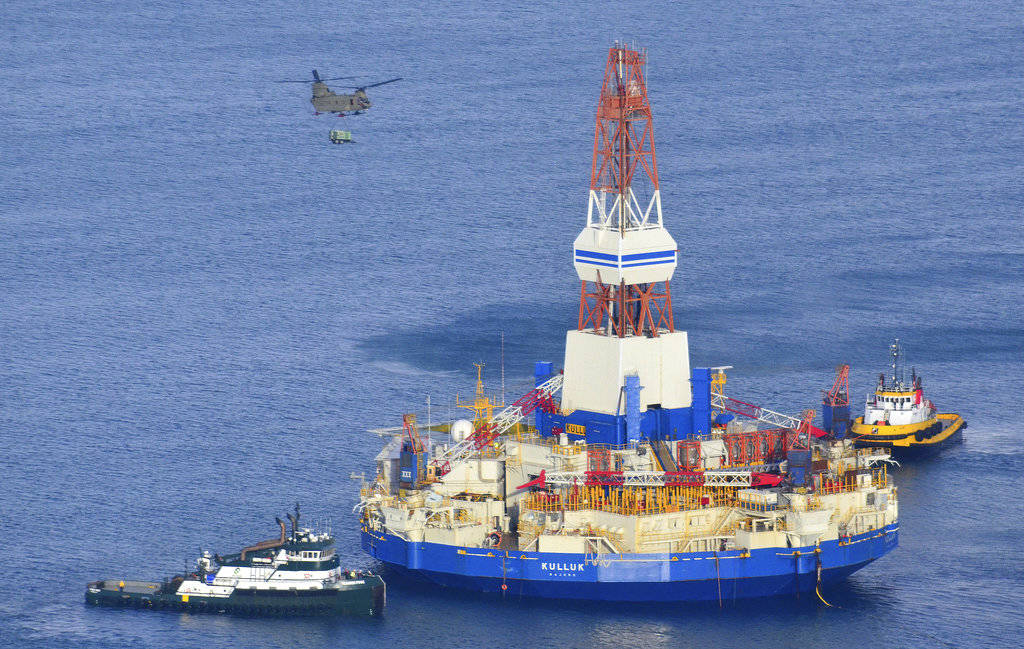
In this Jan. 7, 2013 photo, a U.S. Army CH-47 Chinook helicopter flies over the Kulluk, the Shell floating drilling barge off Kodiak Island in Alaska’s Kiliuda Bay, as salvage teams conduct an in-depth assessment of its seaworthiness. Citing the disappointing results from an exploratory well in 2015, and challenging and unpredictable federal regulatory environment, Shell abandoned drilling in U.S. Arctic waters. The Trump administration is pursuing petroleum lease sales in Arctic waters but an analyst says potential bidders may find other areas more attractive. (James Brooks | Kodiak Daily Mirror File)

In this Jan. 7, 2013 photo, a U.S. Army CH-47 Chinook helicopter flies over the Kulluk, the Shell floating drilling barge off Kodiak Island in Alaska’s Kiliuda Bay, as salvage teams conduct an in-depth assessment of its seaworthiness. Citing the disappointing results from an exploratory well in 2015, and challenging and unpredictable federal regulatory environment, Shell abandoned drilling in U.S. Arctic waters. The Trump administration is pursuing petroleum lease sales in Arctic waters but an analyst says potential bidders may find other areas more attractive. (James Brooks | Kodiak Daily Mirror File)

Report: Alaskans fourth highest greenhouse gas emitters per-capita

Human-caused greenhouse gas (GHG) emissions in Alaska have decreased by 8 percent since 1990, according to an updated report from the Department of Environmental Conservation released Tuesday.

The state’s per-capita emissions are still some of the highest in the nation, but overall, Alaska is 40th out of all 50 states and Washington, D.C. for greenhouse gas emissions.

According to the new report, Alaska has the fourth highest per-capita greenhouse gas emissions of any state in the country. Only West Virginia, North Dakota and Wyoming came in higher in per-capita emissions.

The updated report adds data from 2011-2015 to a report from 1990-2010. Some of the trends found in the report are new, some are ongoing.

“One of the really significant findings in some ways was the stability that we’re seeing in this report,” said Denise Koch, director of the Division of Air Quality. “The major emitters are the same, those patterns haven’t changed.”

In 2014, Alaskans contributed roughly 35 million metric tons of carbon and carbon equivalent. Thirty-nine states had higher overall greenhouse gas emissions, with Texas being the highest at almost 650 million metric tons and D.C. the lowest with just a few metric tons.

Each of the states which came in higher in per-capita emissions has a population below 2 million and comparably large amounts of industry. Industry (54 percent) and transportation (35 percent) are Alaska’s two biggest greenhouse gas emitters by sector.

“We do know that’s consistently been the largest slice of the pie,” Koch said.

The report will inform Gov. Bill Walker’s new Climate Action Leadership team, Koch added. It measures six gases, including carbon dioxide, known to contribute to global warming. Known as the “Kyoto” chemicals, the report measures how much of each Alaskans are putting into the atmosphere and weights them based on their propensity to increase the greenhouse effect, a leading contributor to global warming. Natural sources of greenhouse gases, like wildfires, are not included in the report.

The state has seen an overall decrease of about 8 percent in the amount of greenhouse gas, measured in millions of metric tons, released into the atmosphere on an annual basis since 1990. That decrease has kept pace with an overall decrease in U.S. emissions.

Alaska’s emissions peaked at about 50 million metric tons 1995-2007 and have continued on a mostly downward trend since then, dropping down to around 40 million metric tons in 2015.

The decline could have to do with changes to the economy and the oil industry. Or it could be due to changing cultural practices, like fewer people opting to bike to work or reuse shopping bags.

“We can’t pinpoint a part cause for that decline,” Koch said.

Alaska’s emissions are a small part of the U.S.’s overall, making up 0.63 percent of total U.S. human-caused emissions. Worldwide, that share is about .009 percent.


• Contact reporter Kevin Gullufsen at 523-2228 and kevin.gullufsen@juneauempire.com. Follow him on Twitter at @KevinGullufsen.
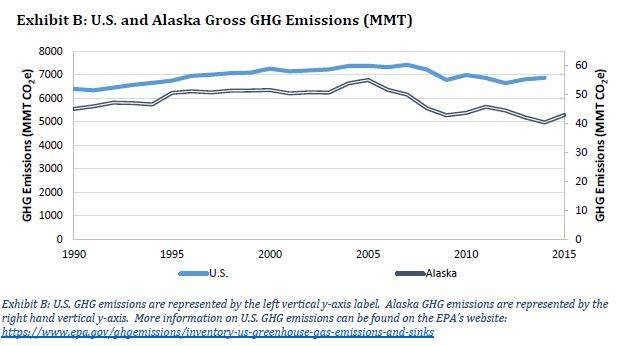

A chart from the Department of Environmental Conservation’s air quality division shows Alaska’s greenhouse gas emissions compared to national emissions.

A chart from the Department of Environmental Conservation’s air quality division shows Alaska’s greenhouse gas emissions compared to national emissions.

More in News

The northern lights are seen from the North Douglas launch ramp late Monday, Jan. 19. A magnetic storm caused unusually bright northern lights Monday evening and into Tuesday morning. (Chloe Anderson/Juneau Empire)
Rare geomagnetic storm causes powerful aurora display in Juneau

The northern lights were on full display Monday evening.

teaser
Juneau activists ask Murkowski to take action against ICE

A small group of protesters attended a rally and discussion on Wednesday.

A female brown bear and her cub are pictured near Pack Creek on Admiralty Island on July 19, 2024. (Chloe Anderson for the Juneau Empire)
Pack Creek permits for bear viewing area available now

Visitors are welcome from April 1 to Sept. 30.

Cars pass down Egan Drive near the Fred Meyer intersection Thursday morning. (Clarise Larson / Juneau Empire file photo)
Safety changes planned for Fred Meyer intersection

DOTPF meeting set for Feb. 18 changes to Egan Drive and Yandukin intersection.

Herbert River and Herbert Glacier are pictured on Nov. 16, 2025. (Mari Kanagy / Juneau Empire)
Forest Service drops Herbert Glacier cabin plans, proposes trail reroute and scenic overlook instead

The Tongass National Forest has proposed shelving long-discussed plans to build a… Continue reading

A tsunami is not expected after a 4.4-magnitude earthquake northwest of Anchorage Wednesday, Feb. 4, 2026. (U.S. Geological Survey)
No tsunami expected after 4.4-magnitude earthquake in Alaska

U.S. Geological Survey says 179 people reported feeling the earthquake.

ORCA Adaptive Snowsports Program staff member Izzy Barnwell shows a man how to use the bi-ski. (SAIL courtesy photo)
Adaptive snow sports demo slides to Eaglecrest

Southeast Alaska Independent Living will be hosting Learn to Adapt Day on Feb. 21.

Cars drive aboard the Alaska Marine Highway System ferry Hubbard on June 25, 2023, in Haines. (Photo by James Brooks)
Alaska’s ferry system could run out of funding this summer due to ‘federal chaos problem’

A shift in state funding could help, but a big gap likely remains unless a key federal grant is issued.

Photo by James Brooks/Alaska Beacon
U.S. Sen. Dan Sullivan stands with acting Coast Guard Commandant Adm. Kevin Lunday during the after the commissioning ceremony for the Coast Guard icebreaker Storis on Sunday, Aug. 10, 2025, in Juneau, Alaska.
Coast Guard’s new Juneau base may not be complete until 2029, commandant says

Top Coast Guard officer says he is considering whether to base four new icebreakers in Alaska.

Most Read