
WASHINGTON — America’s 2016 presidential candidates are split on promoting regime change in the Middle East, but not along the usual party lines.
GOP contenders Donald Trump, Ted Cruz and Rand Paul are finding common cause with Democrats Bernie Sanders and Martin O’Malley in suggesting it’s better to keep authoritarian leaders — including Syria’s Bashar Assad — in power as a bulwark against extremism. Democratic front-runner Hillary Clinton is aligned with Republican contenders Marco Rubio, Jeb Bush and Chris Christie in casting Assad’s ouster as key to defeating the Islamic State.
The divide reflects a nation still grappling with its role in the world after President George W. Bush’s eight years in office, when regime change was at the center of U.S. foreign policy, and trying to decide how best to combat the rising threat posed by IS. The twisted alliances among the candidates raise the prospect of a political role-reversal in the general election, in which the Democratic nominee could be more hawkish than the Republican.
Cruz is among the most vocal in challenging the idea that the U.S. should depose dictators — or support others’ efforts to do so — to fight extremists in the Muslim world.
“We need to learn from history,” Cruz said in last week’s Republican debate. “Obama, Clinton and far too many Republicans want to topple Assad.” The Syrian president is a “bad man,” he added, but so too was Libyan leader Moammar Gadhafi, whom the U.S. helped overthrow in 2011. And Cruz noted that Gadhafi and former Egyptian strongman Hosni Mubarak assisted the U.S. “in fighting terrorists.”
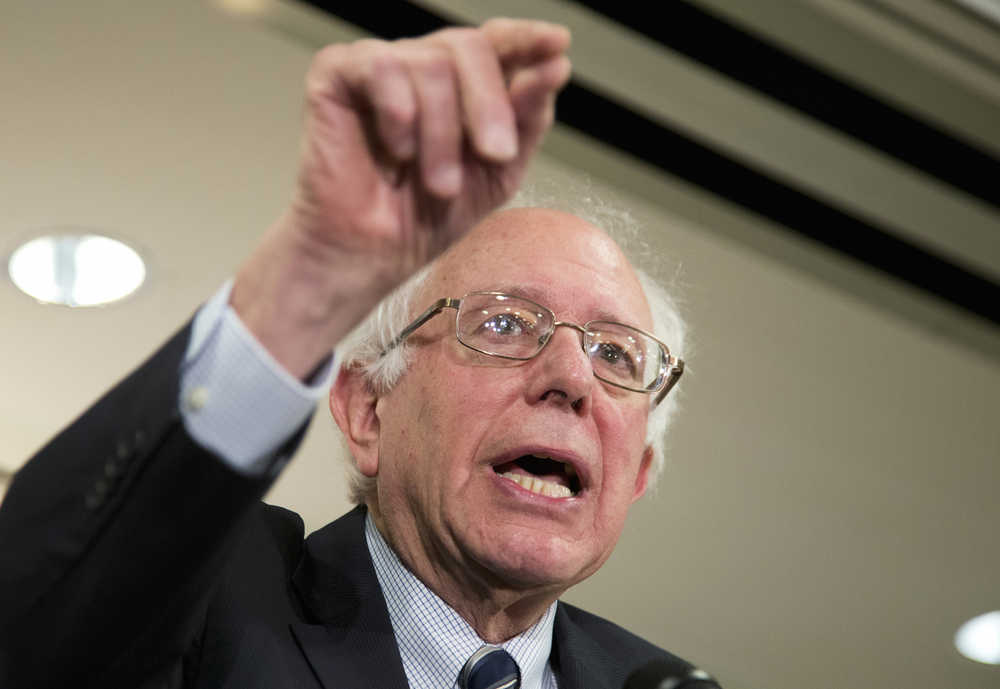
Sanders, the independent senator from Vermont, echoed that sentiment in Saturday’s Democratic debate, saying it is “relatively easy for a powerful nation like America to overthrow a dictator.” What is very hard, he said, is “to predict the unintended consequences and the turmoil and the instability that follows after you overthrow that dictator.”
Much of the campaign discussion centers on Assad, who has presided over a nearly five-year civil war that’s left at least 250,000 thousand people dead, spurred the worst refugee crisis in Europe since World War II and created a vacuum allowing Islamic State militants to seize territory throughout Syria and neighboring Iraq.
To some candidates in both parties, those are reasons enough to help groups on the ground in Syria remove the country’s embattled leader from power.
Rubio, in an interview with CBS’ “Face the Nation” Sunday, said the argument that the U.S. has no vested interest in Assad is wrong.
“Why are there hundreds of thousands of refugees destabilizing Europe, tens of thousands trying to come to America?” asked Rubio, a Florida senator.
He also defends the bombing campaign, authorized by President Barack Obama, that enabled Libyan rebel forces to oust Gadhafi. Clinton, Obama’s secretary of state at the time, was a leading proponent of the effort.
“If we had not joined with our European partners and our Arab partners to assist the people in Libya, you would be looking at Syria,” Clinton said over the weekend, glossing over the North African country’s own, volatile post-war reality replete with attacks and assassinations, rival militias competing for power and its own expanding IS threat.
Given Syria’s current state, Clinton said the U.S. can’t simply choose between defeating IS or Assad.
“The reason we are in the mess we’re in, that ISIS has the territory it has, is because of Assad,” said Clinton, using an acronym for the Islamic State.
The debate underscores how far the United States has moved since the Bush administration blended the promotion of American-style democracy with military campaigns, starting in Iraq and Afghanistan. Many in the Middle East viewed the post-9/11 effort with animosity; after thousands of U.S. lives and hundreds of billions of dollars lost, most Americans eventually rejected it.
Obama has fulfilled a promise to not use large-scale ground operations to seek regime change. While he has called for autocrats to leave power in Egypt, Libya and Syria, his interventions in each case were limited.
Egypt’s Mubarak was pushed from power at the height of the 2011 Arab Spring movement, which saw pro-democracy protests sprout throughout the Middle East and North Africa. Obama’s public pressure on Mubarak built momentum for his departure, but the U.S. wasn’t directly involved in orchestrating his exit.
In Libya, however, Obama joined NATO and Arab allies in a campaign that gave rebels cover to fight Gadhafi’s forces, ultimately leading to his killing.
The U.S. initially cast Libya as a victory for democracy. Its troubles since contributed to Obama’s aversion to taking similarly aggressive action against Assad, whom the U.S. leader first called on to leave in August 2011.
Instead, Obama has pursued diplomacy. Previous rounds have gone nowhere, though last week’s U.N. Security Council resolution setting up talks between Assad’s government and the opposition offered some new hope.
“When you have an authoritarian leader that is killing hundreds of thousands of his own people, the notion that we would just stand by and say nothing is contrary to who we are,” Obama said last week.
But when asked whether Assad might still be in office when Obama leaves the White House in January 2017, the U.S. president sidestepped the question.
_
Follow Julie Pace at http://twitter.com/jpaceDC
