
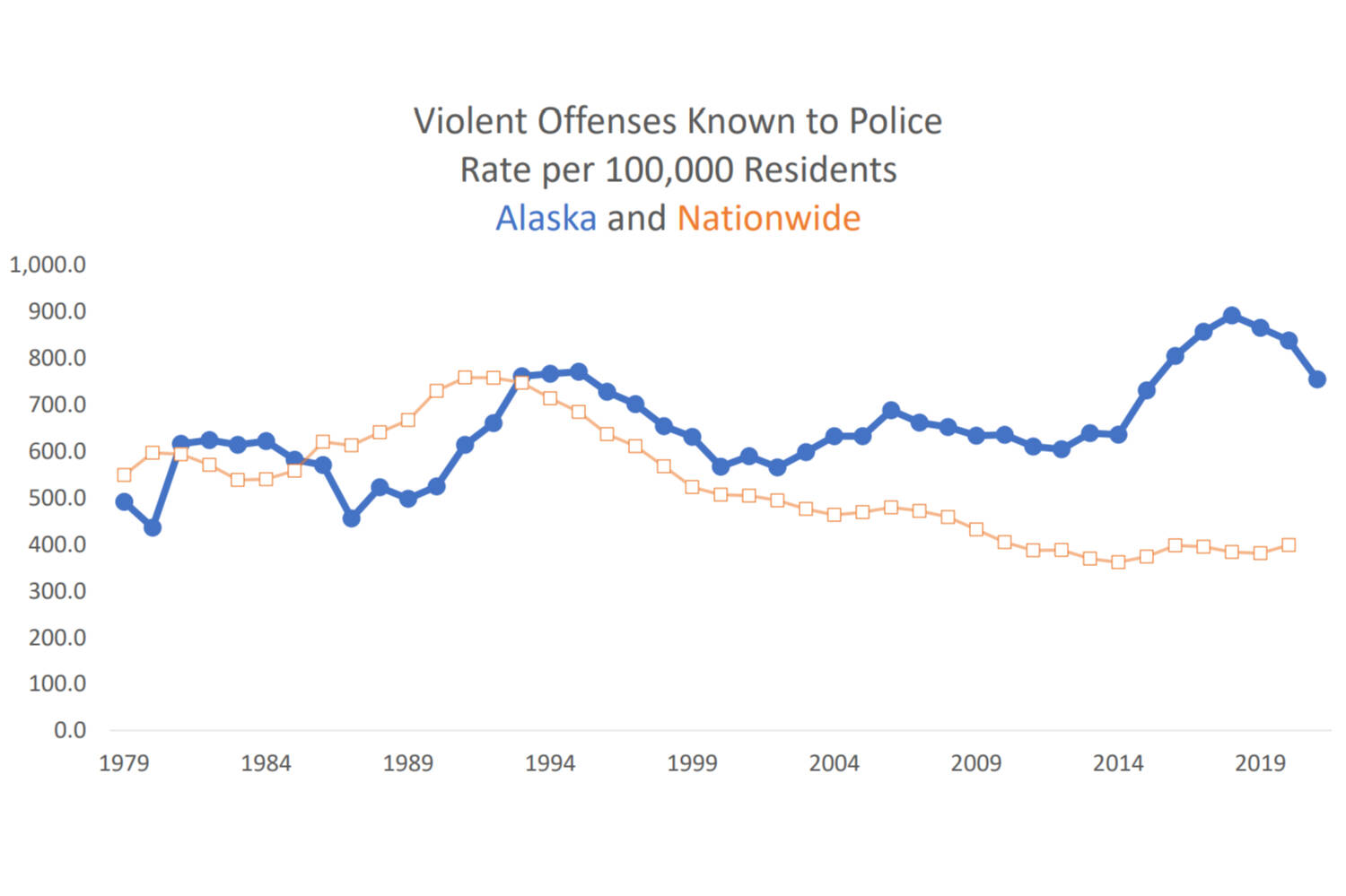
Alaska’s rate of violent crimes has increased, a contrast to the national trends, and the increase is driven by extremely high rates of rape and aggravated assault, according to statistics presented Monday to the state Senate Judiciary Committee.
The statistics, from the Federal Bureau of Investigation’s crime reports and from law enforcement agencies around the state, show that in both Alaska and the nation, the overall crime rate has steadily declined since 1979. In Alaska, the overall decline is the result of a drop in property crimes, as rates of violent crime continued to rise during the four-decade period.
The information was presented by Troy Payne, director of the Alaska Justice Information Center at the University of Alaska Anchorage. The most recent numbers are for 2021.
It makes sense that Alaska’s overall crime-rate drop is driven by the drop in property crimes, Payne said. “The overwhelming majority of crime is property crime and not violent crime,” he said.
Committee Chair Matt Claman, an Anchorage Democrat, asked Payne whether statistics validate Gov. Mike Dunleavy’s claim that Alaska crime rates are at a 40-year low – Payne said they do.
“That appears to be the case. That does appear to be true,” Payne said.
The overall decline in crime is not limited to Alaska, he said. “The decline in crime is global, so it’s not just in the U.S.,” he said. Reasons are unclear; there is no consensus yet on the combination of factors that led to the decline, he said.
However, the violent crime statistics stand out, with Alaska’s rates gradually rising and exceeding the national average since 1993.
Alaska’s rape rate since 2013 has been three to four times the national average, based on reported cases, Payne said. Since rape, like domestic violence, tends to be well-underreported, there are other measures of victimization available, such as confidential surveys, and they are consistent, he said.
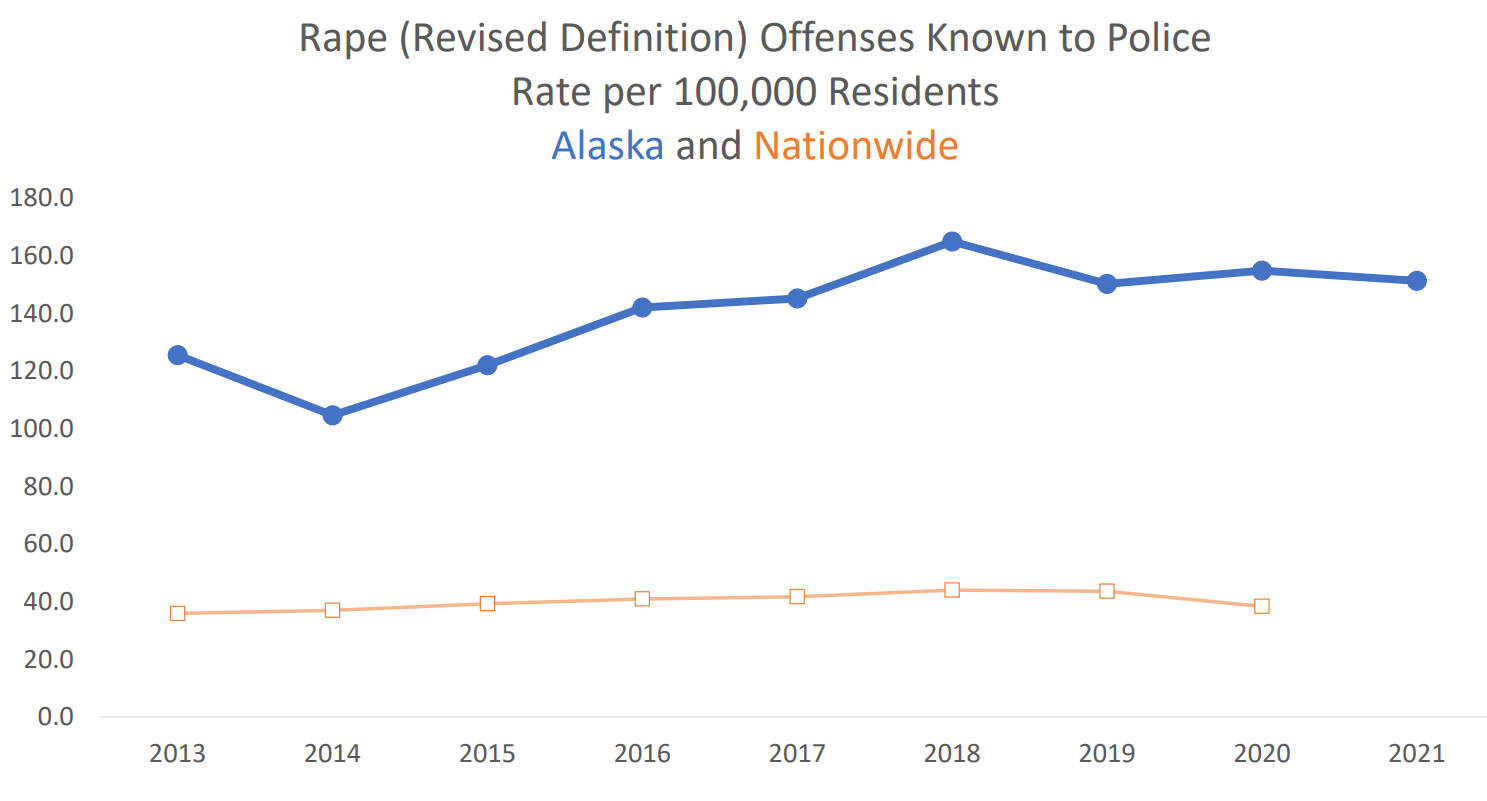
Alaska’s reported rape rate, shown from 2013 to 2021, has been between three and four times the national average. Source: FBI Crime Data Explorer UCR data, 1979-2020. Alaska data for 2021 from Crime in Alaska 2021, Alaska Department of Public Safety. (Graph provided by UAA Alaska Justice Information Center)
“All of the evidence that we have suggests that rates of rape and sexual assault are dramatically higher in Alaska than in the rest of the country,” he said.
Rates of reported aggravated assault are also “considerably higher” in Alaska, about twice the national average since about 1993, he said. An assault is aggravated when it involves a weapon or is likely to lead to severe injury or death, making it different from simple assault, he said.
The trend in Alaska murders diverges from that for rape and aggravated assault, according to Payne’s presentation. Homicide rates in Alaska have decreased in a trajectory similar to the national average.
Rates of robbery have been largely steady in Alaska since about 1980. Until about 2014, Alaska’s robbery rates were below the national average, but that national average declined and is now below Alaska’s rate.
Alaska’s decrease in property-crime rates had a notable but short-lived exception, Payne’s presentation showed. A spike in auto thefts started in 2015 — prior to the passage of a 2016 state criminal-justice reform that continues to be controversial — but then ended by 2020.
Payne said it is possible that, during that period, auto thieves had some new methods of stealing vehicles or disposing of them. Claman said the spike and then collapse in auto-thefts may have been an Anchorage-specific phenomenon influenced by municipal police staffing levels.
Payne said his presentation comes with a caveat: It is difficult to compare 2021 Alaska statistics with 2021 national statistics because the FBI has just completed an update of its National Incident-Based Reporting System. The update breaks down data into finer detail than has been done in the past – for example, better tracking domestic violence — but it means that there is state-federal data mismatch for now and the 2021 numbers should be considered incomplete.
Among the departments that have not yet provided data for the new national system is Anchorage Police Department, Payne said. The department is working on an upgrade of its data system and will match the national system in the future, he said.
It is a big job for the department, he said. “APD is one of the largest police department in the country, and basically, anything involving information technology is way more complicated than you think it is for an agency of their size,” he said.
• Yereth Rosen came to Alaska in 1987 to work for the Anchorage Times. She has been reporting on Alaska news ever since, covering stories ranging from oil spills to sled-dog races. This article originally appeared online at alaskabeacon.com. Alaska Beacon, an affiliate of States Newsroom, is an independent, nonpartisan news organization focused on connecting Alaskans to their state government.
