
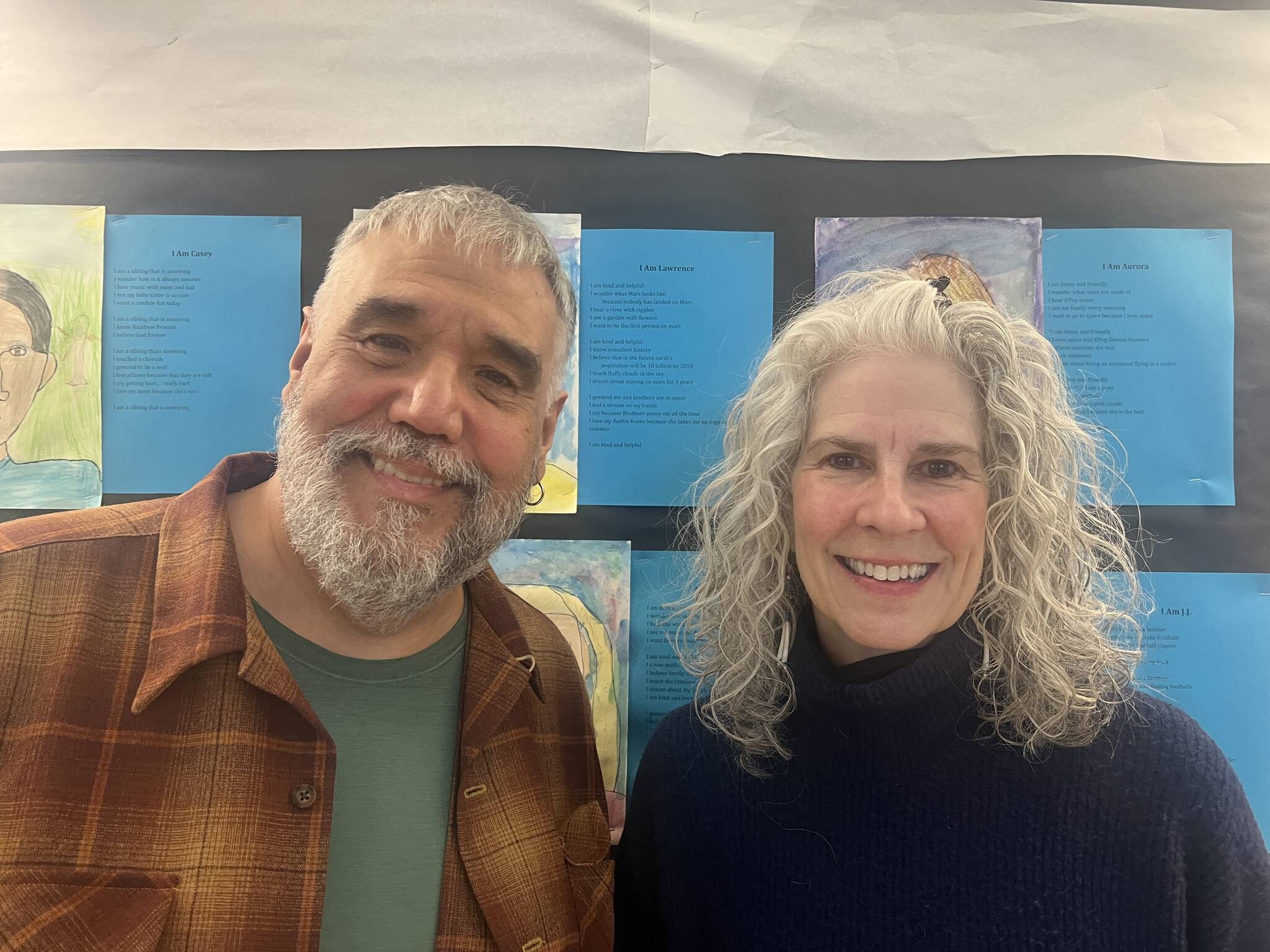
At Sít’ Eetí Shaanáx̱ – Glacier Valley Elementary School, Lorrie Gax̱.áan.sán Heagy and Yuxgitisiy George Holly use music as a tool for Lingít language revitalization.
The pair recently received the 2025 Governor’s Awards for the Arts in part for their work in the language initiative Ḵúx̱de Yaa Nas.áx̱. They were honored at a ceremony in Anchorage on Oct. 28, alongside five other arts and humanities leaders from across the state.
The language initiative is part of the Juneau Alaska Music Matters program, a nonprofit founded by Heagy that offers in- and after-school music classes for 500 children across three elementary schools in the district.
The Juneau Empire sat down with Heagy and Holly ahead of the ceremony to talk about what makes the program sing.
This interview has been edited for length and clarity.
What do you think is unique about teaching music and language to elementary school kids, in particular?
Heagy: You learn so much. You remember whole phrases, whole songs in memory, through a melody line.
We’ve been using music to teach the language, because Lingít is a tonal language, it has high tones and low tones, short vowel sounds, long vowel sounds. So we have been creating music that matches the melody of speech. As the students learn it, they’re actually learning the melodic pattern and rhythm of the language.
They’re singing it all the time. It’s like when you have that earworm where you can’t get it out of your head. They’re singing in the hall. They’re singing in the cafeteria, out on the playground. Families are telling us that they’re carrying it home and teaching them. The beauty of music is that even though the lessons are only 90 minutes, they’re rehearsing it and producing the language through song.
Holly: You know, I believe that music speaks directly to the soul. It surpasses the mind. These are children that represent the entire community. Many of them haven’t heard these words before, but they’re able to feel it along with the music. They feel the sounds that would accompany phrases like, ‘You are an ancestor of tomorrow. You are your ancestors’ dreams.’ It becomes personal in a way with the music that the years that it would take to create otherwise.
Are there any surprising moments where you’re seeing something that you’ve taught really click?
Heagy: Yeah, I think of Evah.
Holly: Oh, my God, yes. She was a kindergartener. I went into the classroom, and we were all standing in a circle. And I said, ‘Well, “kínde i jín,” raise your hand, if you have an idea: What two good ingredients make for a happy heart and a happy school?’
And a little hand shot up right next to me. She said, ‘Wove and a dwum.’ Love and a drum.
And I thought, that is so true. That’s not what I was looking for, but I tell you what, that was irrefutable. It’s been two and a half years since then.
So last spring, I said to Miss Eva, ‘Do you think it’s time to put some music to the words that you shared? The two ingredients that make for a happy heart and a happy school.’ And she said, ‘Oh, love and a drum.’ And I said, ‘How about we do it and Lingít?’
And we started to work on this new song together. And at the very end of it, I said, ‘So, Miss Eva, is there anything at all that you’d want to change about this song? She said, ‘How about we add a little kindness?’ So, it’s one of the songs now that we sing here in the JAMM program.
They have such a purity of soul. There’s not a whole lot that gives folks hope in the world today. It seems as though many things are so reactionary and declarative. When I come and see these kids at the school, I think, this is the generality of the population. And when they are encountering the indigenous ways of knowing and treating each other, they treat each other with dignity.
How do you address, especially with students so young, the history of oppression of Indigenous language?
Heagy: Marie Olsen, she’s an elder who has sadly since passed, or walked into the woods. She did a training for teachers and she said, ‘When you travel to another country, you learn the language, you learn some phrases, you learn the culture, the values out of respect. So why would we not, living on Lingit land?’
At the start of the year we’ll pull down the world map and just say, ‘Wow, look at this amazing class. We have people from all different backgrounds. Who wants to share where they’re from or family is from?’ They’ll go around and say, ‘Philippines, Tonga, Samoa, Hawaii, Mexico.’ Each time they bring up where they’re from, we’ll say, ‘Is there another place in the world where you can speak and hear Tagalog fluently?’ And we do that with all of the languages. Then we get to Lingít, and I’ll say, ‘Where else in the world can we hear this?’ And there’s silence. This is it. This is the place.
So we have to speak it and hold it up here. We’re working to normalize the language. And I think the song helps to break through those barriers. Music itself helps carry it through because kids are singing it just naturally and remembering it as they take it home.
Obviously, this program means so much more to you two than a single award. But could you talk about what this award means to you?
Heagy: I don’t really know if I have the words. I wish I could do it in music to really express it. To be in the same year with George Holly, is just a true privilege to stand with him.
I just want to thank Juneau and the state of Alaska, who have been so supportive of this work. I want to let them know that what we’re doing here is making ripples through other communities across the country. I hope that this award feels like it is a collective one shared by our community in schools.
Holly: It has been a life’s honor, really, to be here and work with Lorrie, with these kids. I’m just so humbled. Spending five years here, to actually see the children growing up is something I could never replace or have really foreseen.
You got to make this years-long song with Evah, right?
Holly: Yeah, that’s right!
To see now some of the kids that I’ve worked with, teaching their own language and their own art. There’s nothing more I could ever ask for. And I look at these kids and I wonder, what is ahead of them? They’re gonna be able to solve problems and imagine new possibilities, because I know it’s in them. That’s something that David Katzeek would say, ‘Itóow yéi yatee.’ It is within you. It is in you. You have everything you need already. It’s just needing to unfold.
This story has been edited to correct spelling errors.
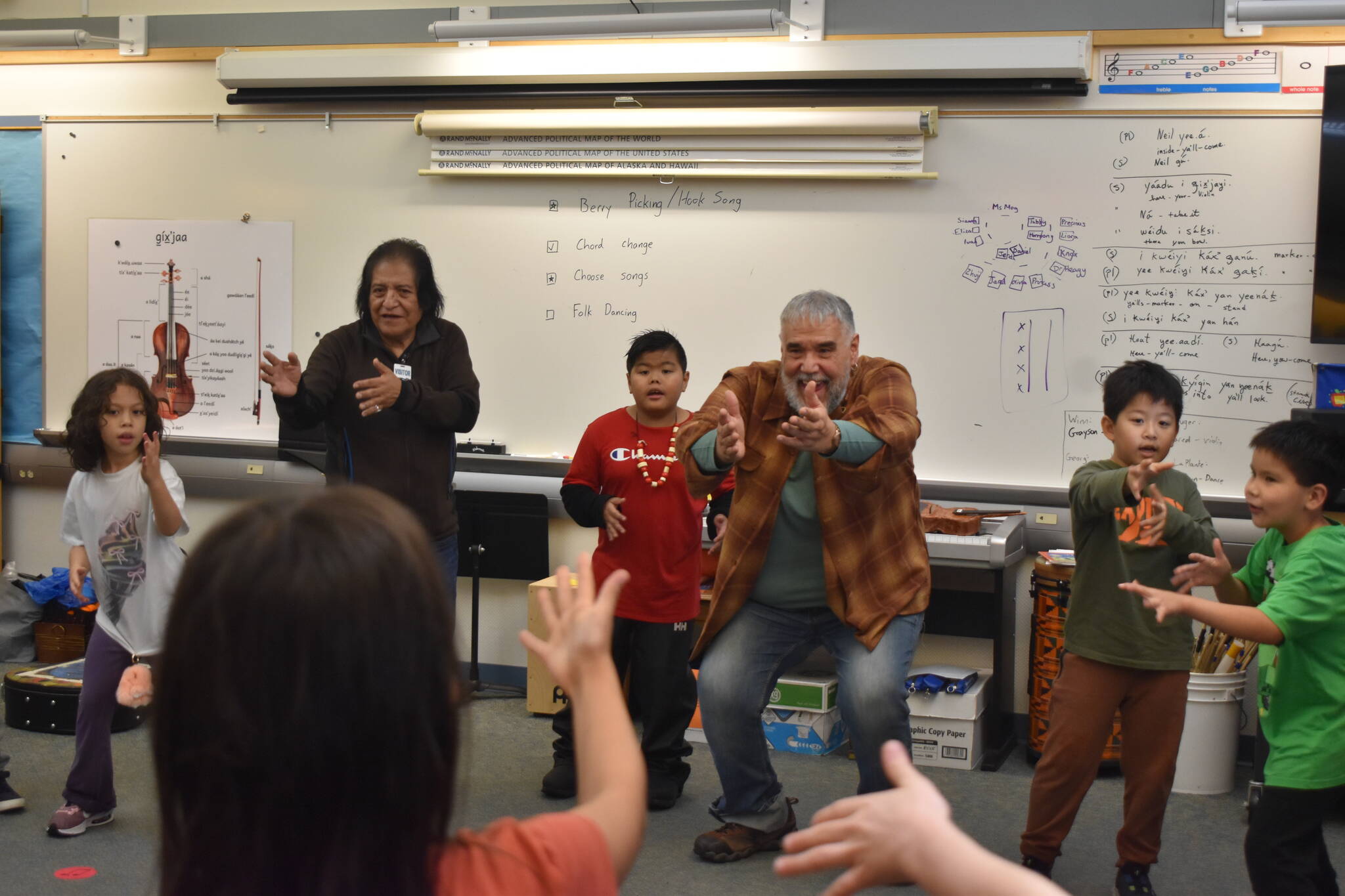
Yuxgitisiy George Holly, center, leads a Lingít dance and drumming class at Sít’ Eetí Shaanáx̱ – Glacier Valley Elementary School on Oct. 23, 2025. (Mari Kanagy/Juneau Empire)
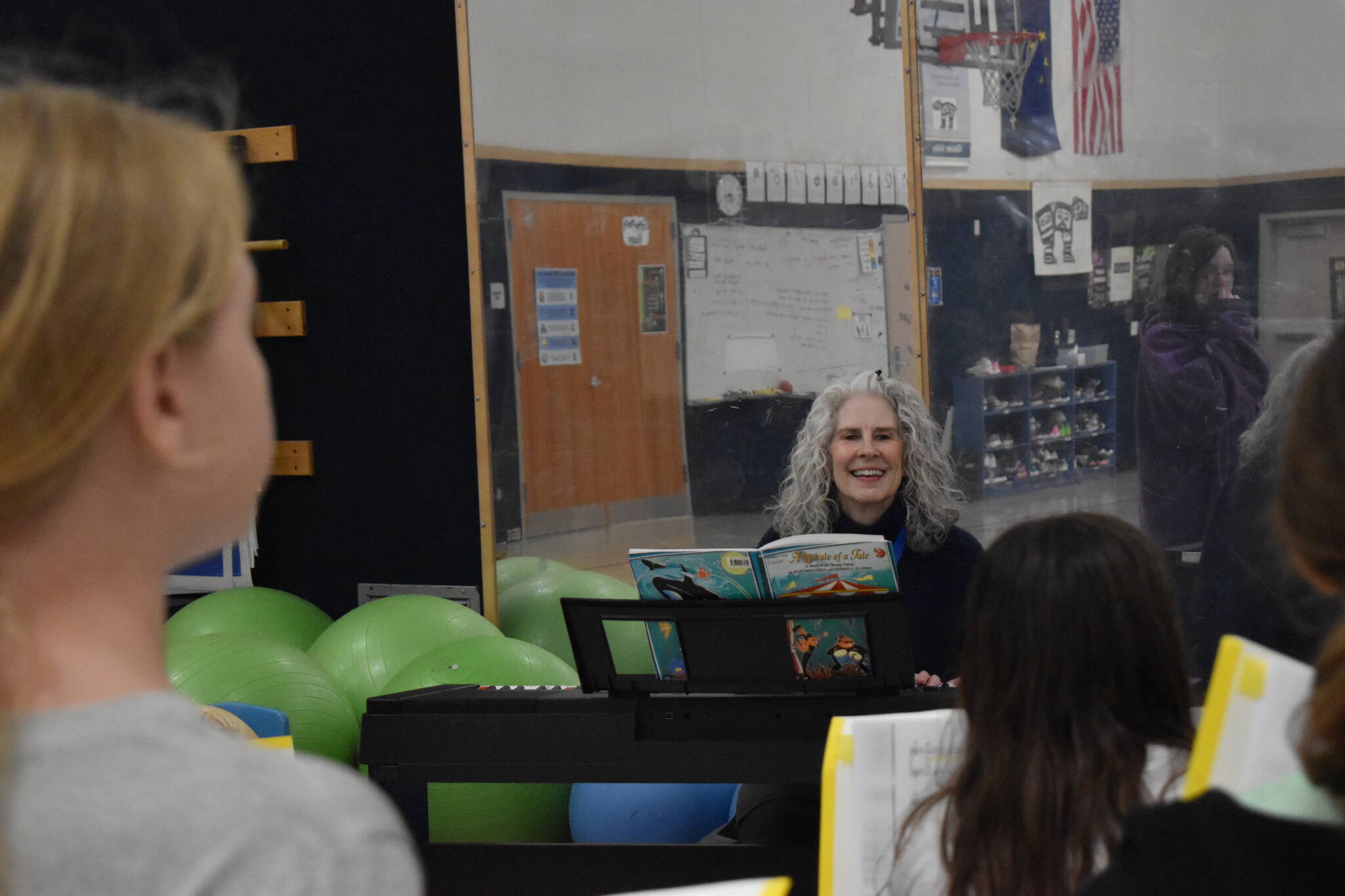
Lorrie Gax.áan.sán Heagy plays piano for a choir class at Sít’ Eetí Shaanáx – Glacier Valley Elementary School on Oct. 23, 2025.
