
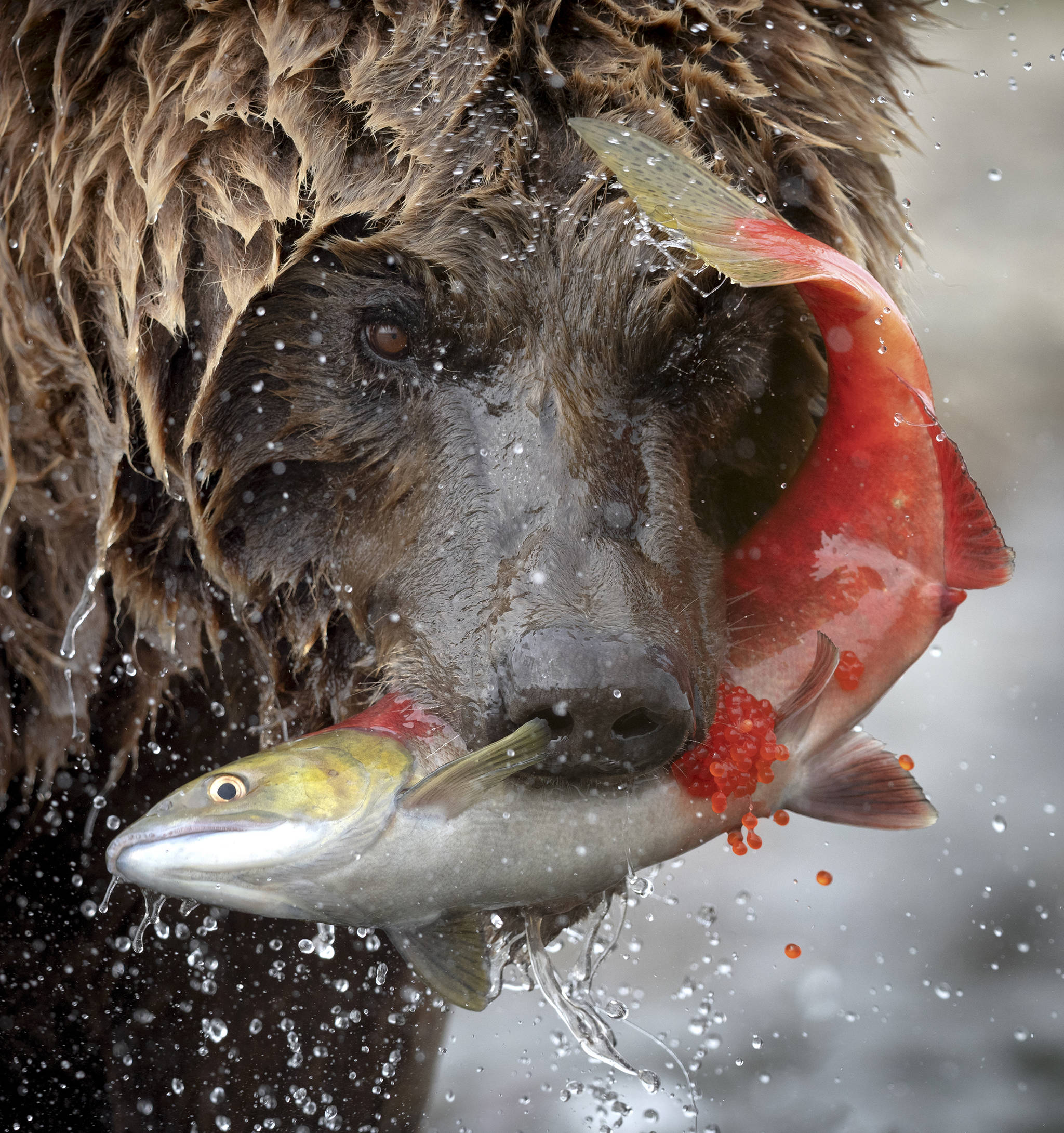
In the late 1990s, Drew Hamilton followed an old timer who lived on a homestead in Alaska’s Lake Clark National Park, on the Alaska Peninsula, to a sedge meadow loaded with brown bears. It was Hamilton’s first real introduction to the animal, and he watched in awe as bears browsed the greenery and peacefully Hamilton went about their lives. Then, to Hamilton’s surprise, his companion spread out a tarp on the grass and lay down to take a nap.
“It was kind of an epiphany. That old timer showed me that what I’d been taught about bears wasn’t true — that they weren’t demon monsters,” Hamilton remembered.
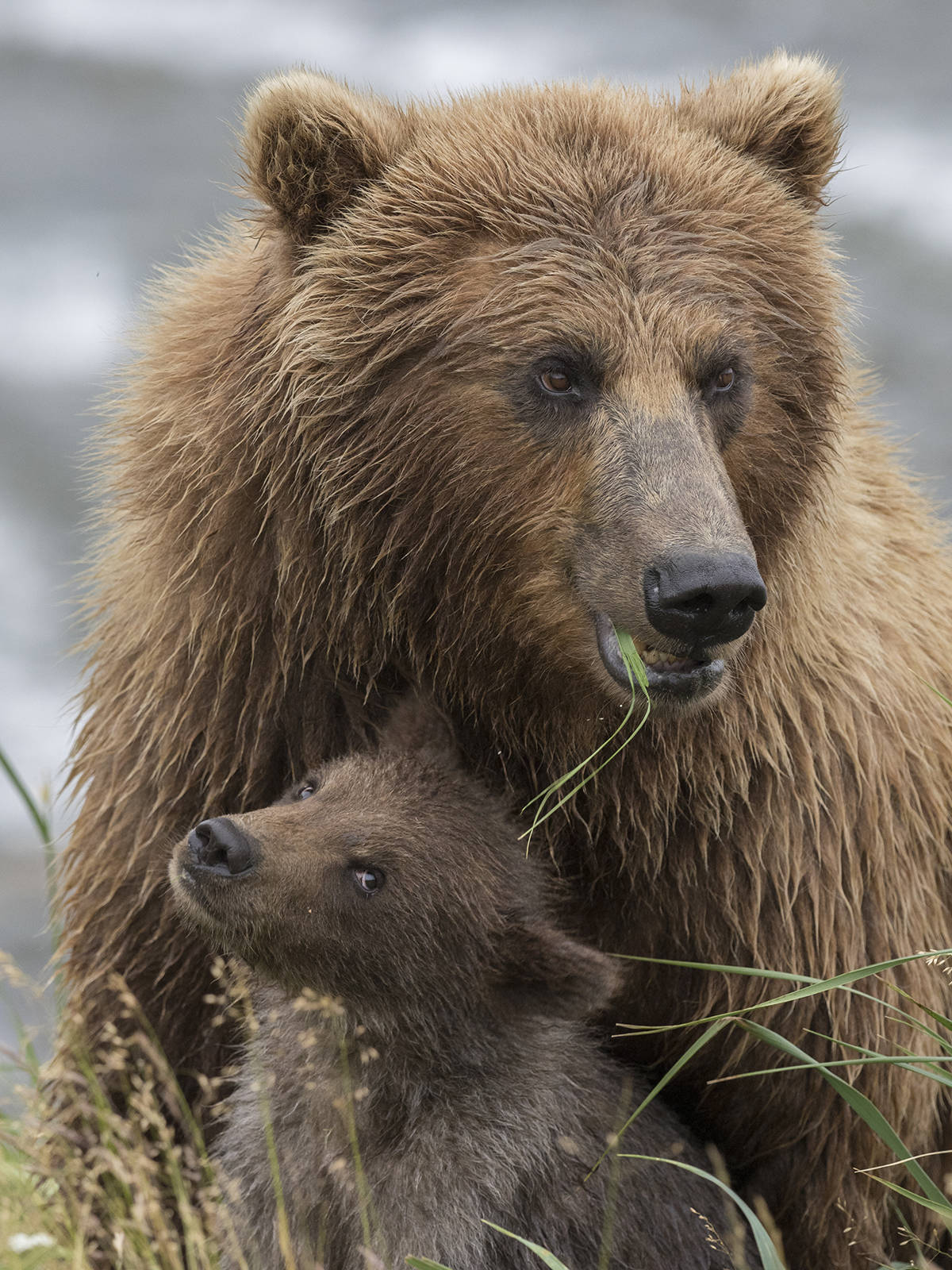
Courtesy Photo | Drew Hamilton A brown bear has a snack with her spring cub in the McNeil River Refuge.
Since then, Hamilton has put in decades working as a bear viewing guide, mostly on the Alaska Peninsula, as well as five years working as the Fish and Game technician at the McNeil River State Game Sanctuary and Refuge. He is the Board President of Friends of McNeil — a diverse yet unified group of people devoted to protecting the sanctuary and the incredible population of brown bears that utilize it. On one occasion, Hamilton counted 78 bears visible at the same time on a quarter mile of river. The sanctuary has the densest concentration of brown bears on Earth, according the Alaska Department of Fish and Game.
“McNeil is where bear biologists go on vacation,” Hamilton said.
[The life-giving breath of the lungs of the island]
McNeil is open to the public for bear viewing from early June through late August each summer. Due to popularity, and to maintain a “wilderness” experience that keeps both bears and people happy, ADF&G has established a lottery permitting system. A bear has never hurt someone at McNeil and since ADF&G actively began managing the sanctuary in the 1970s, no bear has been hurt by a person. The flawless track record is based on people being consistent and respectful in their behavior — as well as measures to make sure bears don’t become accustomed to human food. Polly Hessing, a retired ADF&G wildlife biologist who spent around 14 seasons working as technician at the refuge, emphasized the decades and decades of many people’s effort to make McNeil what it is today: a natural wonder and, hands down, the greatest bear viewing area in the world.
According to recent study made in part by the University of Alaska, bear viewing at McNeil, Katmai National Park and Lake Clark generates $34 million annually.
The future of McNeil’s bears, however, is threatened by the proposed Pebble Mine. Despite decades of local protest — including from Alaskan politicians like Gov. Jay Hammond and Sen. Ted Stevens — the Pebble Project permitting process is currently being rushed along by a politically motivated agenda. When most people think of what’s at stake with Pebble, they think of the damage that will occur to Bristol Bay’s invaluable watersheds and the world’s largest sockeye salmon fishery. The commercial fishery generates nearly $700 million annually.
They also think of sport fishing visitors, and residents dependent on salmon for food. It’s important to also consider the negative effects Pebble would have on bears. Hamilton wants people to understand the consequences Pebble would have on not just McNeil, but brown bears across the Alaska Peninsula and Bristol Bay.
“It’d be a 200-mile gash in the best brown bear habitat in the world. People need to understand that a McNeil bear is also a Katmai and Bristol Bay bear. They move around a lot,”Hamilton said.
Polly Hessing also emphasized how far and wide McNeil bears roam. Bears would be displaced by the enormous footprint of the mine. Habituated animals used to the consistency of McNei — some of which took years to develop tolerance toward humans — have a possibility of being mistakenly viewed as threatening and killed when they wander close to mine workers. If permitted, Pebble’s industrial web would eat up 200 square miles of the wildest country on the Alaska Peninsula. A proposed natural gas line and industrial corridor would run from Lake Iliamna to Amakdedori Bay, around 12 miles from McNeil, where a giant industrial port will be built. The proposed road, at certain points, would come within an eighth of a mile of the sanctuary’s border.
In 2018, Rachel James, the Bristol Bay Campaign Coordinator for SalmonState, decided to see what was at stake and to walk from where the port would be built in Amakdedori Bay, along the route of the proposed road to Iliamna Lake. It was a four-day trek and it quickly became obvious that James, and her travel companions Erin McKittrick and Jayme Dittmar, were traveling through a brown bear’s paradise. Signs were everywhere and the several streams they crossed were chock full of spawning salmon. The proposed road followed a huge wildlife corridor used by animals to get from one side of the Alaska Peninsula to the other. James called the route “the umbilical cord to Pebble’s proposed mine.”
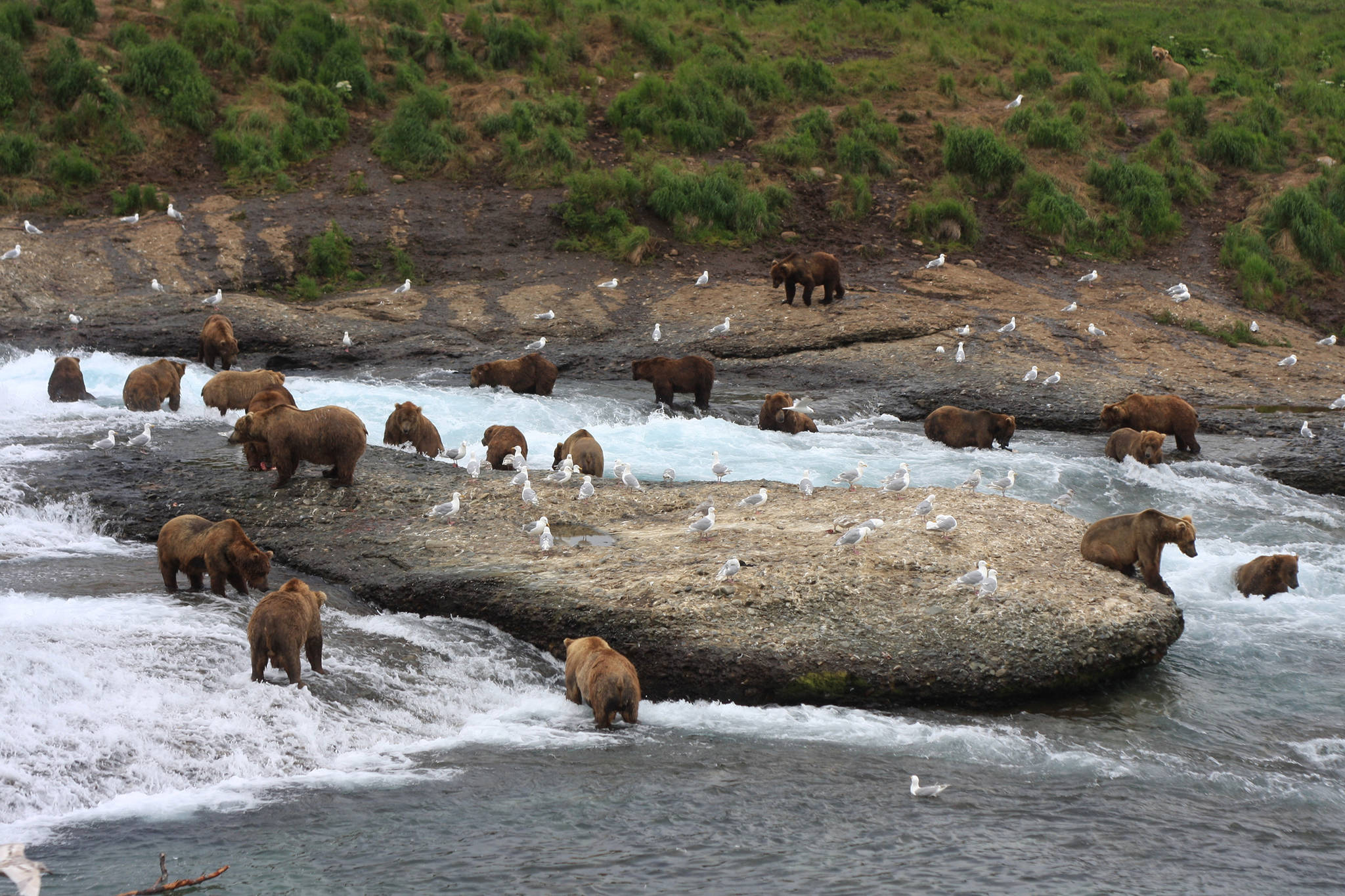
Courtesy Photo | Drew Hamilton Brown bears congergated on McNeil River.
James, Hamilton and Hessing don’t mince their words when they talk about Pebble and what permitting the mine will mean for the future — and the lack thereof — of the region’s salmon, brown bears and people. For them, and the majority of Alaskans, what the world stands to lose with permitting Pebble far outweighs what we could potentially gain.
[A rugged Alaskan’s COVID-19 story]
James, reflecting on her hike and experience in the region, said “Having been in the belly of the beast, I can say the Alaska Peninsula is a Serengeti. An industrial complex there would be a gravestone for wildlife.”
“You’re looking at a world with 8 billion people,” Hamilton said. “Deep down in all of us, going back to our primal roots, bears are representative of the wild and a world we lost. They’re in our DNA. There will soon come a time where wild places like McNeil will be a priceless commodity.”
What the future holds for the bears of McNeil remains to be seen. One thing is certain, though, we can either have Pebble or we can keep one of the last remaining brown bear strongholds left on Earth. What’s more important is up for us to decide.
• Pride of Bristol Bay is a free, monthly column written by Bjorn Dihle and provided by its namesake, a fisherman direct seafood marketer that specializes in delivering the highest quality of sustainably caught wild salmon from Bristol Bay to your doorstep. For more information visit https://prideofbristolbay.com/.
