
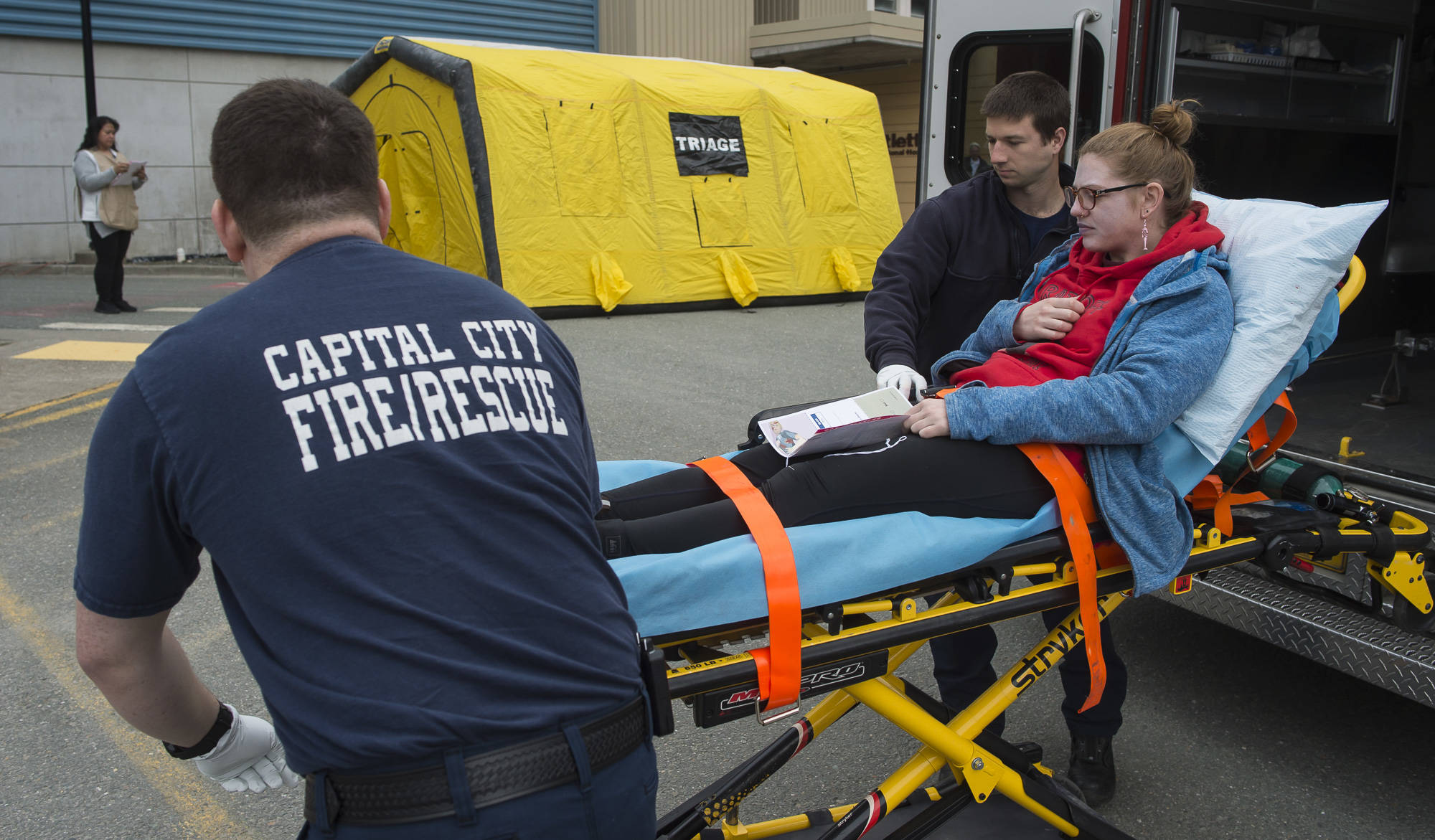
Bartlett Regional Hospital staff were hustling Thursday morning.
In less than two hours, a bus crash with 25 casualties needed immediate attention, an emergency room fire forced 10 patients to evacuate and a flood from the fire spread through the ER.
Well, none of this actually happened, but this type of scenario is something the BRH staff played out as part of training through Federal Emergency Management Agency’s Incident Command System model.
“It really helps (the hospital) because in times of disaster it’s actual true chaos and we don’t have the luxury of backing up and redoing things,” Kim McDowell, ER Director at BRH, said. “So practicing these kind of drills gives us the advantage to be able to know what we are doing and gives us the muscle memory to act quickly in a true emergency or true disaster.
One of the “victims,” Keren Goldbergbell, had blunt trauma to her abdomen from the crash. Goldbergbell said she has done wilderness first responder training and was interested in volunteering for this drill to see how the hospital reacts in this type of situation.
“It is really important to learn about accidents and how to prevent them and how to prepare for them,” Goldbergbell, of Juneau, said. “I wanted to see how a hospital actually works because I have never gone to the hospital for anything like this and I have never taken an ambulance.”
Susan Webb, a nurse in Juneau, played the role of an 88-year-old man with a laceration on his head who had lost consciousness. Webb said she wanted to take part in the drill because of her medical background.
“I wanted to see how things are handled and see the flow of the hospital,” Webb said.
Throughout the morning, volunteer “victims” would be transported by ambulance to the ER. There they were “treated” for their injuries before being released. At the end, staff would make sure every patient was correctly accounted for their injuries and received the right treatment.
But not everybody played that type of role. Carolyn Kelley, of Juneau, was given the task of being a member of the media. She quickly found out getting everything needed for an article can be a tough task.
“You kind of get locked out of a few things and you don’t get all the information that you want,” Kelley said about trying to get information from patients in the ER. “There is also lots of waiting around.”
Charlee Gibbon, who is part of the emergency management team at BRH, said the hospital needs to runs drills like Thursday’s because major disasters change how staff react.
“We want to be ready,” Gibbon said. “In this kind of situation, we have a different kind of procedure. We have a different set of triage to track people, to assess them and put them in the right place. It’s a major impact on the work flow of the hospital and when we go to alternate procedures, we have to practice them.”
At the end of the drill, staff discusses what happened and what they could do differently in a real-life situations.
“We end the session with something called a “Hot Wash,” Katie Bausler, Community Relations Director at BRH, said. “We debrief and discuss what went right and what went wrong. Things will inevitably get mixed up. That is the idea so we can preempt, if at all possible, confusion in a real situation.”
• Contact reporter Gregory Philson at gphilson@juneauempire.com or call at 523-2265. Follow him on Twitter at @GTPhilson.
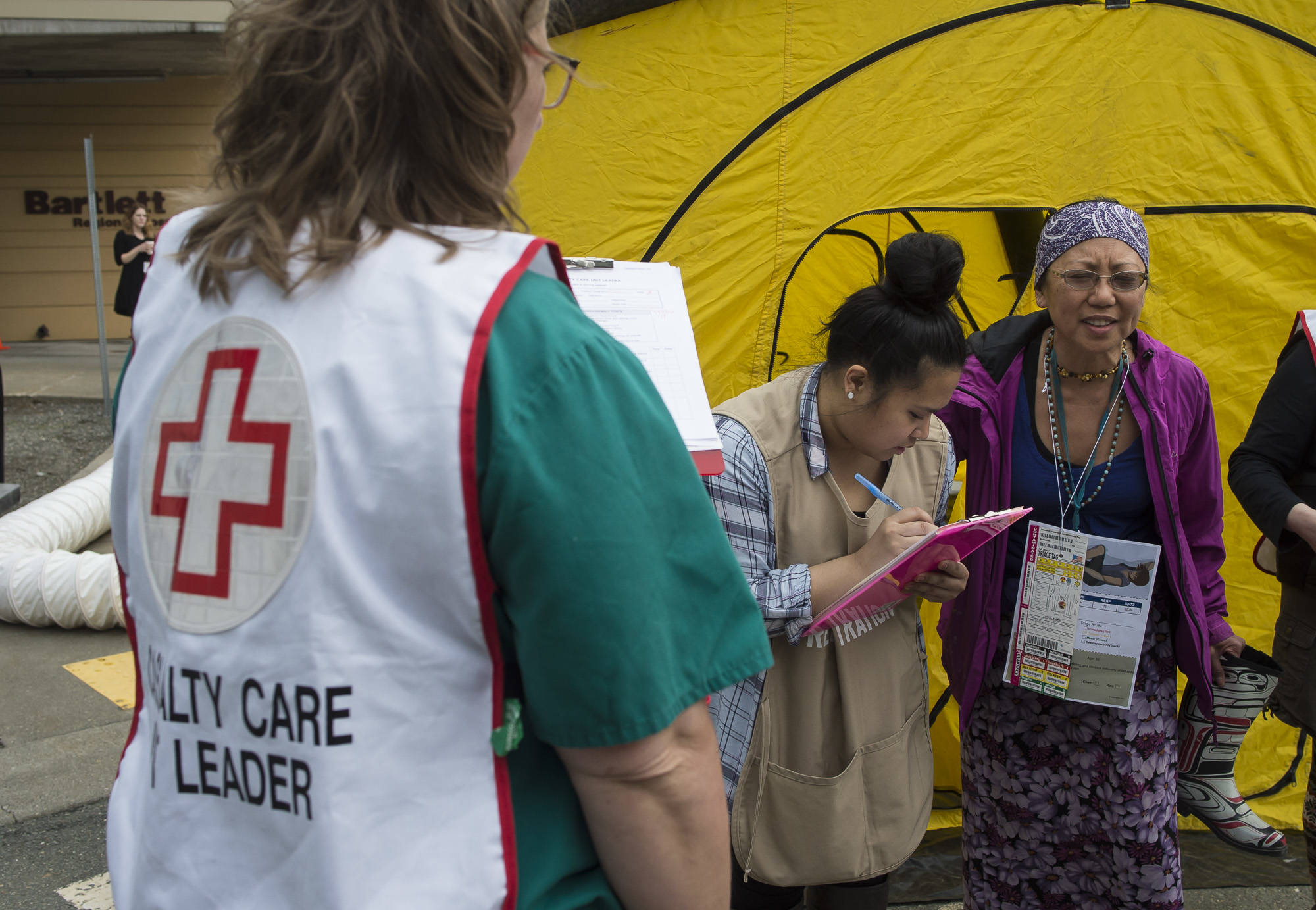
Melissa Vogt, center, registers victim Carolyn Garcia, right during a mass casualty drill at Bartlett Regional Hospital on Thursday, May 3, 2018. (Michael Penn | Juneau Empire)
