
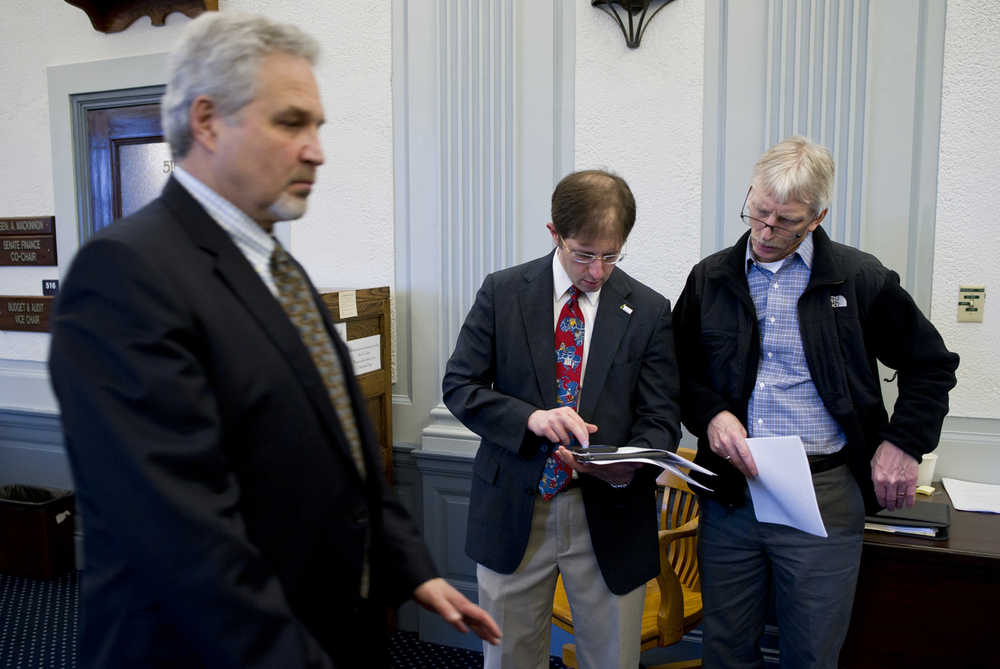
At the end of Tuesday afternoon’s Senate Finance Committee, Sen. Anna MacKinnon, R-Anchorage, was envisioning a bridge.
Constructed of four interlocking pieces of legislation, the bridge would allow the state to shift millions of dollars in pension liabilities to local governments across Alaska.
“The state cannot continue to bear the costs … when those costs are in the hundreds of millions of dollars,” she said.
With the state facing a $4.1 billion annual deficit, “we just don’t have the funds to continue to invest the same way we have in the past,” she said.
Bob Bartholomew, the finance director of the City and Borough of Juneau was in the audience, listening.
“That’s not a bridge,” he said afterward. “That’s saying if you want to raise taxes locally, we won’t do it at the state level. That’s probably more of a pothole than a bridge.”
On Tuesday, the Senate Finance Committee rolled out four bills intended to increase municipalities’ share of the Public Employees Retirement System and the Teachers Retirement System. Those two systems, paid jointly by the state government, local governments and employees, are used across the state but have suffered a multibillion-dollar shortfall. People are living longer, health care costs are rising, and when the plans were created, they didn’t save enough money. Now they’re billions of dollars short of the money they need to pay for benefits promised to retirees.
The state and local governments have renovated the retirement systems and paid down the debt that looms over government like an avalanche chute above a mountain town.
Now, the Legislature is addressing the immediate problem of a multibillion-dollar deficit by pushing off some of the responsibility for the long-term pension problem.
Senate Bill 207 calls for increasing local governments’ contribution to teacher retirement from 12.56 percent to 22 percent by 2019. That would save the state $46.3 million in Fiscal Year 2017, which starts July 1. The savings rise each year, reaching more than $110 million by 2021, according to an analysis provided by the Legislative Finance Division. Senate Bill 209 calls for increasing the local contribution to public employee retirement from 22 percent to 26.5 percent by 2018. That would save the state $24.2 million next year, a figure that rises to $53.6 million by 2024, according to an analysis provided by the Legislative Finance Division.
To gradually phase in the increase, the Senate Finance Committee has proposed two other bills: Senate Bill 208 and Senate Bill 210. Each intends to give communities a means to raise revenue and offset the increased costs from the other two bills.
“It’s not our intent to abdicate responsibility,” said Sen. Pete Kelly, R-Fairbanks and co-chairman (with MacKinnon) of the finance committee.
SB 208 eliminates most of the state’s college scholarship programs for high-school graduates, then diverts much of the fund for those scholarships. About $36.5 million per year would be given to communities across the state to compensate for increases in the cost of teachers’ retirement.
In the first year of increases, that money – plus some extra from a different bill – would almost equal the local cost increase for teacher retirement.
The $36.5 million would continue for four more years, continuing to offset the increase to a lesser and lesser degree with each year. Communities would have to come up with the rest, either by cutting their own spending or raising taxes.
To compensate for the rise in public employee retirement costs, SB 210 permits municipalities to increase property taxes on senior citizens. The bill erases the mandatory $150,000 property tax exemption for Alaskans over 65 (currently, the first $150,000 of a home owned by a senior is exempt from property taxes) and makes it optional.
For smaller communities that don’t have a large property tax base, SB 210 reformulates the state’s revenue sharing program, taking money away from larger communities and raising the minimum for smaller ones that rely on that program to a larger degree.
The exact fiscal impact of the four bills, which rely on each other in the same way a suspension bridge does, is not yet clear. The finance committee is still waiting on final numbers from a state actuary. Municipalities are also waiting for those final numbers, but Bartholomew said initial figures indicate the impact on the City and Borough of Juneau will be significant.
If all four bills become law in their present form, the CBJ would have to pay approximately $1.9 million more for retirement in Fiscal Year 2017, which starts July 1.
By Fiscal Year 2019, the CBJ would be paying $3.5 million more.
At the same time, the CBJ would be seeing revenue sharing money dwindle, then disappear. This fiscal year, the CBJ received more than $2.5 million in state revenue sharing. If SB 210 passes in its current form, that would drop to just over $1 million in FY17. By FY18, it would be down to about $684,000.
The bill would result in a higher payout in FY19; under the existing plan, the program would not provide a payment in that year. SB 210 stretches the existing funding for another year and results in another $684,000 payment to the CBJ.
Bartholomew and Senate Finance members pointed out, however, that future payments would depend on appropriations by future legislators.
The four bills remain in the Senate Finance Committee. If approved there, they would face a vote of the full Senate and comprehensive vetting in the House.
• Contact reporter James Brooks at 419-7732 or james.k.brooks@juneauempire.com.
