
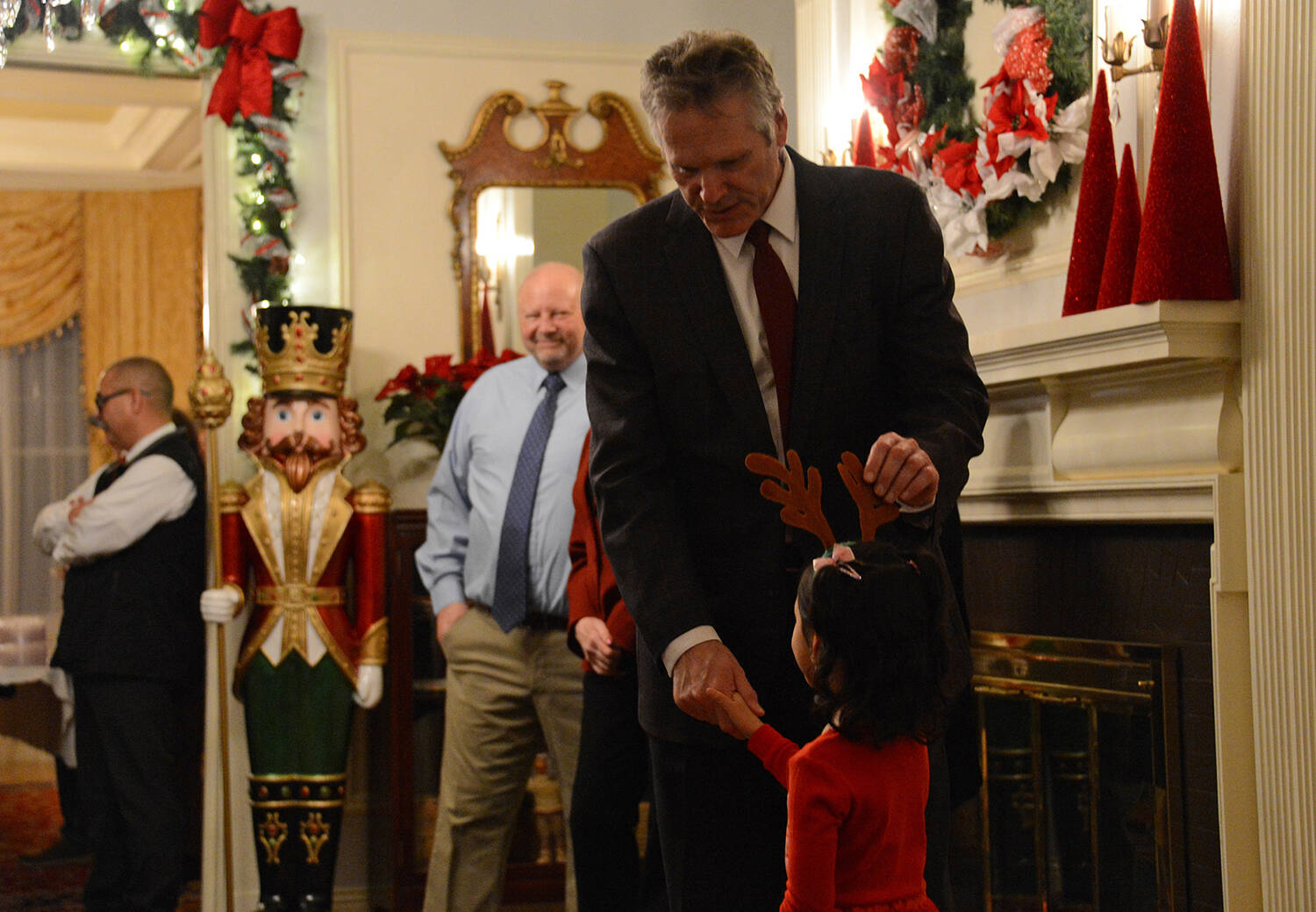
Framed by the fireplace in Alaska’s governor’s mansion earlier this month, Gov. Mike Dunleavy shook hands and posed for pictures in the final holiday open house of his two terms as Alaska’s top elected official.
Dunleavy is prohibited from running for another term, and 14 candidates have already signed up to run for his office in the 2026 elections. One of those candidates, Lt. Gov. Nancy Dahlstrom, stood next to Dunleavy at the open house, smiling alongside her husband.
Speaking to reporters before the open house, Dunleavy said the highlight of the year at a statewide level was the signing of a gas pipeline contract with developer Glenfarne.
“It started what I think is going to be a real pipeline,” Dunleavy said. “It’s something that the state has dreamed about for decades, ever since the trans-Alaska oil pipeline came into being.”
Since January, when Glenfarne announced it was buying into the long-pursued Alaska LNG pipeline project, it’s announced a series of preliminary agreements from international companies interested in buying gas.
To date, it doesn’t have firm deals for either buying or selling, and it is expected to make a go/no-go decision on the first phase of the project — a pipeline from the North Slope to Southcentral Alaska for in-state use — within the next month.
“I think in January there’s going to be some major announcements that will solidify that this pipeline as a go,” Dunleavy said.
Dunleavy said he’s also been pleased with rising forecasts for Alaska North Slope oil. In November, the federal Energy Information Administration predicted that North Slope production would grow 13% in 2026, reaching levels that haven’t been seen since 2018.
“That’s good for Alaska as well,” Dunleavy said, “because of the renaissance on the Slope.”
The state’s unemployment rate is holding below 5%, he noted.
“When you look at the turmoil across the country and you look at the turmoil across the world, I think Alaska is in pretty good shape. … We have a lot of resources here, and I think we have a lot of great people,” he said.
Asked for the lowest point of the year on a statewide basis, Dunleavy said: “You’re always dealing with disasters. Under my tenure, there’s been 73 declared disasters … we had the issue out in Western Alaska, and so we have to add now a typhoon to our mix of volcanoes, earthquakes and so forth.”
Dunleavy himself was affected by the recent Matanuska-Susitna Borough windstorm disaster, and his wife couldn’t attend the holiday open house as a result.
“We lost some of our roofing on a building or two out there, and the heat went out,” he said.
While disasters are part of living in Alaska, he said Typhoon Halong was something extra.
“I would say that whenever a disaster impacts people at the visceral level, at the local level, at their household level — we got hit hard with that typhoon,” he said.
For much of the year, as in his conversation with reporters, the governor preferred to focus on the positives.
Earlier this year, Dunleavy said the arrival of the Trump administration was “like Christmas every morning” for Alaska.
Since Trump was sworn into office, his administration has relaxed restrictions on oil and gas drilling on the North Slope. It has advanced the Ambler Access Project, which promises to open a large mining area in Northwest Alaska.
The Interior Department has also pushed forward the road between Cold Bay and King Cove and proposals to explore for oil in the coastal plain of the Arctic National Wildlife Refuge.
The Dunleavy administration has been enthusiastic in its support of those actions, but most have been tied up in federal court and will be for months or years.
The ANWR drilling issue, for example, won’t even come before a federal judge until late 2026, according to a status update published this month in the U.S. District Court for the District of Alaska.
The Trump-backed Big Beautiful Bill Act passed by Congress this year will deliver millions of dollars in construction projects to the state, and other legislation will provide millions more, but other projects — particularly those involving renewable energy and projects intended to deal with climate change — were eliminated.
“Christmas every morning” entailed other metaphorical bits of coal for Alaska this year: The extended government shutdown left thousands of Alaskans unpaid for over a month, and the cuts instituted by the Elon Musk-led Department of Government Efficiency caused significant amounts of uncertainty.
In the long run, DOGE doesn’t appear to have significantly affected the number of federal jobs here: The latest available figures show more federal employees in the state than there were at the start of the year.
While some federal grants targeted by DOGE have since been restored, many were not. Public radio stations and arts organizations laid off staff and curtailed their work.
Tariffs, visa issues and a prolonged dispute with Canada threatened the summer tourist season, but a feared Yukon boycott never appeared, and the number of cruise ship passengers traveling to Alaska increased slightly, to a new record high of more than 1.7 million.
At the holiday open house, Dunleavy said there’s plenty to look forward to in the coming year and in the years once he leaves office.
“There’s just a whole host of things — the possibility of data farms, artificial intelligence, and how that’s gonna revolutionize not just the world, but here in Alaska, I think we could become a data transportation center because of our proximity on the globe. So I think you’re going to see a number of announcements throughout the year that I think will set the stage for a great several decades going forward,” he said.
James Brooks is a longtime Alaska reporter, having previously worked at the Anchorage Daily News, Juneau Empire, Kodiak Mirror and Fairbanks Daily News-Miner. A graduate of Virginia Tech, he is married and has a daughter, owns a house in Juneau and has a small sled dog named Barley.
Alaska Beacon is part of States Newsroom, the nation’s largest state-focused nonprofit news organization.
