
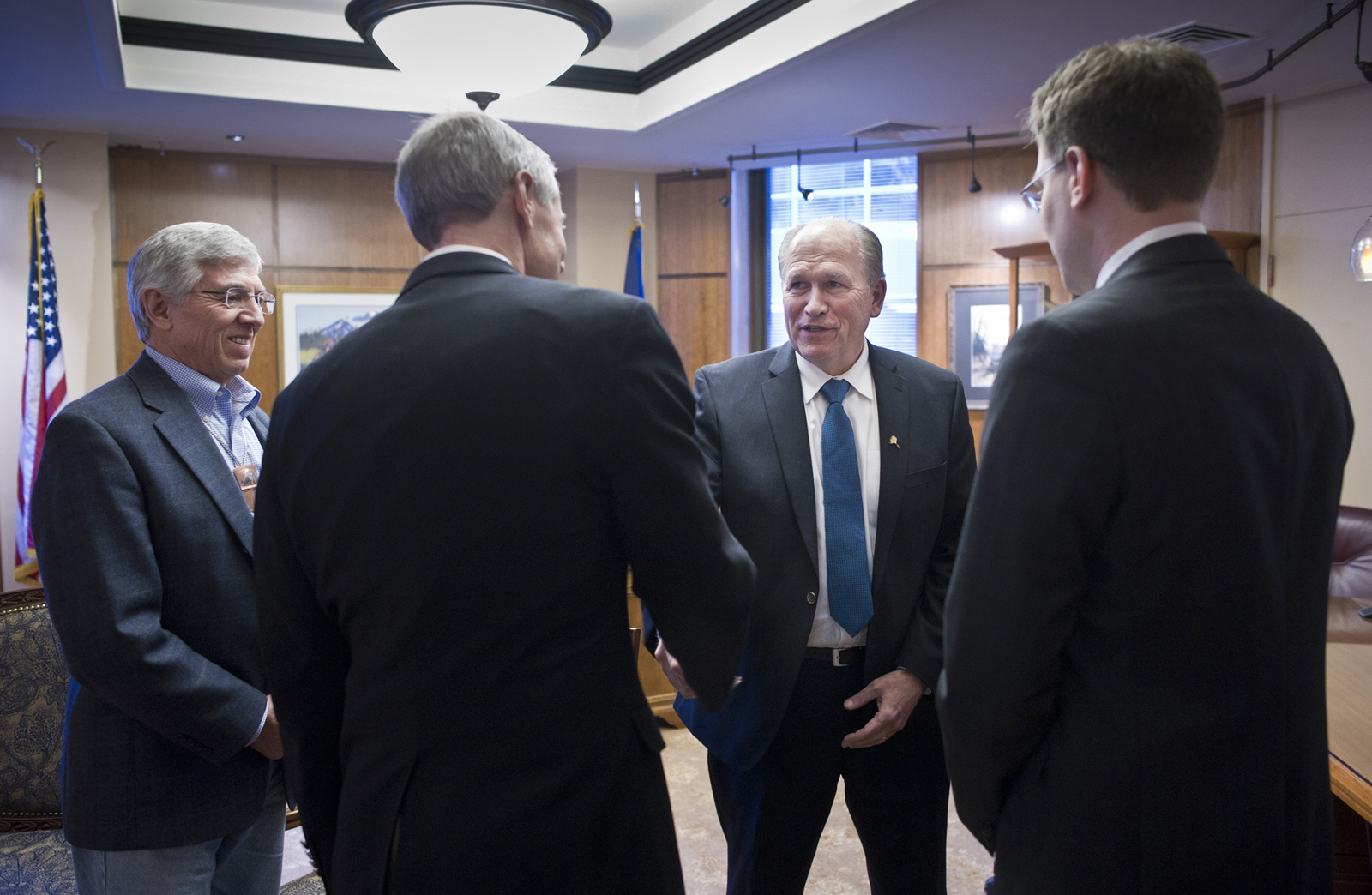
Sen. Mike Dunleavy has followed through on his promise to fight for the restoration of last year’s half-vetoed Permanent Fund Dividend.
The Wasilla senator’s pair of bills is on top of the list of legislation prefiled by members of the 30th Alaska Legislature and released Monday. The Legislature has unveiled 51 pieces of legislation – 47 bills and four proposed constitutional amendments – in its equivalent of the preseason.
A second round of prefiled bills will be released Friday, and the Legislature gavels into session one week from today.
On Monday, as Alaskans across the state examined the list of prefiled bills, lawmakers and their staffs were busy moving into new Capitol offices. Boxes lined the hallways and filled offices, but for some, it was more of a waiting game. Weekend winds canceled ferries and left staffers, cars and some furnishings stuck in Skagway and Haines.
Tuesday begins a series of orientation meetings for new legislators, and among them will be Rep. George Rauscher, the Republican from Sutton.
Rauscher replaces Jim Colver in House District 9, and one of Rauscher’s two prefiled pieces of legislation was something the Alaska Senate said is also among its top priorities: a spending cap.
In a statement Monday, the Republican-led Alaska Senate Majority said it intends to seek $750 million in general fund spending cuts over the next three years and “also plans to implement a state spending limit.”
Rauscher has proposed a constitutional amendment that would impose a $4 billion cap on state operating expenses. That cap would be adjusted annually for inflation and the state’s population. Alaska’s constitution already contains a spending cap originally proposed by Gov. Jay Hammond and approved by voters in 1982, but the state has never approached that limit.
Rauscher said by phone that his proposal is part of the “evolutionary process” that will establish a spending cap.
With the Senate opposed to new taxes and the new House majority likely to require new taxes as a prerequisite for further cuts, a spending cap is seen as one lever to move a compromise.
While the budget and Alaska’s $3 billion unsolved deficit will be the biggest topic of the session, Monday’s prefiled bills included plenty of non-budget items.
Rep. Geran Tarr, D-Anchorage, was particularly active, introducing seven pieces of legislation covering topics from nursing mothers to genetically modified fish and paid sick leave.
Tarr’s House Bill 30 would require employers to give employees one hour of paid sick leave for every 40 hours worked.
In a prepared statement, Tarr said she also intends to introduce bills calling for a $15 per hour minimum wage and equal pay between men and women.
The next steps for Tarr’s measures – and the rest of the prefiled bills – will come after the Legislature convenes in one week.
One-sentence
summaries:
SENATE
SB 1: Spends $666.4 million from the Permanent Fund to pay the portion of the Dividend vetoed by Gov. Walker in 2016. (SB 1 and SB 2 are two halves because appropriating money from the Permanent Fund and paying that money out are two separate actions.)
SB 2: Pays out the $666.4 million appropriated in SB 1 as a supplemental dividend to each eligible Alaskan.
SB 3: Exempts ferry construction from the state’s “percent for art” program and gives ferries an alternative way to meet sewage discharge standards.
SB 4: A barber doesn’t have to be tested on bleaching, dying or waving hair if the barber applies for a special license that doesn’t allow those practices.
SB 5: Legislators can’t bypass the spirit of campaign finance regulations by setting up personal political action committees.
SB 6: Industrial hemp is not a controlled substance.
SB 7: Creates (but doesn’t fund) a museum renovation and construction grant program. (Sen. Stevens, who prefiled this, tried the same bill as SB 61 last Legislature.)
SB 8: Pick.Click.Give. can give money to tribal governments as well as charities.
SB 9: Expands the use of “military facility zones” designed to help military development, to areas without an incorporated municipality.
SB 10: Medicaid will pay for home care, and the Alaska Department of Health and Social Services allows adult foster care homes, where a home cares on a 24-hour basis for up to three disabled adults.
SB 11: It’s easier for the state to allow an antlerless moose hunt.
SB 12: Establishes a school tax on residents and nonresidents earning money in the state.
SB 13: Legislators can’t collect per diem payments for food or housing starting in the 91st day of the session unless they’ve already passed an operating budget for the year.
SB 14: Allows Uber, Lyft and similar companies to operate in Alaska.
SJR 1: This is a constitutional amendment that would protect the account that pays Permanent Fund Dividends and require them to be paid as they were in 2013.
HOUSE
HB 1: Alaskans can register to vote on Election Day.
HB 2: Employers can prefer veterans when hiring.
HB 3: An employer must give someone time off to serve in the National Guard, even if they’re a member of the National Guard in another state.
HB 4: Expands the use of “military facility zones” designed to help military development, to areas without an incorporated municipality.
HB 5: The spouses and children of a firefighter or police officer who is killed on the job can continue to receive health insurance.
HB 6: Creates the Jonesville Public Use Area near Sutton on vacant state-owned land.
HB 7: It’s OK to take a ballot “selfie.”
HB 8: Law enforcement is required to enforce a protective order issued Outside as long as it appears authentic.
HB 9: The Alaska Board of Pharmacy regulates drug wholesalers that ship medical drugs into the state.
HB 10: When the Office of Children’s Services takes a child away from his or her parents, OCS has to consider whether the removal is likely to “result in serious emotional or physical damage.”
HB 11: Public employees and teachers can take early retirement (up to three years early) through 2020.
HB 12: The Office of Children’s Services can only take custody of a child (unless there’s an emergency) with a court order.
HB 13: Alaska will not participate in any federal effort to register Americans on the grounds of race or religion.
HB 14: The Legislature gets more say on Pebble Mine.
HB 15: Replaces the terms “husband” and “wife” in state statutes.
HB 16: Police must be trained to recognize and appropriately deal with people who have disabilities.
HB 17: Creates a fund to collect donations from people who want to support the Alaska Department of Fish and Game but don’t like predator control.
HB 18: The Ketchikan Chamber of Commerce’s “Race to Alaska” can operate a lottery.
HB 19: A type of pesticide called a neonicotinoid cannot be used outside.
HB 20: Any elected office-holder can make a marriage official in Alaska.
HB 21: Spends $666.4 million from the Permanent Fund to pay the portion of the Dividend vetoed by Gov. Walker in 2016. (HB 21 and HB22 are two halves because appropriating money from the Permanent Fund and paying that money out are two separate actions.)
HB 22: Pays out the $666.4 million appropriated in HB 21 as a supplemental dividend to each eligible Alaskan.
HB 23: The spouses and children of a firefighter or police officer who is killed on the job can continue to receive health insurance.
HB 24: A designer drug called U-47700 is on the schedule of illegal drugs.
HB 25: Health insurance has to cover birth control.
HB 26: Employers have to provide scheduled breaks for nursing mothers.
HB 27: State agencies have to publish a list of chemicals likely to harm children, and three specific flame-retardant chemicals are forbidden.
HB 28: Makeup (and other cosmetics) has to list its ingredients on the packaging.
HB 29: Genetically modified fish can’t be sold in Alaska.
HB 30: Employers must provide paid sick leave.
HB 31: Alaska police have to list how many untested “rape kits” they have, and the Alaska Department of Public Safety has to give a full accounting.
HB 32: Genetically engineered food must be labeled.
HB 33: May 31 each year is “Katie John Day.”
HJR 1: Calls for a constitutional amendment reversing Alaska’s previous constitutional amendment defining marriage as between one man and one woman.
HJR 2: Proposes a constitutional amendment setting a spending limit in the Alaska Constitution at $4 billion in operating expenses per year, adjusted for inflation and population each year from 2017 onward.
HJR 3: Calls for a constitutional amendment setting the Legislative session’s length at 90 days instead of 121 days.
