
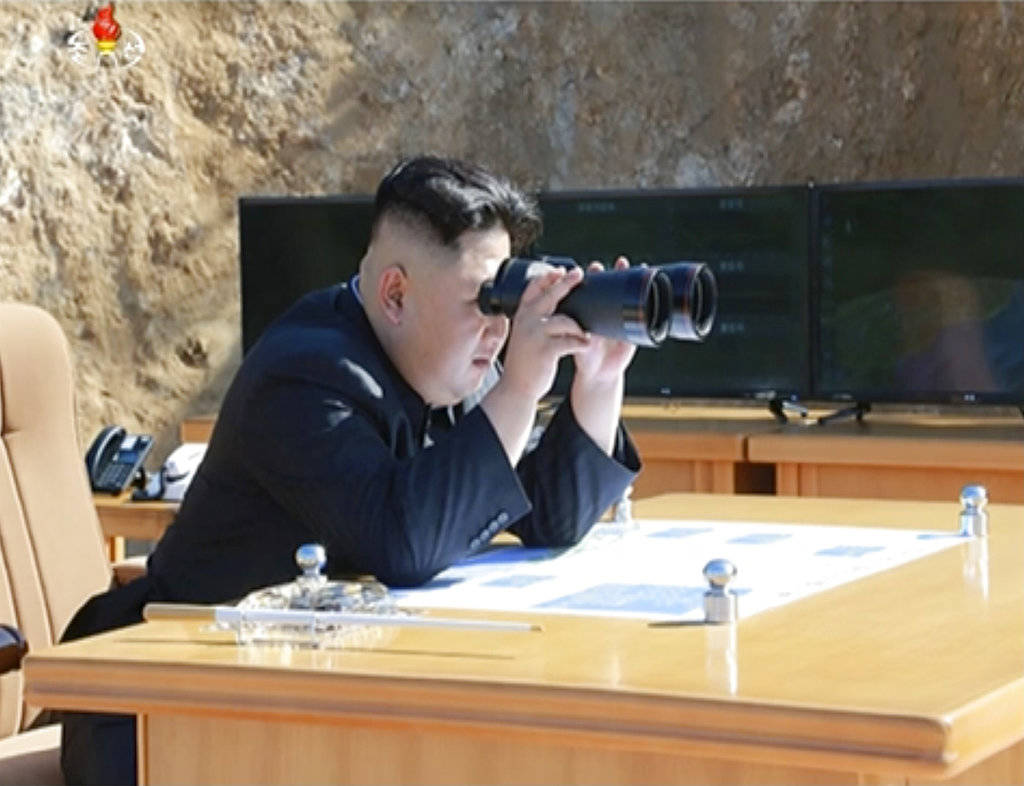
This image made from video of a news bulletin aired by North Korea’s KRT on Tuesday, July 4, 2017, shows what was said to be North Korea leader Kim Jung Un, center, using binoculars to watch the launch of a Hwasong-14 intercontinental ballistic missile, ICBM, in North Korea’s northwest. Independent journalists were not given access to cover the event depicted in this photo. North Korea claimed to have tested its first intercontinental ballistic missile in a launch Tuesday, a potential game-changing development in its push to militarily challenge Washington — but a declaration that conflicts with earlier South Korean and U.S. assessments that it had an intermediate range. (KRT via AP Video)

This image made from video of a news bulletin aired by North Korea’s KRT on Tuesday, July 4, 2017, shows what was said to be North Korea leader Kim Jung Un, center, using binoculars to watch the launch of a Hwasong-14 intercontinental ballistic missile, ICBM, in North Korea’s northwest. Independent journalists were not given access to cover the event depicted in this photo. North Korea claimed to have tested its first intercontinental ballistic missile in a launch Tuesday, a potential game-changing development in its push to militarily challenge Washington — but a declaration that conflicts with earlier South Korean and U.S. assessments that it had an intermediate range. (KRT via AP Video)

Parsing hype from reality in North Korea’s ICBM claim

SEOUL, South Korea — If North Korea’s claim Tuesday of its first ICBM test-launch is true, it has barreled over a red line that the world has long called a tripwire for potential nuclear disaster.

As always with North Korea, however, it’s hard to tell how wide the gulf is between reality and rhetoric.

Analysts, for instance, believe the latest missile may be able to hit Alaska, a marked improvement on past efforts and potentially placing it in the intercontinental ballistic missile category, but far from backing North Korea’s claim it can now “strike anywhere on Earth.”

Skeptics will also ask how North Korea can claim mastery of such a complicated technology after only one test.

That said, the message from North Korea seems clear: If not stopped, it is now only a matter of time before one of the most dogged countries on Earth achieves its goal of being able to hit all parts of the United States.

Here is what Tuesday’s potentially game-changing claim might mean:

Why it might be an ICBM

The claim has the air of the inevitable for some North Korea watchers.

The country has, with single-minded determination, been devoting its best and brightest, and a huge amount of its tiny financial resources, to this goal for generations.

The pace has quickened dramatically under leader Kim Jong Un, who took over in 2011. Since late 2012, North Korea has placed two satellites into orbit with long-range rockets, which outsiders see as clandestine tests of missile technology.

Last year, North Korea conducted its fourth and fifth atomic bomb tests and claimed a series of technical missile and atomic breakthroughs.

After what North Korea said in March was a ground test of a new type of high-thrust rocket engine, Kim Jong Un was quoted as saying that the “whole world will soon witness what eventful significance the great victory won today carries.”

Outside analysts say the missile’s potential range, if fired at a normal trajectory, could be more than 3,750 miles, which would make it technically an ICBM.

Why it might not be

It is difficult, maybe impossible, for outsiders to understand exactly what happened in the launch.

“It’s something that only North Koreans would know,” said Kwon Sejin, a professor at the Korea Advanced Institute of Science and Technology in South Korea.

Maj. Gen. Cho Han Gyu, director of operations at South Korea’s Joint Chiefs of Staff, told a televised briefing that the missile showed an improved range over an intermediate-range missile North Korea tested on May 14. But he said South Korean and U.S. intelligence authorities are trying to determine if the North had indeed fired an ICBM.

Some doubt whether North Korea has mastered the technology needed to build a re-entry vehicle that is crucial for returning a warhead to the atmosphere from space so it could hit its intended target. Or whether North Korea can build a warhead small enough to fit on a long-range missile.

Chae Yeon-seok, a professor at South Korea’s University of Science and Technology, said radar and satellites can track a missile’s flight but not the specifics of the missile’s technology. “We cannot verify if a warhead lands in the ocean without any problem,” he said.

Why it doesn’t really matter

Persistence.

North Korea, whose ethos of self-reliance is akin to a national religion, has for decades sought to build weapons that can combat U.S. and South Korean “hostility.”

Nothing has stopped the country’s tenacious progress — not sanctions, not threats, not diplomacy.

A U.S. and South Korean attack would end North Korea’s ruling class, but it would also kill huge numbers of South Koreans who live an easy drive from the world’s most heavily armed border.

This means that without finding the right solution, it may only be a matter of time before reality matches North Korea’s propaganda, which on Tuesday called the test the “final step toward completing the nation’s nuclear military strength.”


• Associated Press writer Hyung-jin Kim contributed to this report.


More in News

CBJ sign reads “Woodstove burn ban in effect.” (City and Borough of Juneau photo)
CBJ issues air quality emergency in Mendenhall Valley

All woodstove and fireplace burning in the valley is prohibited until further notice.

A dusting of snow covers the Ptarmigan chairlift at Eaglecrest Ski Area in December 2024. (Eaglecrest Ski Area photo)
Update: Waterline break forces closure at Eaglecrest Friday, Saturday

The break is the latest hurdle in a challenging opening for Juneau’s city-run ski area this season.

Patrick Sullivan stands by an acid seep on July 15,2023. Sullivan is part of a team of scientists who tested water quality in Kobuk Valley National Park’s Salmon River and its tributaries, where permafrost thaw has caused acid rock drainage. The process is releasing metals that have turned the waters a rusty color. A chapter in the 2025 Arctic Report Card described “rusting rivers” phenomenon. (Photo by Roman Dial/Alaska Pacific University)
Ecosystem shifts, glacial flooding and ‘rusting rivers’ among Alaska impacts in Arctic report

NOAA’s 2025 report comes despite Trump administration cuts to climate science research and projects

The U.S. Capitol in Washington, D.C., on Oct. 1, 2025. (Photo by Jennifer Shutt/States Newsroom)
Moderate US House Republicans join Dems to force vote on extension of health care subsidies

WASHINGTON — Republican leaders in the U.S. House will face a floor… Continue reading

The National Weather Service Juneau issues a high wind warning forDowntown Juneau, Southern Douglas Island and Thane due to increased confidence for Taku Winds this afternoon. (National Weather Service screenshot)
Taku winds and dangerous chills forecast for Juneau

Gusts up to 60 mph and wind chills near minus 15 expected through the weekend.

Chloe Anderson for the Juneau Empire
Fallen trees are pictured by the Mendenhall river on Aug. 15, 2025. Water levels rose by a record-breaking 16.65 feet on the morning of Aug. 13 during a glacial outburst flood.
Lake tap chosen as long-term fix for glacial outburst floods

The U.S. Army Corps of Engineers and Juneau leaders agreed on the plan.

Gift card displays, such as this one in a CVS in Harlem, N.Y., have been a source of concerns for lawmakers hoping to combat gift card fraud. “Card draining,” or stealing numbers from poorly packaged cards, is one of the costliest and most common consumer scams, and states are trying to combat it with consumer alerts, arrests and warning signs on store displays. (Photo by Robbie Sequeira/Stateline)
Alaskans targeted by scammers posing as government officials, FBI warns

The FBI reports Alaskans lost over $26.2 million to internet-based scams in 2024, with $1.3 million of those losses due to government impersonation scams

A buck enters the view of an Alaska Department of Fish and Game trail camera on Douglas island in November 2020. (Alaska Department of Fish and Game courtesy photo)
Douglas deer: The island’s hunt faces calls for new rules

Board of Game is seeking public comment on regulation changes that would affect Juneau.

A cat says hello at Juneau Animal Rescue in February 2025. (Jasz Garrett / Juneau Empire file photo)
New animal shelter site approved by Juneau Assembly

Juneau Animal Rescue secures eight-acre lease, but fundraising remains.

Most Read