
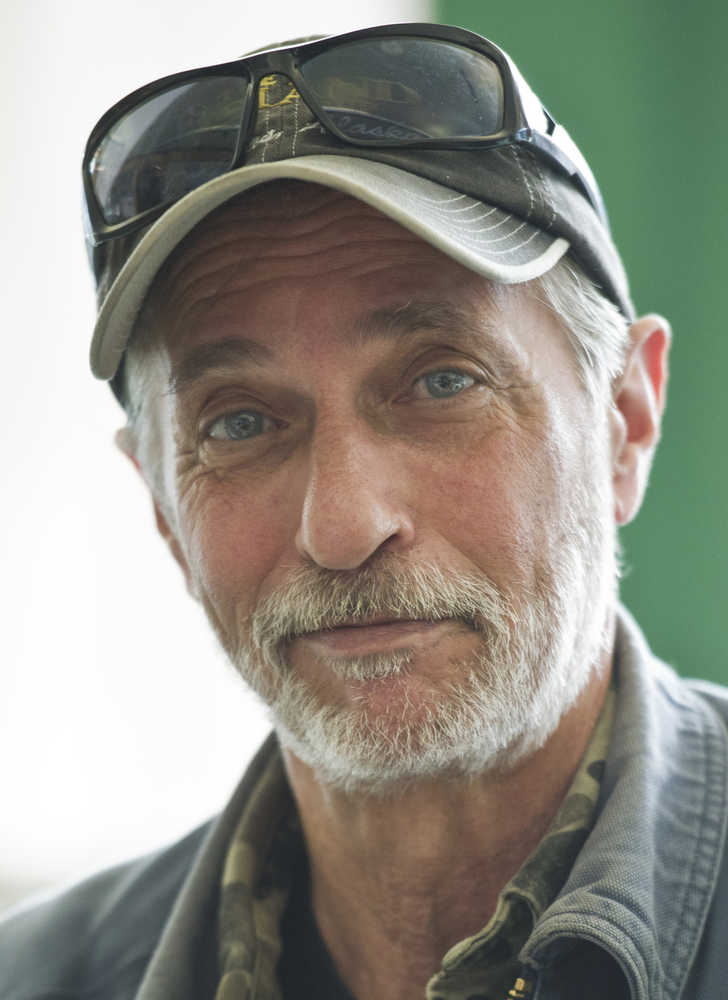
R.D. Robinson is a man with big plans. A mosaic artist who works in granite, he envisions and creates projects that last more than a lifetime.
Now, he finds himself in the middle of a project that’s already disappeared.
When the 96-foot tugboat Challenger sank in Gastineau Channel last fall, Robinson was identified by the U.S. Coast Guard as its owner, the “responsible party” in charge of keeping the fuel aboard it from leaking into the ocean.
Since then, the Coast Guard has spent more than $1 million from the federal Oil Spill Liability Trust Fund to raise the Challenger and demolish it. The final bill could rise as high as $1.7 million, and the Trust Fund is likely to seek repayment from the boat’s owner.
In his first interview with the Empire since the Challenger sank, Robinson said Friday he should not be considered its owner.
“It’s not a matter of exoneration,” he said. “It was never mine.”
The boat’s last confirmed owner, Tim Miles, denies that statement.
“He did pay me half of what he owed, and he does have the contract … that states he is totally responsible for it,” Miles said.
Robinson’s involvement with the Challenger began in 2014, when he began talking with Miles about buying the Challenger. Miles and his family had spent a handful of years renovating the tugboat, which was built in 1944 and previously served as a “bunk and breakfast” in Seattle. Miles’ wife taught music lessons aboard the Challenger and his family lived aboard it at times.
The upkeep on the 70-year-old boat was too much, however, and Miles began seeking to sell the Challenger.
In Robinson, he thought he found a perfect match. Robinson, a sculptor and art teacher, has repaired boats before, including the 117-foot tugboat Sea Ranger.
Speaking to the Empire, and in a letter provided to the newspaper, Robinson said he envisioned the boat as a floating studio “and perhaps a teaching facility.”
He toured the boat three times, but crucially, admitted he never had it surveyed.
He signed a bill of sale and paid half the boat’s price up front. Both Robinson and Miles have copies of the bill of sale and a signed check.
Afterward, Robinson attempted to bring the Challenger into the Douglas Boat Harbor but was forbidden.
“We aren’t really ship harbors; we’re a small-boat harbor,” said Juneau Harbormaster Dave Borg on Friday.
While the Challenger had previously been moored in the harbor, officials noticed that at low tide, the Challenger would bottom out, its keel touching the harbor bottom. The boat, no longer held up by the ocean, would lean away from the dock, pulling on its mooring lines and actually tilting the dock.
“It could kind of pull the entire dock system with (it),” Borg said.
That wasn’t just bad for the dock, it’s also bad for the hull of the boat. “Any boat sitting on bottom is a concern,” Borg said.
Whenever a boat bottoms out, there’s a chance of a rudder post being forced upward, propeller shafts bending, or a weakened hull plank giving way.
Especially with a 70-year-old wooden-hulled boat, “there’s no way to know how seaworthy any one part of that boat was below the water,” Borg said.
Robinson said he wasn’t aware the boat was bottoming out before he bought it.
“Failure to disclose this information is deception beyond any Alaskan trust,” Robinson wrote in his letter to the Empire.
“You just can’t sell things and not disclose serious data,” he said in an interview. “Had I known that from the very beginning — no way.”
Robinson stopped doing work on the Challenger, except to pump its bilges (the boat had a slow leak) and failed to pay the second part of what he owed Miles.
By phone, Miles said he walked through the Challenger with Robinson several times. “I took him on tours, answered his questions,” Miles said. “I didn’t have anything to hide.”
“I even asked him three times,” Miles said. “Are you sure this is something you want to do?
“He signed to it and agreed to it.”
Through 2015, the Challenger stayed in Gastineau Channel. Robinson said he kept pumping its bilges because he felt he couldn’t just leave it.
“If somebody’s laying on the highway, I’m going to help them,” he said.
He wasn’t the only person pumping its bilges, he said.
He tried to find a buyer for the boat, offering it to a group of younger men who intended to take it to Craig. Before he could close the deal, the Challenger sank on Sept. 12.
Robinson said the whole ordeal has made him angry, though he is trying to focus on his art as an alternative.
“He brought me into his world on deception,” Robinson said of Miles. “If I were 20 years younger, he might be in the hospital.”
Miles said he’s been sickened by the loss of a place he and his family called home.
“It’s just been emotionally painful for us, because we loved that boat and put a lot of time and effort into her,” he said. “I wanted to sell her to someone who would take her further. Obviously, he wasn’t capable of doing that.”
• Contact reporter James Brooks at 523-2258 or james.k.brooks@juneauempire.com.
