
Opponents of a bill that would create a state process for giving waters the highest level of protection under the federal Clean Water Act say the bill would effectively deny any Alaska waters such a designation.
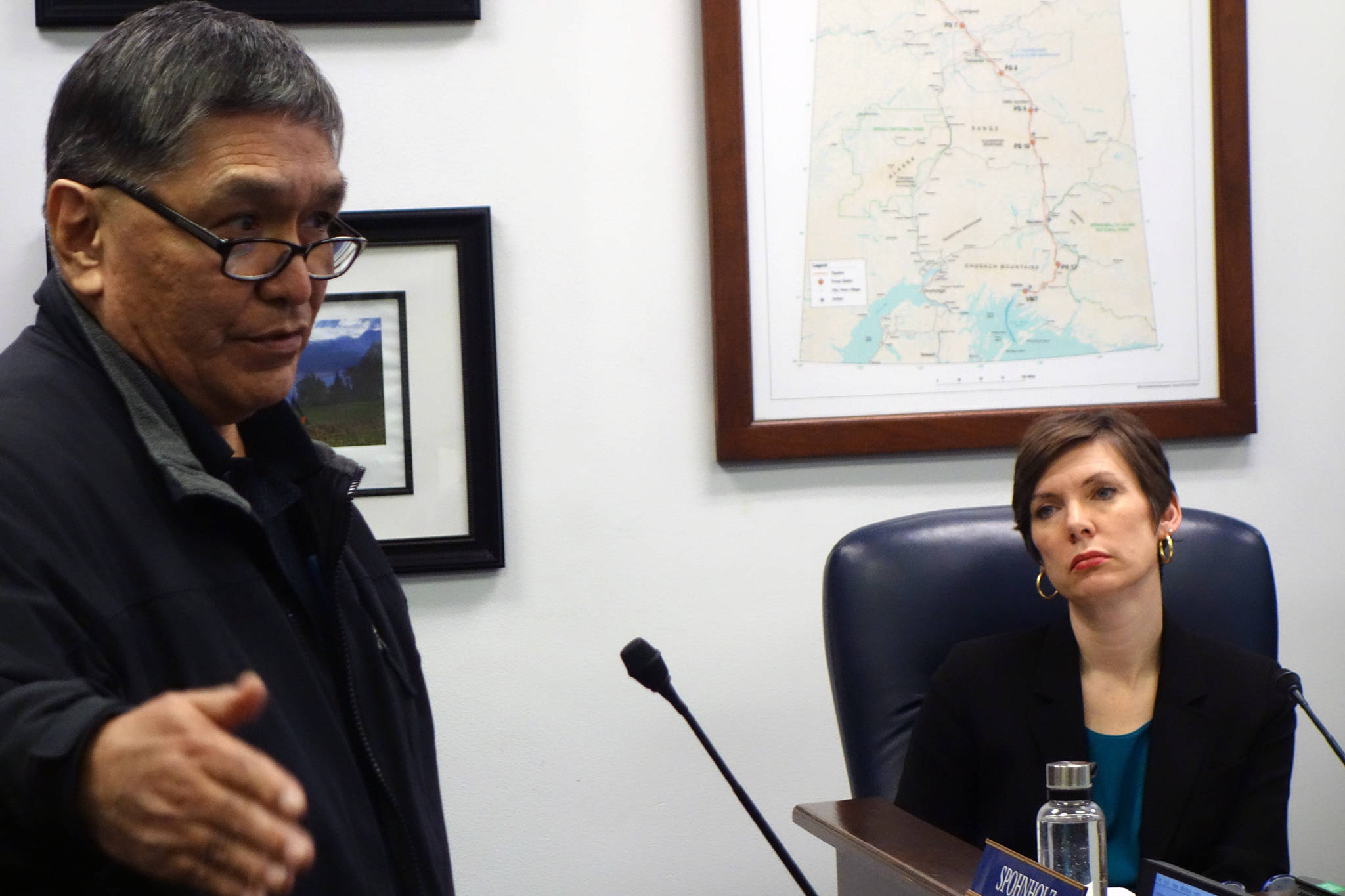
About a dozen people spoke against a proposed bill during a Monday afternoon House Resources Committee meeting. They argued the bill, which would create a water advisory commission and legislative process for designating Outstanding National Resource Waters, would make it unnecessarily difficult to designate what are often called Tier 3 waters. That designation allows for only minor and temporary decreases in water quality.
“Requiring a Tier 3 water nomination go through a three-step political process rather than a science-based administrative process all but ensures there will never be a Tier 3 water designation in this state,” said Sarah Davidson during public testimony. Davidson is the Inside Passage Waters Program Manager for Southeast Alaska Conservation Council. She was one of a handful of SEACC staff members who gave personal testimony during the meeting.
House Bill 138, which is sponsored by Rep. Chuck Kopp, R-Anchorage, would allow the public to nominate bodies of water and put the power of designating Tier 3 waters the hands of the Legislature, but only if nominated bodies of water received approval from a 7-person commission. There are currently no Tier 3 waters in Alaska but five bodies of water have been nominated. More public testimony for the bill will be heard Friday.
The commission would include the commissioners of the Alaska departments of Natural Resources, Environmental Conservation and Fish and Game as well as four designated seats to be filled by governor appointments, according to a presentation given during the meeting.
That includes a seat for a tribal entity or Native corporation, environmental or conservation on-governmental organization, a resource-development NGO and a representative of local governments.
Rep. Sara Rasmussen, R-Anchorage, asked if the commission would be subject to legislative review.
[Read live coverage of the meeting here]
“The bill does not permit that,” Kopp said. “The reason for that is to try not to politicize the commission.”
Rasmussen said allowing the Legislature a say in the commission’s makeup could eliminate perceived politicization of the commission since it would provide a possible check on governor appointments.
Such a commission would review nominations from residents, and the nominations would need to include a description of the water, upstream and downstream boundaries, explanation of what makes it exceptional, a description of existing water quality and a cost-benefit analysis.
Rep. Ivy Spohnholz, D-Anchorage, asked if the nomination criteria might make it difficult for one person or even a small tribe to nominate a body of water.
“These are more policy determinations than science determinations,” Kopp said. “The intent is to not make the bar so high that it is prohibitive.”
Dan Cannon, Tongass Forest Program Manager for SEACC, said during public testimony that the process that would be established by the bill made it sound tough for an individual to nominate a body of water.
Chilkat Indian Village Vice President Jones Hotch Jr. said it would be difficult to attach such a value to resources contained in the Chilkat River.
[Opinion: Include Chilkate River in mining conversation]
“I cannot put a cost on how valuable salmon is to us,” Hotch said. “It has a value to us, I can say that much. We are against this bill.”
If the bill becomes law, and a nomination was approved by the commission, the governor would then be required to introduce a bill designating a water as an ONRW which would then go through the legislative process.
Some who gave testimony, including SEACC staff scientist Guy Archibald, said that makes the matter of environmental protections inherently political rather than based in science. Archibald specified he was only speaking for himself, not the organization.
“The idea that it would have to go through the Legislature and that would not be a political process, honestly does not pass the blush test,” said Guy Archibald. “If you are making a process easier for a corporation to pollute water and meanwhile setting a high bar for residents to protect water, that is in violation of the Alaska constitution that the resources be developed for the benefit of all Alaskans.”
• Contact reporter Ben Hohenstatt at (907)523-2243 or bhohenstatt@juneauempire.com. Follow him on Twitter at @BenHohenstatt.
