
By Mary F. Willson
For the Juneau Empire
Early March brought us a lot of gray skies, but there was one spectacularly sunny day when there was deep, fresh snow at Eaglecrest. The parking lot was jammed, the slopes were thronged with down-hillers, but the nicely groomed lower Nordic loop was little-used by humans, at least the morning I was there.
So, a friend and I ambled around the loop on snowshoes, looking for tracks and hoping (in vain) to hear an early junco singing. There were a few deer and hare tracks, and a probable mouse. A raven had landed, punching deep in the snow and bracing a bit with one wing tip; then it walked a few feet and took off again — I wondered why it chose that particular spot. Here’s where an ermine dashed out from under a bush, bounded over the snow, and dove under the deep snow blanket. Oh look! Lots of bipedal three-toed tracks circling one blueberry bush after another… clearly a grouse or ptarmigan had come for lunch, nipping dozens of tiny buds off the blueberry twigs.
Just as we were about to move on from the bud-feeding area, we saw a small shrub at the side of the trail, poking up out of soft snow: a single stem with just a few twigs on top. Suddenly, it quivered very noticeably, and then did it again. That movement was not caused by wind or a falling clump of snow or anything else detectable on the surface. So I suspect that some small critter under the snow was jostling the base of the stem. A lot goes on down there that we don’t see.
The next day was gray again.
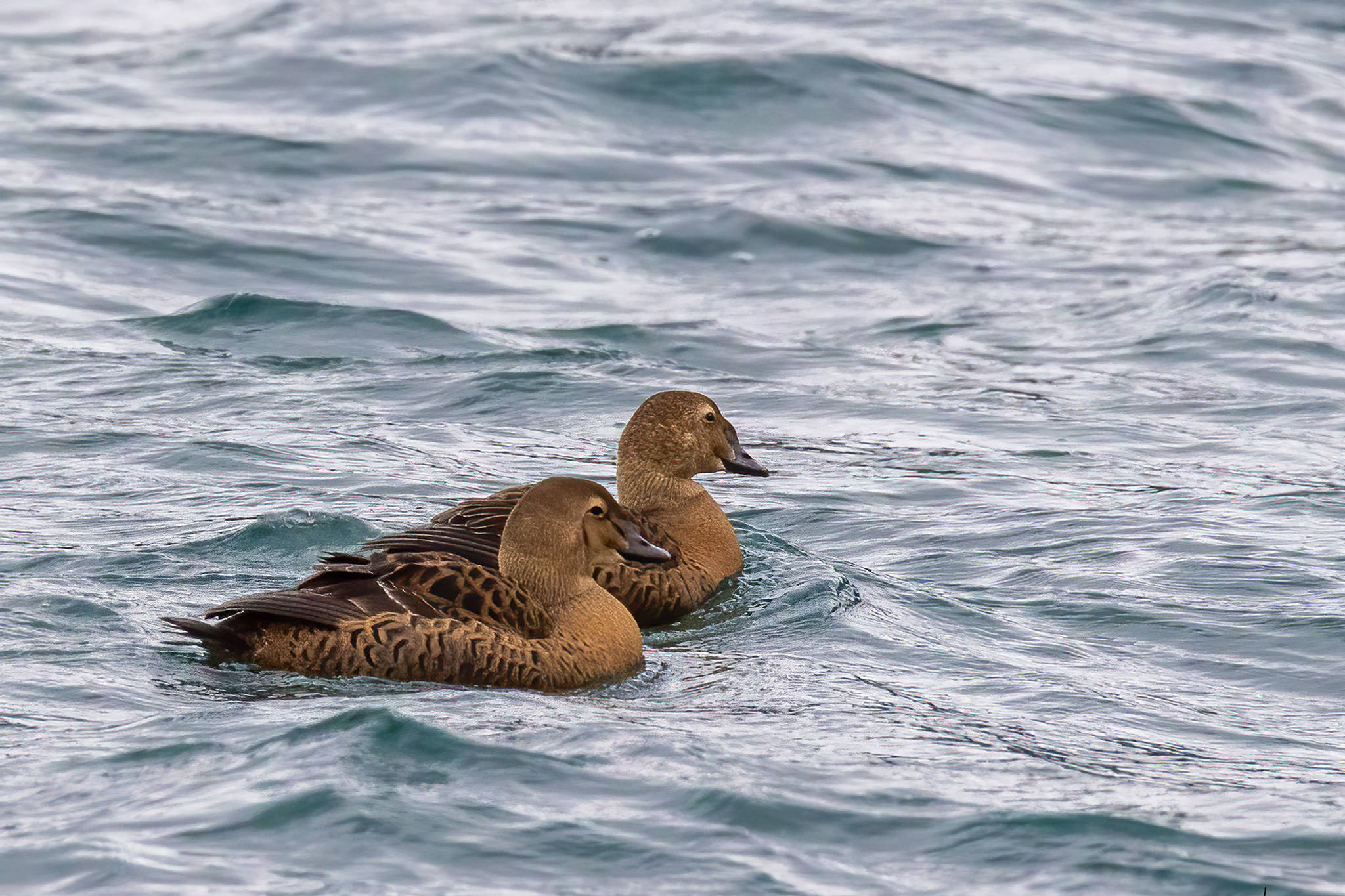
I made a quick trip to Point Louisa with another friend. I wasn’t expecting to see very much, because the tide was way out. But when we got out on the point, a gaggle of bird watchers had gathered, drawn by reports that some king eiders were seen there. The watchers were what I call “real birders,” who keep up on recent sightings and often carry telescopes as well as binoculars and don’t need to consult the field guides to know what birds they are seeing.
Just off-shore was a big crowd of scoters that even I could identify, along with a few harlequin ducks and goldeneyes. The birders assured me that mixed in with that lot were two female king eiders and even graciously loaned me the use of a telescope. After lots of finger-pointing and information on just where in that big flock I should look, I think I finally saw them—two brownish ducks with smaller bills than those of the scoters. A first, for me!
King eiders nest on the coastal tundra way up north, with the males then in their colorful breeding dress. There, they feed on invertebrates in the freshwater ponds. Most of the birds that nest up there spend the winter in the Bering Sea, where they dive for benthic invertebrates.
However, some of them wander down our way at times. In addition to some records from Gustavus, there are records, over several years, of sightings from Sandy Beach to Eagle Beach—that stretch of coast is, of course, where most of the local birders are active; it seems likely that the eiders occur sporadically up and down the coast. Most of the sightings have been in winter and early spring. I have to wonder what brings them to our area…
The birds in the big flock were bobbing about peaceably.
King Eiders feeding amongst Scoters from Bob Armstrong on Vimeo.
The scoters were diving and coming up with prey, usually a mussel. When a scoter surfaced with prey in its bill, it shook its head with the prey securely clamped in the bill, perhaps to jettison some indigestible bits and extra water. Meanwhile, the eiders were cruising around among the scoters, occasionally dipping down to grab things not far below the surface. I suspect that all those paddling feet and diving birds stirred up small invertebrates, making them more accessible to the eiders.
Perhaps the eiders also occasionally snatched up edible fragments that were accidentally discarded by the scoters.
Thanks to Doug Woodby and Mary Hausler for the loan of their telescope and guidance on where to look, and to Gus van Vliet for helpful consultations. Thanks also to Kerry Howard for the photo and to Bob Armstrong for the video.
• Mary F. Willson is a retired professor of ecology. “On The Trails” appears every Wednesday in the Juneau Empire.
