
By Mary F. Willson
It’s official now. Never mind what the calendar says; the fireweed flower buds are emerging from tall, leafy stems, and that’s the seasonal clock that matters!
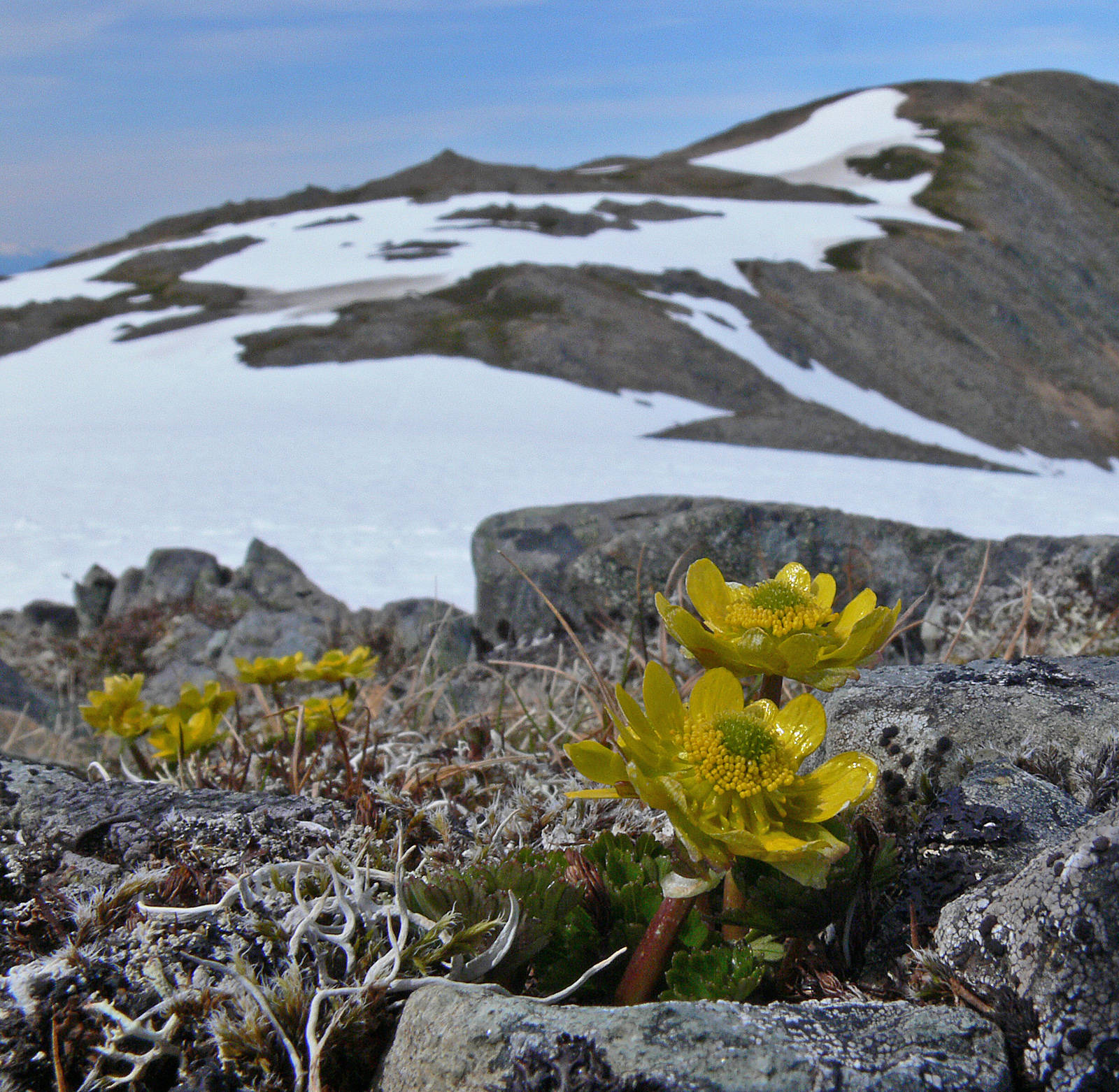
A trip up the tram in mid-June led to an encounter with lots of snow across the trail, becoming too much for me just a little way above the cross. Even so, on the lower part of the trail, narcissus anemones, yellow violets and Cooley’s buttercups were showing off, along with an alp lily, a few pixie eyes, one deep purple Alaska violet, and a few others scattered about. Fox sparrows, juncos, robins, and Wilson’s warblers sang.
Just 10 days later, the trail was almost clear of snow as far up as I could see, although I found one old ptarmigan burrow with the usual fecal deposits, beside the trail. Going just a few levels beyond the hang-gliders’ wind-sock, I noted about 30 kinds of flowers. Now the Alaska violets were in full swing; buttercups and anemones still flourished and were joined by northern geranium, spotted saxifrage, roseroot, moss campion, fine displays of villous (woolly) cinquefoil, and many others. A friend reported that the glaucous gentians were blooming nicely, higher on the ridge. What a difference those 10 days made!
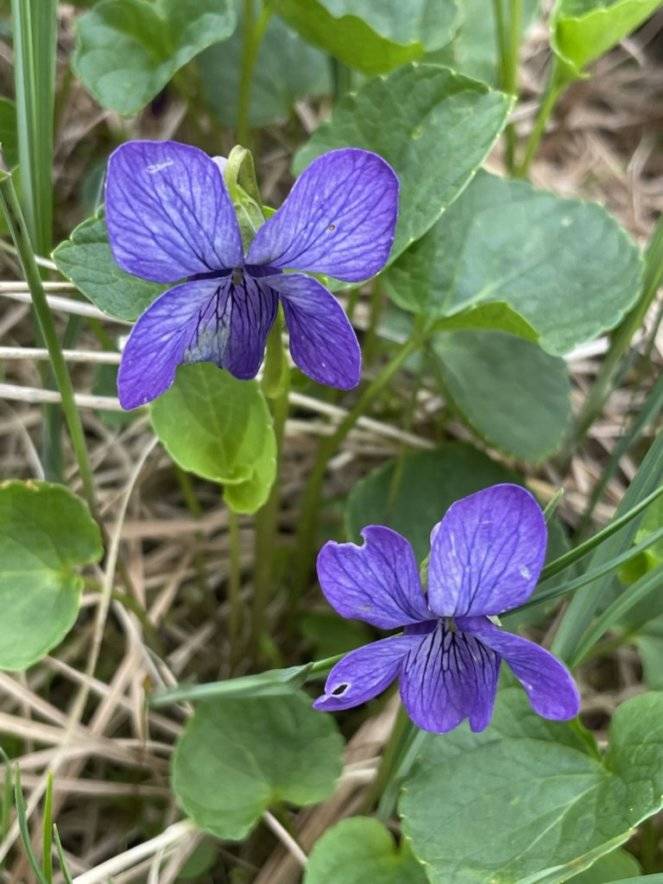
Alaska violets come just a bit later, their rich purple flower distinguishing them from other violets. (Courtesy Photo / Deana Barajas)
At the very end of June, on a low tide, a friend and I wandered out to some of the dredge islands in the wetlands off the dike trail. Sculpins scuttled away in the nearly-dry channels. A few hot, sunny days had made the lichen carpets on the islands dry and crispy, but they still offered a tapestry of varied color and texture. Savanna sparrows sang from the grassy areas and shrubs along the edges, song sparrows from the thickets, hermit thrushes from the spruces. Beach rye was shedding pollen, cow parsnip’s big, white inflorescences were platforms for nectar-sipping flies, and an angelica inflorescence was totally covered by tiny flies doing the same. Willow seeds freed from their capsules were floating about, sometimes getting caught on branches, making fluffy clumps. Mayflower and dwarf dogwood plants had established in some places, but they were small, pale, and without flowers, quite unlike the ones growing in forest. The little plant called sheep sorrel (an introduced species gone feral) had opened some of its tiny reddish buds, and yellow rattle (or rattlebox) was flowering too.
There was, of course, the usual accumulation of trash — spent shotgun shells, plastic jugs, beer cans and what not. We had a big yellow litter bag, so there is less of that now. When we picked up half of a damaged plastic jug, we panicked a colony of ants that had built their tunnels under that convenient roof; we did what we could to give them a new roof of natural materials. Ants arrive out there when a winged queen with fertilized eggs wafts over the channels and sets up shop wherever she can find a place. Ants seem to be so uncommon here, that I get a bit excited when I find some.
A few days later, three friends wandered out the Fish Creek trail and perched for lunch on a beached log. We were amused by a pan-handling squirrel that came up behind us, clearly expecting some snacks. It got some, of course. Out on the exposed tide flats, an eagle stood quietly, no food in-hand, doing nothing in particular, but a mischievous crow dove at it repeatedly, even striking it occasionally, for no apparent reason except devilment.
We walked around to the end of the ‘island’ and looked out over the tide flats. Suddenly, a gang of 50 or more crows rose up and flew toward the trees behind us, making a tremendous racket, sounding very angry. The crows converged on one spot at the edge of the trees, clearly focused on something down under elderberry bushes and sweeping spruce branches, hollering and swooping down at whatever it was. Fifty crows can make a terrific amount of noise!
So, of course, we had to watch. The sharpest observer among us finally spotted a bird (or, rather, part of one), barely visible under all the brush. At first, all I could see was a small patch of gray feathers, surrounded by green elderberry leaves. But on the other side of those green leaves, close to the ground, I finally could make out a bird head—a glaring eye and a red-stained beak. That bird didn’t move while the crows were furiously mobbing it — yelling bloody murder and crashing into the vegetation around it. After many minutes, though, the hidden bird moved a few feet and stood up; now we could see the front of it—a belly marked with some dark, horizontal bars.
Putting the visible pieces of the harassed bird together, we determined that it was a peregrine falcon, a deadly predator of other birds, although we couldn’t see if this one held any prey in its feet. But mysteries remained: How did the gang of crows out on the tide flats know it was there? Did they see it come in or did a lookout in the trees notify them? Had the falcon captured a small bird or even a young crow, which would set off all the crows’ alarm systems?
Eventually, the hubbub subsided, although the crows still kept watch from perches in the trees. The falcon remained almost invisible in the thick foliage. We didn’t stay to see what might happen when the falcon tried to leave its leafy cover.
• Mary F. Willson is a retired professor of ecology. “On the Trails” appears every Wednesday in the Juneau Empire.
