

By Mary F. Willson
In early August, on the trail that starts near the end of the North Douglas Highway, I found a funny looking thing on the underside of an alder leaf. There was a long, thin, stick-like form underneath a transparent, plate-like covering. A photo was sent off for help with ID; the word came back that it is the typical cocoon of a moth in the genus Caloptilia. There are many species in this genus, and we don’t know which one this is. But, in general, the larvae are leaf miners at first, and later on they become leaf rollers, rolling up a leaf edge into a cone-shaped tube. The adult moths are very small, with a wingspan of about a centimeter. Judging from online images, the wings are very strange (at least in some species): the hindwing is totally fringed, and the rear border of the forewing is likewise fringed. Despite that unusual wing feature, apparently they can fly fairly well.
Along that same short stretch of trail, many small spruces had obvious damage on the new growth. This turned out to be spruce needle rust (a fungus). It infects only the new needles and seldom kills the tree, although it may reduce growth of the tree because the new needles are a better source of photosynthesized carbohydrates than are old needles. Outbreaks of infection occur periodically, but seldom erupt in the same place for more than a year or two. Outbreaks are triggered by cool, wet weather in spring, when spore spread from the alternate host, Labrador tea, to spruce needles. Then in summer, different spores disperse from needles back to Labrador tea, and yet another kind of spore then spreads to more Labrador tea plants. The following spring, it’s back to spruce again. This part of the trail would seem to be ideally suited to this life cycle, because some of the area is muskeg, with Labrador tea shrubs, and spruces are colonizing the edges of the muskeg.
Some of the alders in the same area had small fuzzy, white caterpillars on the leaves. These were the larvae of the woolly alder sawfly. The fuzzy, woolly look is produced by a waxy secretion that is shed before the larva pupates. An adult female is about 7 millimeters long; she inserts eggs into alder leaves, usually those that are relatively young and low on the tree. The larvae feed first on the upper leaf surface, later moving to the underside. Their feeding activity can skeletonize leaves, leaving only the veins. When the larvae are fully developed, they drop to the ground and make a cocoon in the leaf litter. Thought to originate in Europe, this species may be largely parthenogenetic, since males are reported to be absent in North America and quite rare in Europe.
Not far away, there were lots of galls on some willow leaves, mostly near the veins. Pointed underneath and reddish on top, they might be the temporary homes of larval gall midges (possibly an Iteomyia species). These seem to be better studied in Europe than in North America, but I found no details of the biology and life history. In general, the tiny female fly lays eggs on the leaf; when mature, the larva drops to the ground to pupate for the winter.
Thanks to Charley Eiseman for long-distance consultation and Elizabeth E. Graham of FSL for local consultation.
• Mary F. Willson is a retired professor of ecology. “On the Trails” appears every Wednesday in the Juneau Empire.
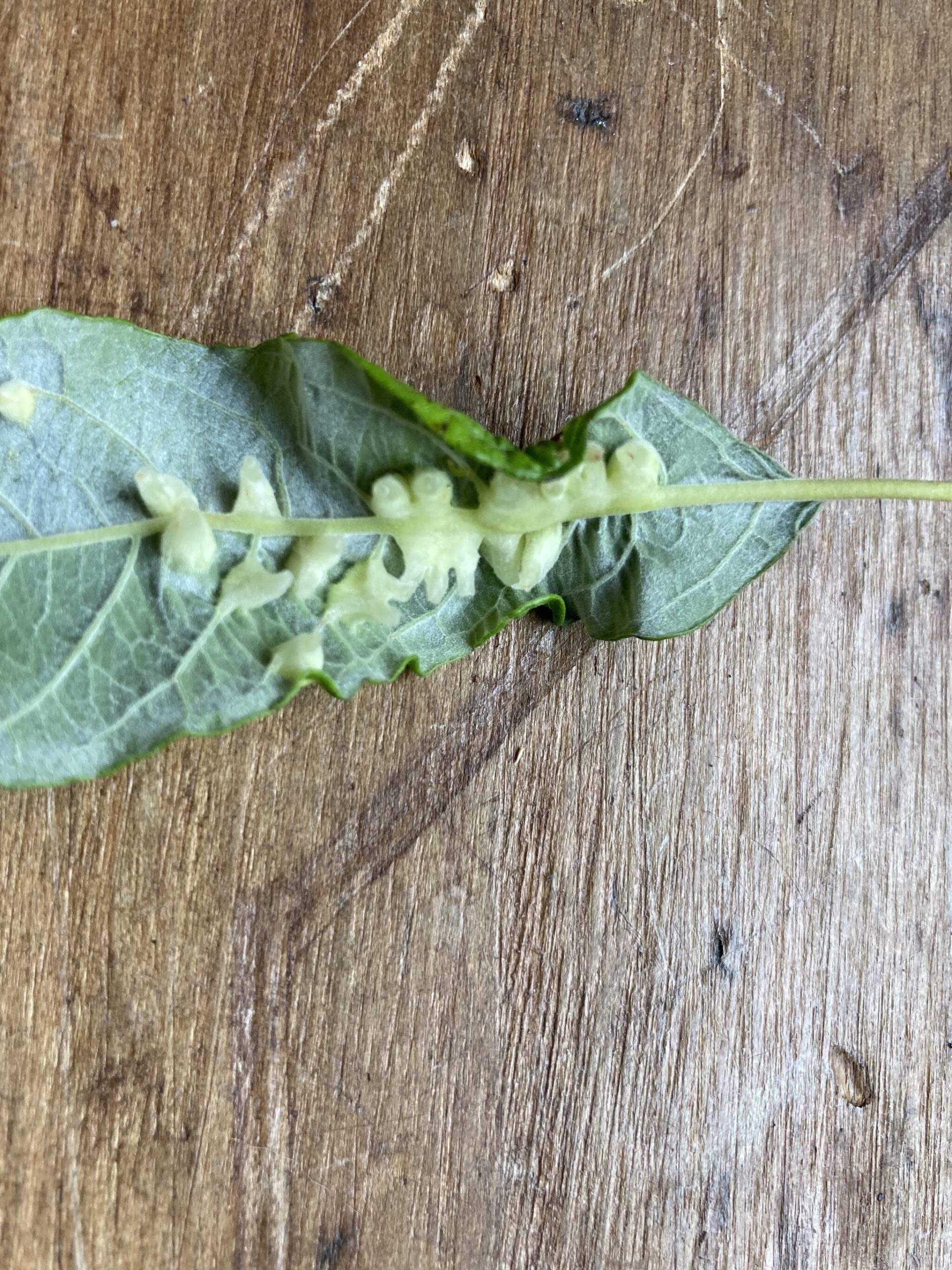
Galls, possibly of a gall midge, cluster along the veins of willow leaves. (Courtesy Photo / Mary F. Willson)
