
By Mary F. Willson
For the Juneau Empire
All quiet on the home pond, just a few loafing male mallards and a wandering bunch of big ducklings.
Not so, on the suet feeder, occupied by a male hairy woodpecker. An adult nuthatch was taking issue with his occupancy, darting at him repeatedly, making him duck and dodge. Eventually, both birds departed. The nuthatches have been feeding a sturdy juvenile, stuffing it with suet and peanut butter (and insects too, I hope), and perhaps there was a sense of ownership. But it was certainly a surprise to me, seeing that little nuthatch go after the woodpecker that weighs about six times more.
Up on Eaglecrest’s Lower Loop, a three-toed woodpecker was drumming energetically on the top of a tall dead snag. Presently, another woodpecker flew in and they both went off somewhere briefly, and then one came back to the snag. I don’t know what was going on, but that prompted me to learn a little more about their drumming behavior.
Both male and female three-toed woodpeckers drum (as is true of at least some other species, too). There are two styles of drumming: fast, which is more common, and slow. Fast drumming typically includes about sixteen hits at an average rate of over thirteen hits per second. It is used primarily for territorial advertisement, often in response to another drummer. Slow drumming averages about nine hits at a rate of just over eleven hits per second. It occurs between members of a pair, apparently as a way of locating each other and getting together.
[On the Trails: Meet the percussionists of the animal world]
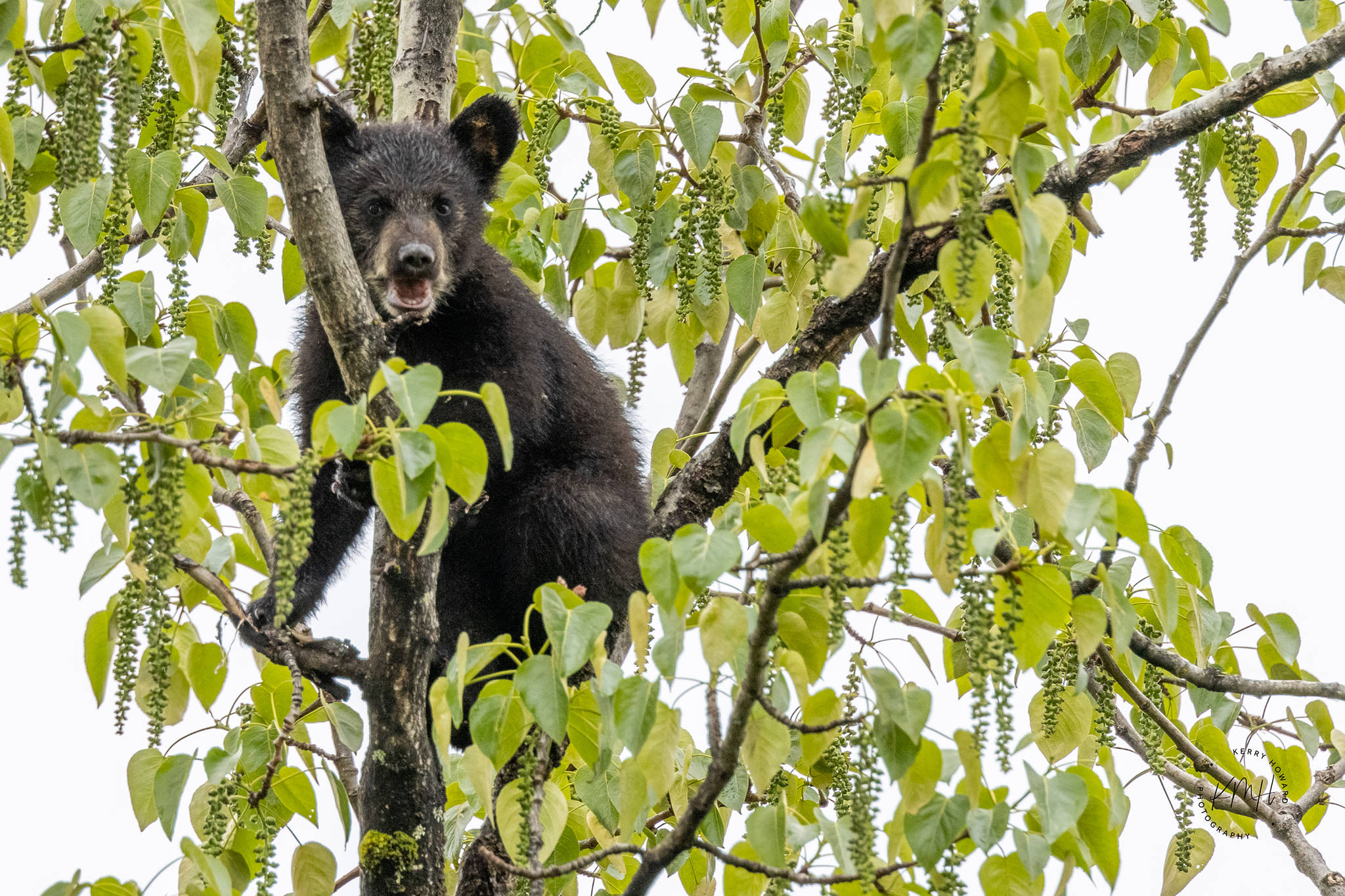
There hasn’t been much bear traffic in my yard, but up near the visitor center, a friend made some good observations. Two little bear cubs were up in a cottonwood tree, pulling in branches and snacking on the ripening seed pods, while mama rested at the foot of the tree. One of the cubs started to descend but panicked and started bawling. So mama scrambled up to guide the little fellow down, the sibling cub coming along, too.
A number of years ago, we often saw bears up in the cottonwoods, feeding on male and female flowering catkins and on seed pods, but that activity seemed to have diminished recently, so it was good to hear that our bears still do this. When we first noticed this behavior, years ago, it seemed perhaps a bit unusual and certainly interesting, so we wrote a small paper about it and sent it to a journal. “We” in this case consisted of me, three very experienced Forest Service rangers, and an Alaska Department of Fish and Game statistician.
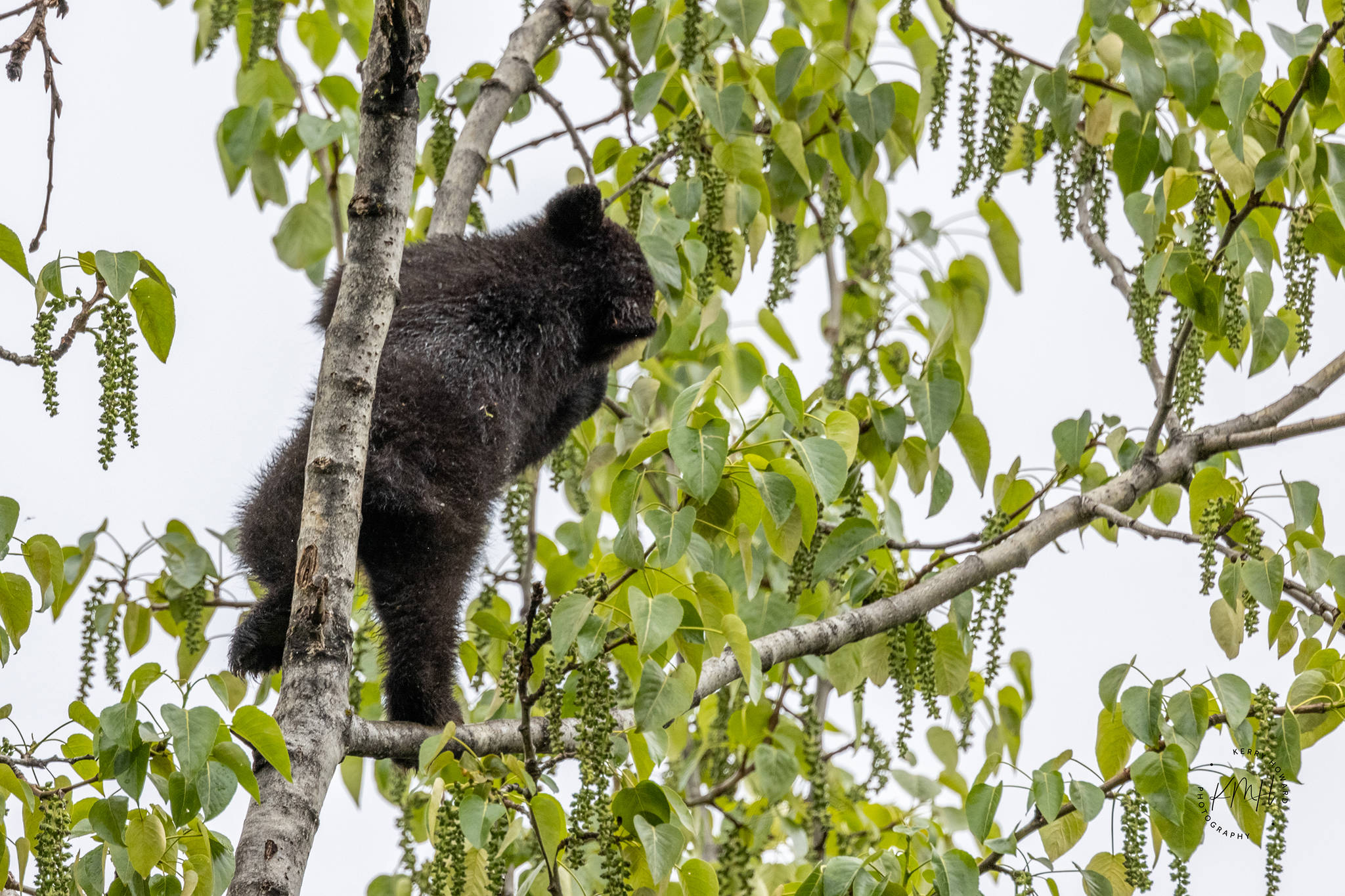
That bear cub, with its back turned, grabs cottonwood branches to get access to the seed pods. (Courtesy Photo / Kerry Howard)
Well, the journal rejected our paper, disbelieving our observations — even though black bears all across North America are known to eat catkins of many species!
Now, I’ve written a lot of scientific and natural history papers, and as an author, I know to expect journal editors to request revisions, sometimes extensive ones. But this was the only time in a long career that I’ve experienced rejection based on disbelief. Harumph (and a few other, unprintable, words)!
Fortunately, we had more photos of our bears in action in our cottonwoods, and those photos eventually persuaded the journal to accept our paper.
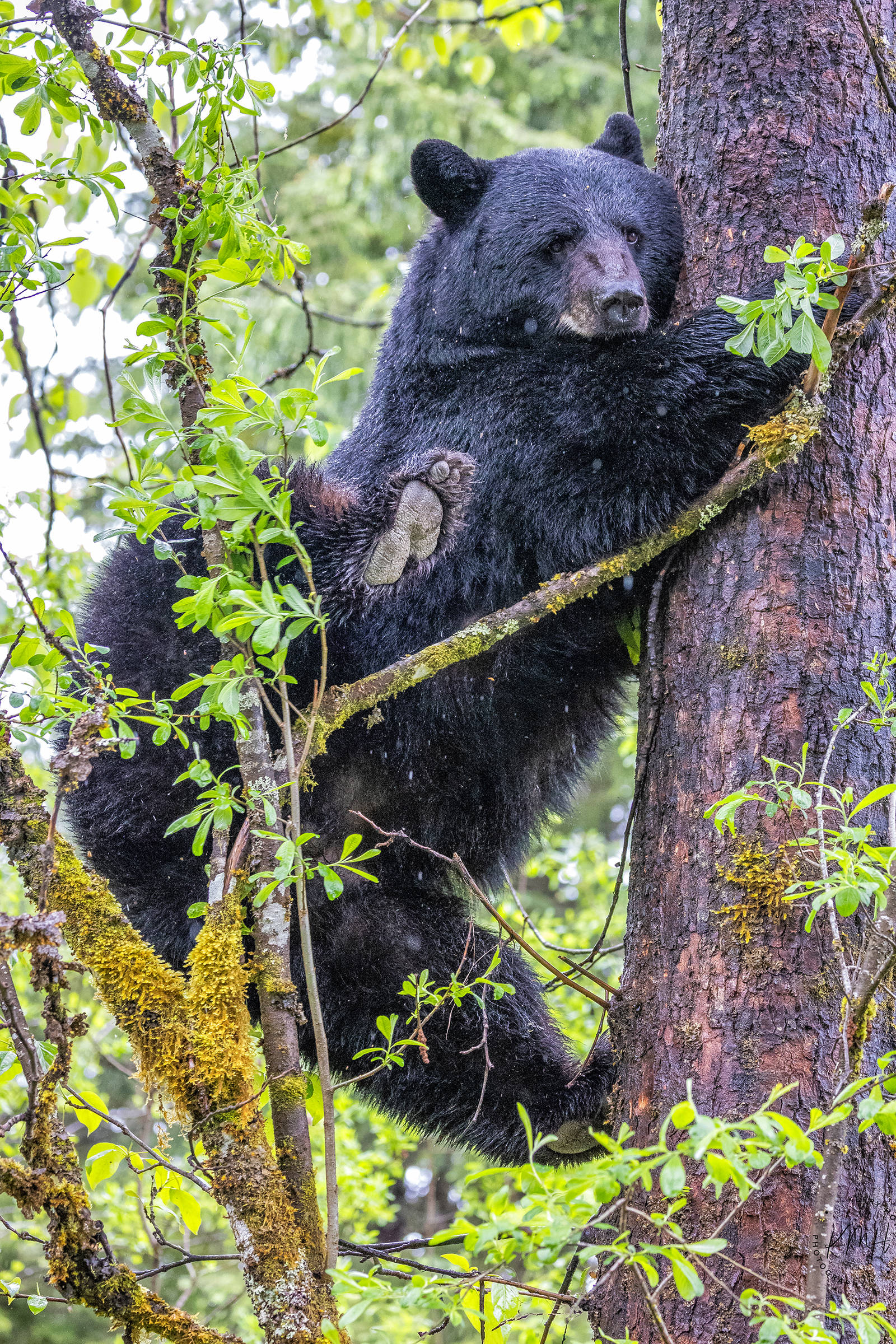
The mother bear scrambled up the trunk to rescue her frightened cub and its sibling. (Courtesy Photo / Kerry Howard)
Some of the trees near the visitor center still show signs of bears getting access to catkins and pods: Some large branches are missing altogether, broken off when bears pulled them in toward the trunk where they perched securely. Many small branches are gone, too, broken off by bears or by porcupines, which relish the catkins and pods too. We noted that female trees endured heavier damage than male trees, probably because of the extended depredation of seed pods after the floral catkins were gone.
Squirrels and mice relish the seeds in the seed pods, too. I find evidence of their work on the ground and occasionally see them in action.
• Mary F. Willson is a retired professor of ecology. “On the Trails” appears every Wednesday in the Empire.
