
A mid-October trip to my old stomping ground in Wisconsin was full of quiet pleasures (plus a fine performance by the Madison symphony). Despite recent rains and high winds, the deciduous trees put on a grand show of color. Although there were pockets where all the leaves had turned to yellows and reds, the best color exhibits were the swathes of fall color set off by a hillside framework of green.
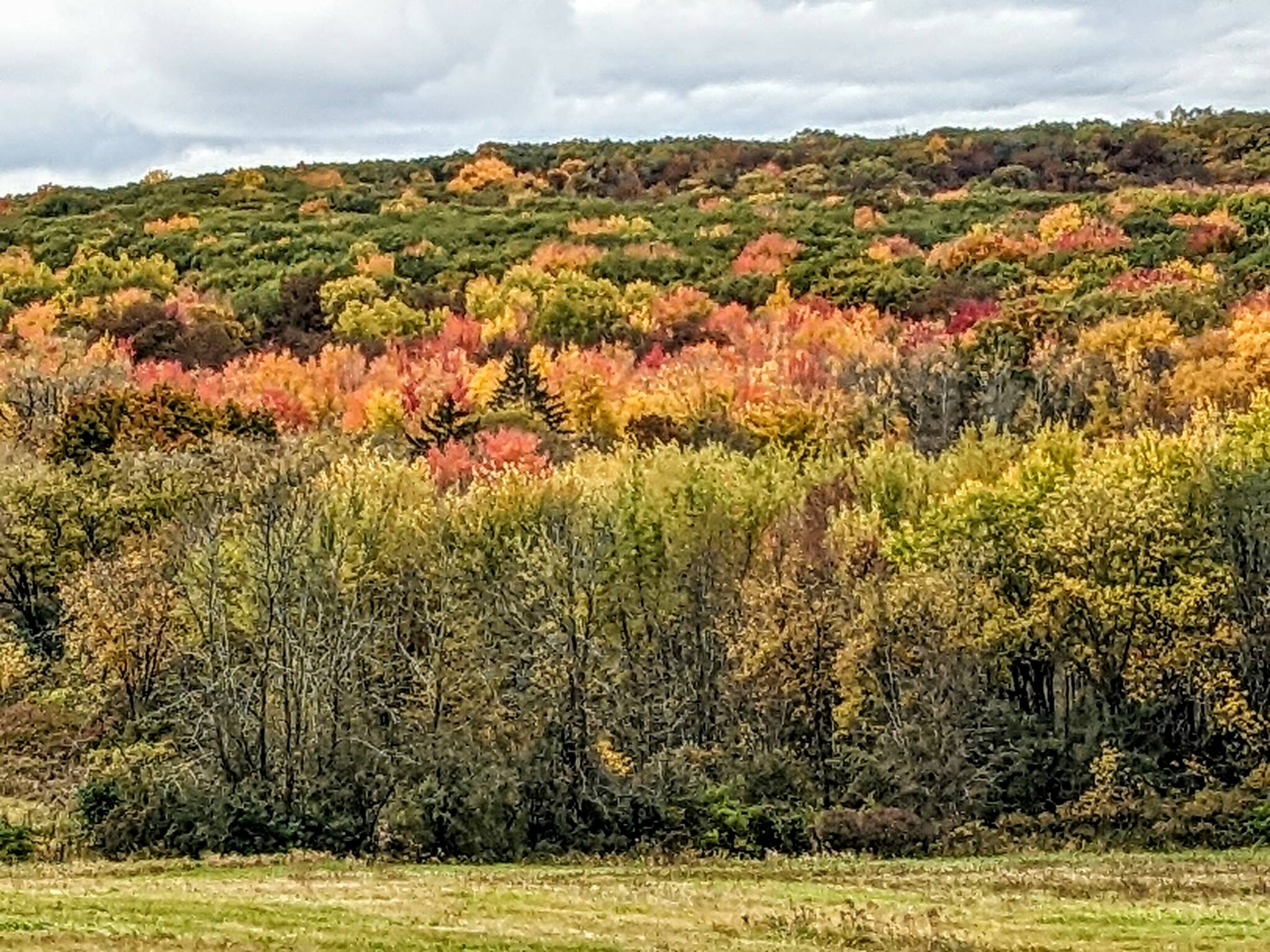
A streak of fall foliage color highlights a hillside. ( Courtesy Photo / J. S. Willson)
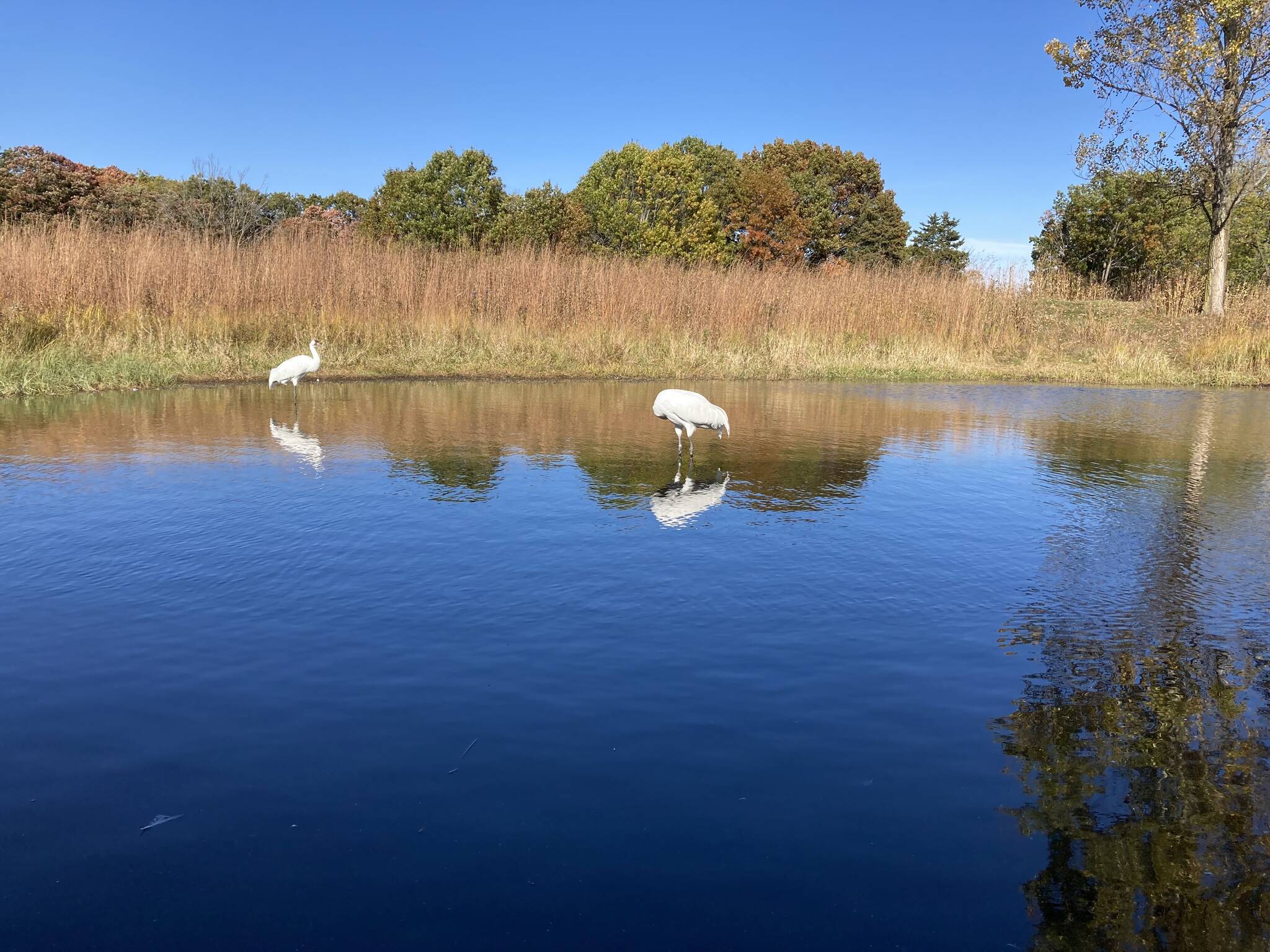
In certain fields outside my hometown, we often see cranes in the fall. So we went looking. No whooping cranes this year, but little groups of sandhill cranes were foraging in corn-stubble fields. We don’t usually see cranes in fields where soybeans had been harvested and stripped right down to the soil. But this time was an exception: six cranes were looking for things to eat in a now-barren soybean field. I had to wonder what they could be finding.
A visit to the International Crane Foundation offers not only some nice exhibits of cranes of the world but a chance to walk some easy trails in a variety of habitats. There’s mixed deciduous forest of oaks, maples, big-tooth aspen, cherry, and so on. This time I wanted to see the tall-grass prairie section with its rich mixture of grasses and late wildflowers — one of the most diverse ecosystems in the world. The tallest grass is called big bluestem or turkey foot (for the shape of the seed heads); it grows higher than my head. Thousands of small seed heads of little bluestem almost glowed when backlit by the sun. Here and there were a few yellow, white, or purple flowers persisting among the grasses. The tall-grass prairie once occupied thousands of square miles in the Midwest: centered in Illinois and Iowa, but extending from eastern Nebraska to western Indiana and from Minnesota and southern Wisconsin to eastern Kansas, with outliers in southern Manitoba and Oklahoma. But most of it has long since been plowed under, leaving only small patches and a few conservation areas.
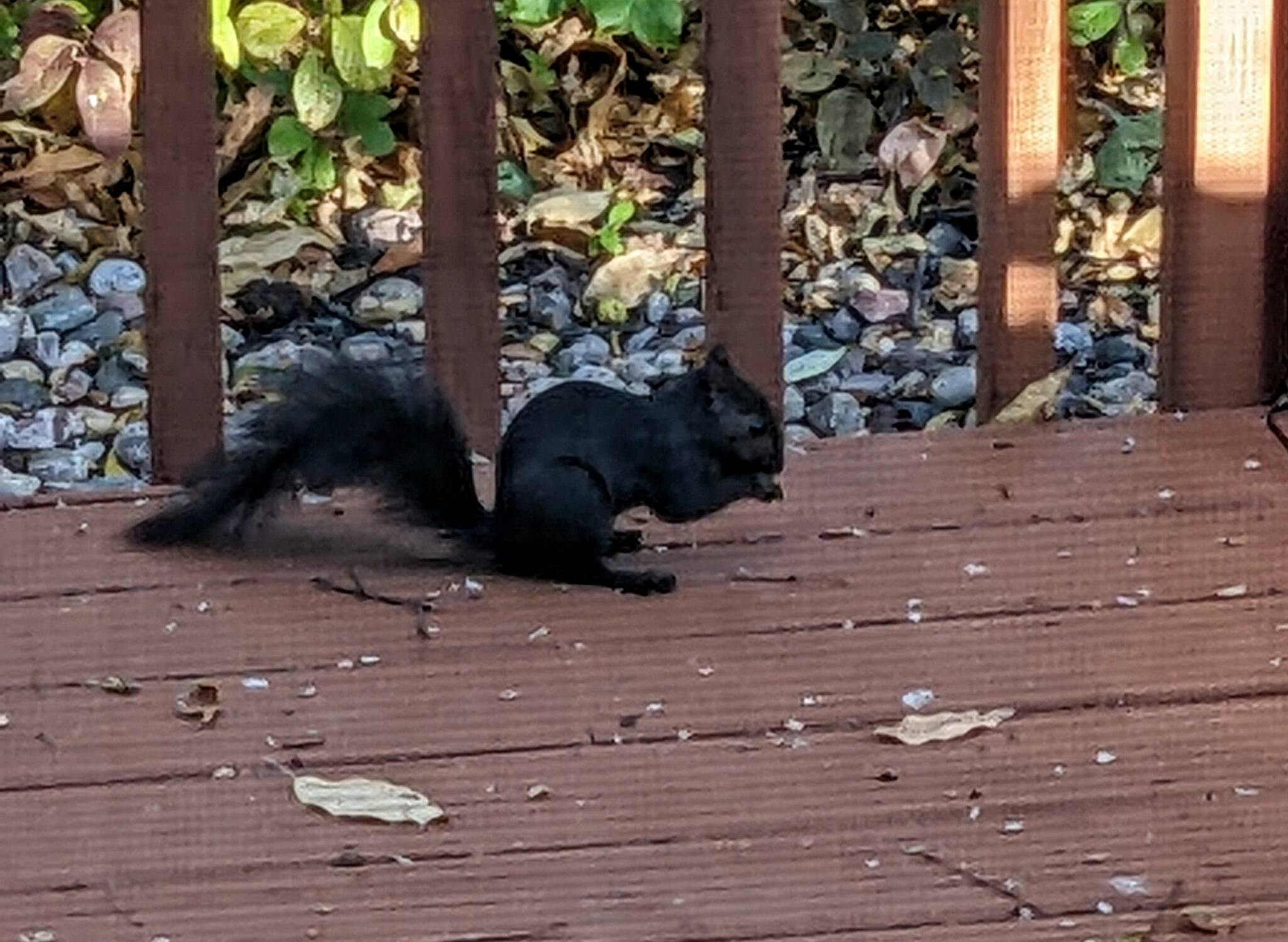
A black-furred gray squirrel gleans spilled seeds below a bird feeder. ( Courtesy Photo / J. S. Willson)
A string of bird-feeders and a water-bath outside a window offered continual entertainment, much more variety than at my Juneau house. A male cardinal sometimes claimed the water-bath for himself, but a female was never far away. There were red- bellied and downy woodpeckers, black-capped chickadees, house finches and goldfinches, a few house sparrows, bluejays (real ones, not our Steller’s jay), and white-breasted nuthatches. I always enjoy watching nuthatches scurry vertically up and down tree trunks. Walking down a tree trunk is made possible, it seems, by the large, strong hind toe on each foot, giving a good purchase on the bark. Best of all is watching a nuthatch fly to a trunk and instead of landing head-up, it turns in a flash and lands head-down. (Why don’t woodpeckers do that? They have two back toes on each foot, which would give a good grab on the bark.)
Gray squirrels were occasional visitors to the spilled seed below the feeders, but they spent most of their time collecting hickory nuts and acorns. Gray squirrels occupy the eastern deciduous forests and are often found in wooded suburban areas. Bigger than our local red squirrels, they scatter-hoard their harvest, burying each prize separately; if they fail to retrieve their stash, the nuts may germinate and contribute to the forest composition.
Mixed in with the normal gray-colored squirrels, we often see a few melanistic ones with black fur. The black fur results from a mutation in the DNA of a certain chromosome. If a black squirrel has two copies of the mutation, it is deep black, darker than one that has just one copy. If a blackish squirrel with one copy of the mutation mates with a normal gray squirrel, the litter generally has both blackish and gray pups.
Is blackness an adaptation to some environmental condition? At present, there are two suggestions: It might contribute to concealment, especially in northern forests where there are more dark conifer trees mixed with the deciduous ones. Another suggestion deals with thermoregulation. Black squirrels are said to be uncommon in areas with high air temperatures. Research has shown that black squirrels have more cold-tolerance than the grays: they have lower heat loss at very low temperatures, as well as a lower metabolic rate and a better ability to generate heat. But it is not clear what, if anything, black fur has to do with all that. Things to ponder, but there seem to be no conclusive data, and other possible explanations may exist.
• Mary F. Willson is a retired professor of ecology. “On the Trails” appears every Wednesday in the Juneau Empire.
