
By Mary F. Willson
For the Juneau Empire
The day dawned bright and sunny at my place, so I decided to visit the wetlands, to catch some rays and maybe see something interesting. By the time I got there, though, clouds were shedding snowflakes (again) and, staying near the dike trail, I didn’t see much except otter tracks going over the icy ponds. The best part was meeting two very nice Bernese mountain dogs, a friendly golden retriever and an elegant Gordon setter.
On the way back to the car, however, I encountered a reliable observer who reported sighting of numerous snow buntings, Lapland longspurs, and gray-crowned rosy finches way out on the sedge and sand flats exposed by the low tide. Flocks of these migrants were on their way north to their nesting areas.
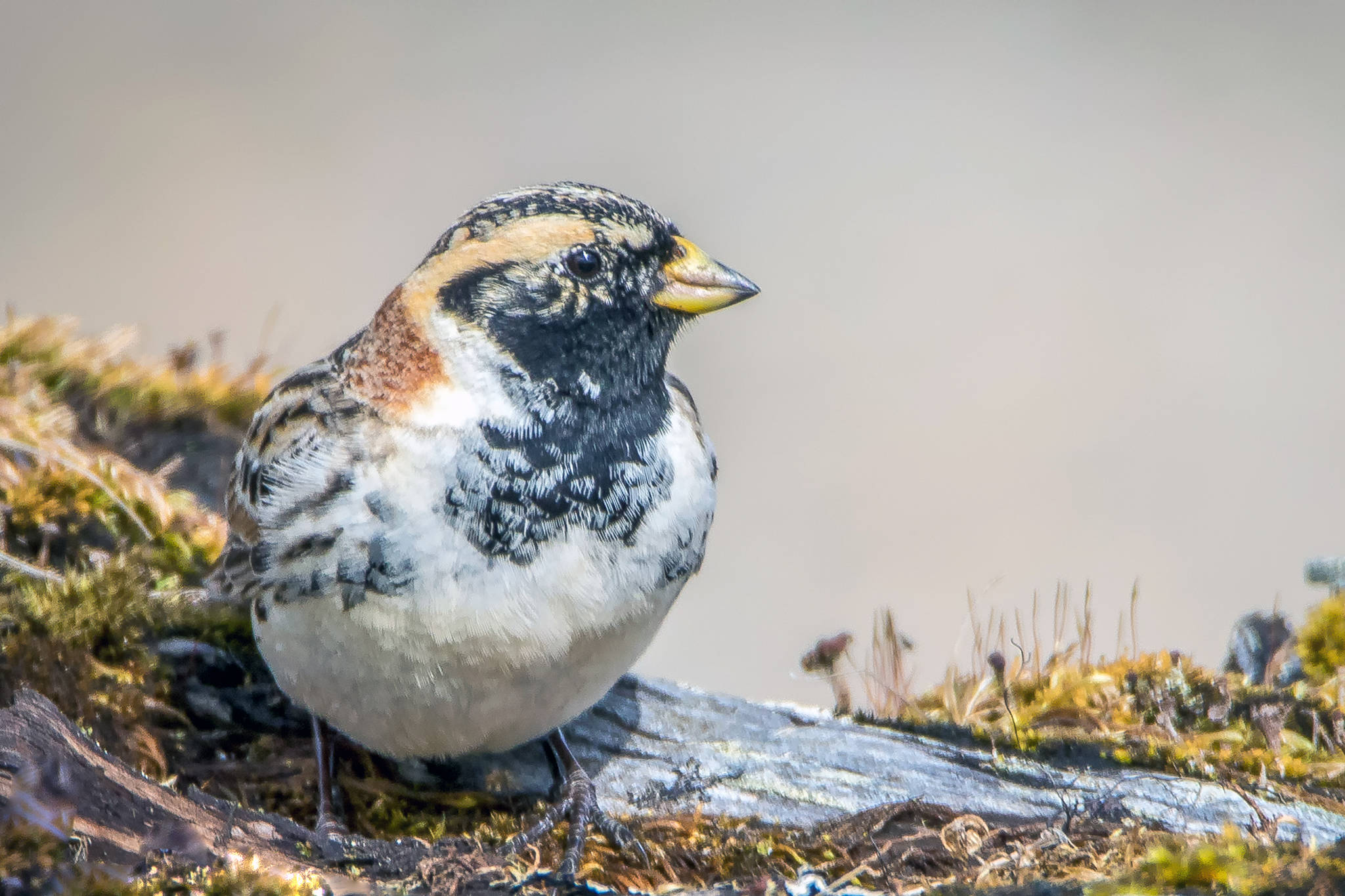
Disappointed at having missed those birds, I went back the next day, again on the low tide, in hopes of finding them. By then, however, the weather had deteriorated to stiff cold wind and ‘snain.’ I rambled around out on the flats for what seemed like a long time — saw a few geese and ravens. Then, I saw a flock of snow buntings zoom by overhead. And, at last, there were some small birds scuttling about in the tide-flattened vegetation. Yes! Some Lapland longspurs, a couple of little groups of them, looking for fallen seeds or errant insects. So I found two of the three I’d been seeking. Hardy harbingers of a long-awaited spring.
Lapland longspurs get their English common name from the long hind claw. They breed across the far-northern tundra of North America (and Eurasia). In winter, they’re seen across the middle of the U. S. (or Asia), usually in flocks, and they arrive on the breeding ground still in flocks. Socially monogamous pairs form there, and males defend territories around nesting sites selected by females. Females build the nests, often lined with feathers, and lay clutches of three to seven eggs—earlier if the weather is good and snow cover has receded, later if the weather is poor and snow cover is thick. Nests are usually hidden in the side of a bank or tussock, or maybe under a low-sprawling shrub. Females do the incubating, for eleven to twelve days, with no help from the male beyond a bit a guard duty.
[Meet the persuccionists of the animal world]
Males are decorated with black facial masks and bibs of black feathers on the upper chest; the size of the bib varies (but it’s not related to age). Super-charged males with big bibs don’t help feed the young chicks much; they are busy chasing other mating opportunities—monogamy in name only. These males might help with their fledglings—by then, there are fewer opportunities for extracurricular activities. The obvious question then is: what do females get from mating with guys that are unhelpful? Somehow, they have a higher clutch size, bigger hatchlings, and faster-growing nestlings—that leaves a lot still to be explained. Still more questions: Do females (at least the experienced ones) know what they are getting when they choose to pair up with a big-bibbed male? And do they mate with other roving males?
More faithfully monogamous males bring food to their mates while she is brooding tiny nestlings and both members of these pairs bring insects to the chicks during a nestling period that lasts about a week and a half. When the chicks leave the nest, they cannot fly yet, and the brood is divided—some in the care of the female, the rest tended by the male.
The chicks become independent after about three weeks. There is usually only one brood each year, given the short summer so far north. Adults may live five or six years, but most lives are shorter.
Snow buntings nest in the circumpolar High Arctic too. Males arrive before the females and choose a territory. Buntings often nest in rocky crevices; these crevices tend to be cold, and nests are often thickly lined with fur and feathers. Females build the nests and are accompanied by their mates while they gather material. Buntings form monogamous pairs, and at least in northern Canada (but not everywhere), males feed incubating females and help feed the chicks.
Male participation increased nestling weights and the number of chicks successfully raised per nest. Because incubation starts before a clutch is complete, hatching is asynchronous, and so is nest-leaving by the chicks. Once out of the nest, the brood is divided between the parents for the next week or two, until the chicks become independent.
• Mary F. Willson is a retired professor of ecology. On the Trails appears in the Juneau Empire every Wednesday.
