
Most of my recent trail walks have produced little sign of wildlife activity. But on a stroll in the Dredge Lake area, I saw a river otter in a bit of open water near the inlet of the Holding Pond. It soon dove under the ice and came up near the outlet, where the creek flows out to the river. I’ve seen otters here in other winters too and suspect they come up from the river to see if there are any fish to be had, not staying long. And at Point Louisa, there are sometimes scoters, goldeneyes, buffleheads and harlequins.
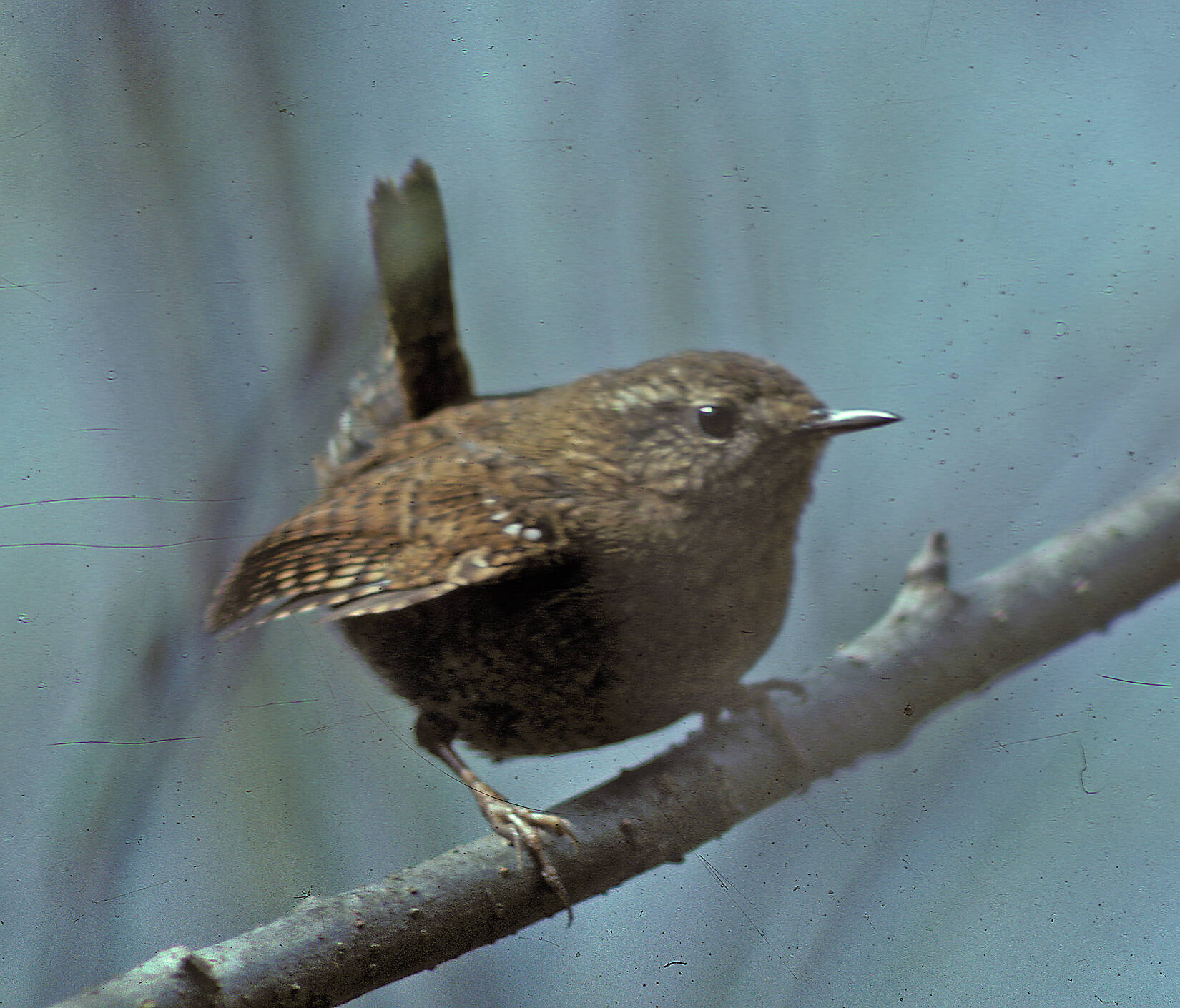
Over on North Douglas, a tight little bunch of sea lions surged past the boat ramp. A friend and I cruised the Outer Point/Rainforest loops while falling snow quickly covered lots of squirrel tracks. There were a few fresh tracks of a small bird, perhaps a junco, in the snow at the edge of the meadow. A big vole or a mouse had bounded across a gap between clumps of grass on the upper beach, making a leap of about seven inches. Goldeneyes nibbled along the rocks at the edge of the water and, a bit offshore, a little bunch of harlequins dove. Back in the woods, a wren darted out from under a foot bridge into a brushy tangle and then under a big log, not to be seen again.
That little wren is known as the Pacific wren, but it used to be called the winter wren, part of a species that nests widely across North America (and in Eurasia too). But taxonomists got busy and decided that these were really three different species, so they split the old classification and assigned new names. Now there’s the Eurasian wren (Troglodytes troglodytes), the Pacific wren (T. pacificus) that nests along the Pacific coast and in the Pacific Northwest, and the winter wren (T. hiemalis) that nests in the northern part of the eastern U.S. and adjacent Canada—but with a long westward extension of the breeding range out to northern British Columbia, where it overlaps with the Pacific wren.
Most of us could not tell these North American species apart by sight, although the Pacific wren is somewhat darker. But the vocalizations are known to be different. Where the ranges overlap in B. C., males of different song types held territories next to each other. Furthermore, singers of the different songs have different genetics, different enough to justify splitting them into separate species. Now we need information on what the females are doing…selecting males that match their own type?
And the taxonomists may have fun with another bird, known to us as Steller’s jay. Bird-watchers have noted the existence of plumage variation in various parts of the species’ range: Coastal jays have short black crests, blue forehead streaks, no eyebrow mark. Interior jays are similar but have a white eyebrow mark. Rocky Mountain jays have a long black crest and white marks on forehead and eyebrow. (In addition, jays in Guatemala and southern Mexico have blue, not black, crests.)
Geneticists got to work on comparing the Rocky Mountain jays with the Coastal/Interior jays and found significant genetic differences. That pair of populations is at least as different genetically as other pairs that are now accepted as different species: for instance, alder and Traill’s flycatchers, red-breasted and red-naped sapsuckers, white-crowned and white-throated sparrows. Furthermore, the Rocky Mountain jays occupy areas with different vegetation, a different climatic regime, and probably had a different history during glacial times.
So the researchers suggested some new names, perhaps officially becoming names of separate species. The Rocky Mountain forms might be called the long-crested jay (or perhaps the long-crested Steller’s jay), while the coastal/interior forms might be called the blue-fronted jay (or the blue-fronted Steller’s jay). More distinctions probably lurk down the taxonomic road!
Why bother with such distinctions?
From a scholarly perspective: sometimes, when we compare two very similar things (in this case, species), we discover that some tiny, subtle difference is actually not subtle at all but has significant ramifications for ecology and behavior. These discoveries expand our understanding. Furthermore, if two populations are sufficiently different to rank as separate species, they are capable of evolving in different, independent, directions, acquiring new, distinctive traits. Discovering those new directions increases our understanding of the ecological system.
In directly practical matters, distinguishing related but separate species is a useful tool for conservation: population trends can be monitored separately, not obscured by whatever is happening in the whole taxonomic complex. In this era of massive declines in many populations, it is useful to know how each population is faring.
• Mary F. Willson is a retired professor of ecology. “On the Trails” appears every Wednesday in the Juneau Empire.
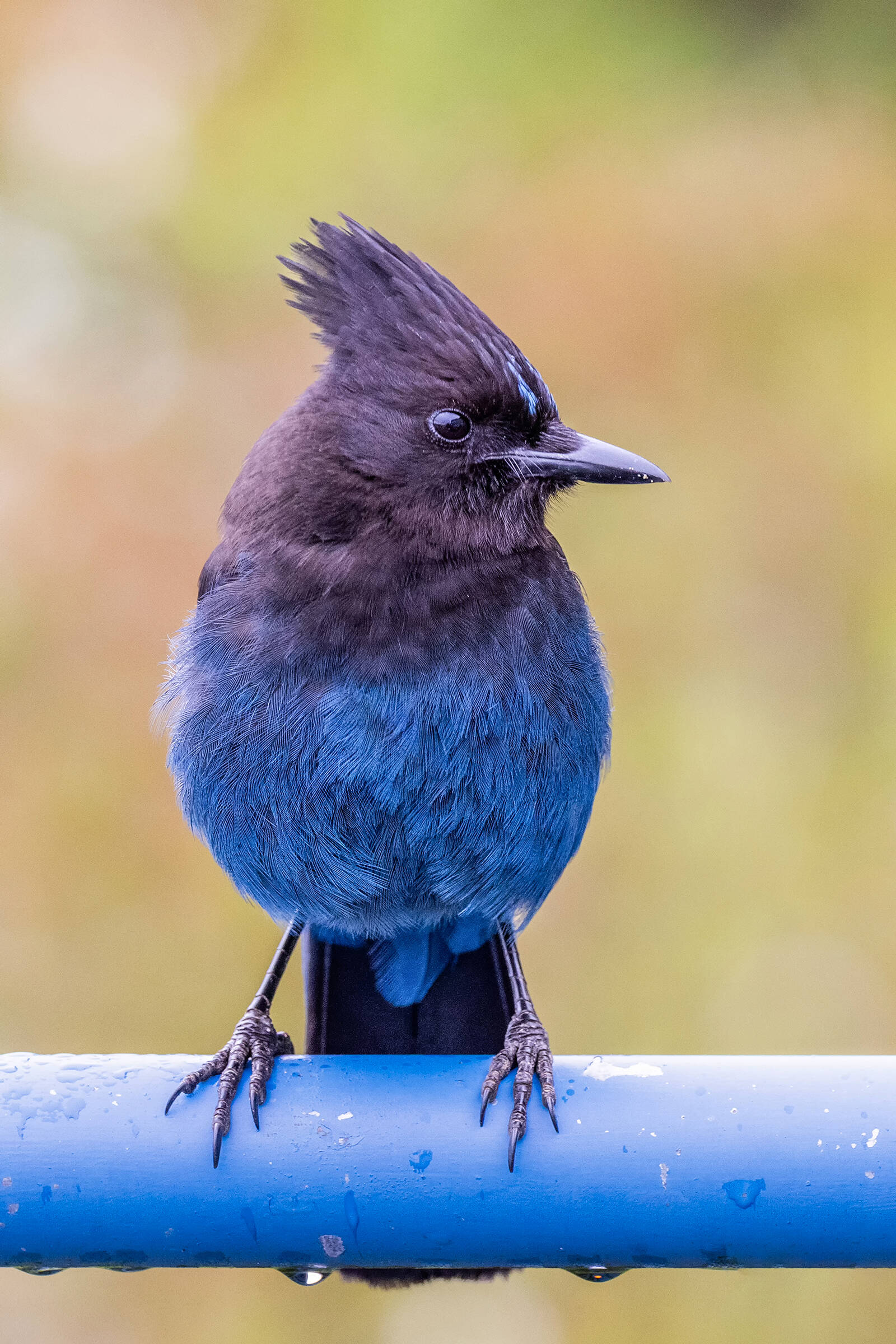
Coastal Steller’s jays have a blue forehead mark (Courtesy Photo / Kerry Howard )
