
By Mary F. Willson
On a gray mid-August morning with shirt-sleeve temperatures, a friend and I went up the Spaulding Trail to visit the first meadows near the trail. Recent heavy rains had bedraggled the trailside aster and turned the fluffy tops of cotton grass into sodden mop-heads.
The flowering plants of the meadows were in all stages of their respective seasons. Sundews, both round-leaf and long-leaf, bore buds but no open flowers. Swamp gentians flowered profusely, some still in bud. A small green orchid, called the bog adder’s mouth (Malaxis paludosa), was flowering, its tiny flowering stems scarcely visible among the other plants. White bog orchids and ladies’ tresses orchid flowers were nearly finished. Buckbean and deer cabbage were past flowering and making seeds. And one last bog laurel peeked out from behind a fallen branch.
Two sedges stood out in the meadow’s tapestry of color. Dense stands of the few-flowered sedge made a bright green contrast with the rest of the vegetation, the small yellow seed-heads making it even more showy. A pale bluish-green sedge, mostly leaves with few flowering stems, was common but not growing in tight, dense stands; this made a further contrast.
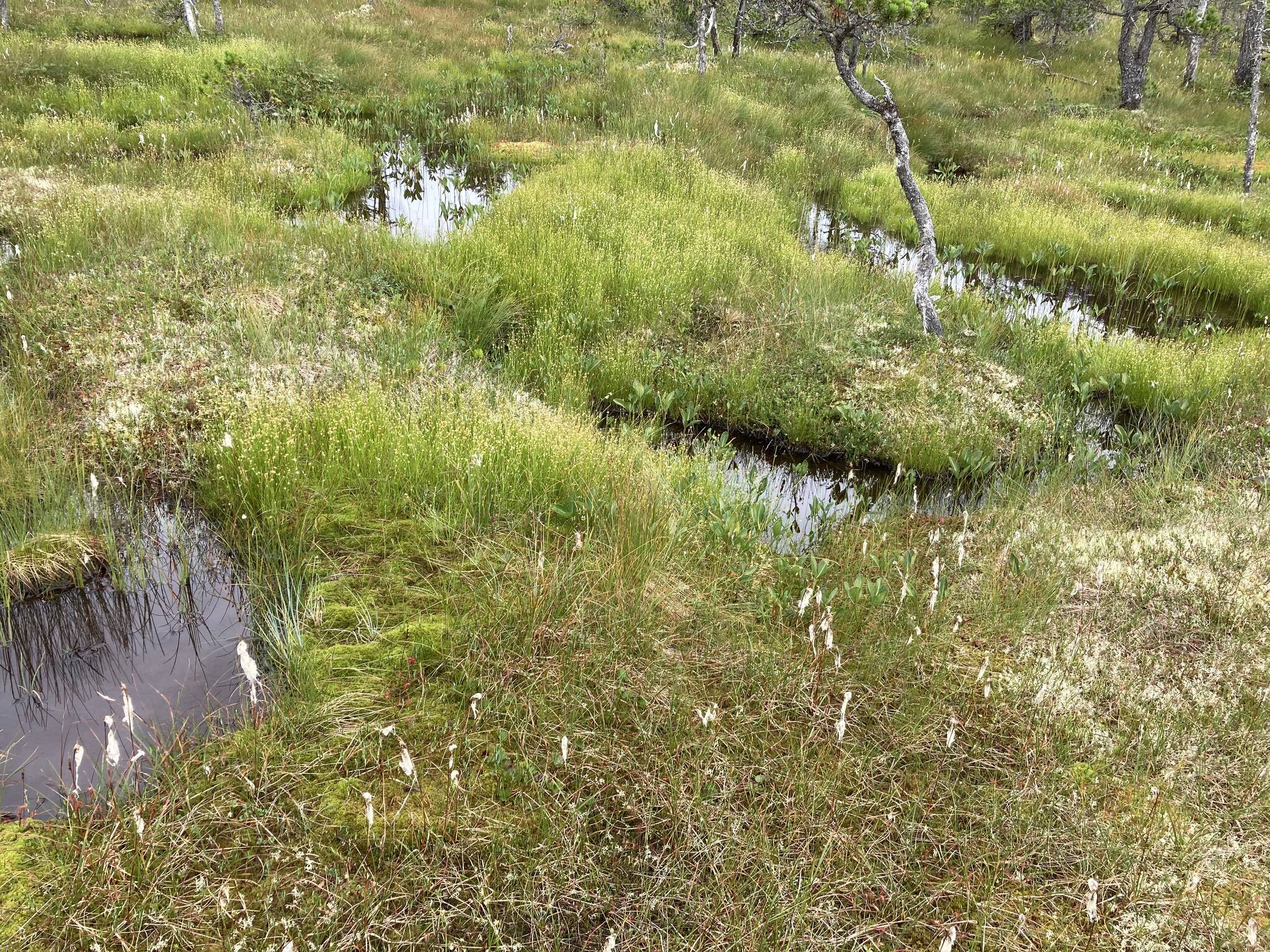
The bright green of few-flowered sedge enlivens the tapestry of other vegetation in the meadow.
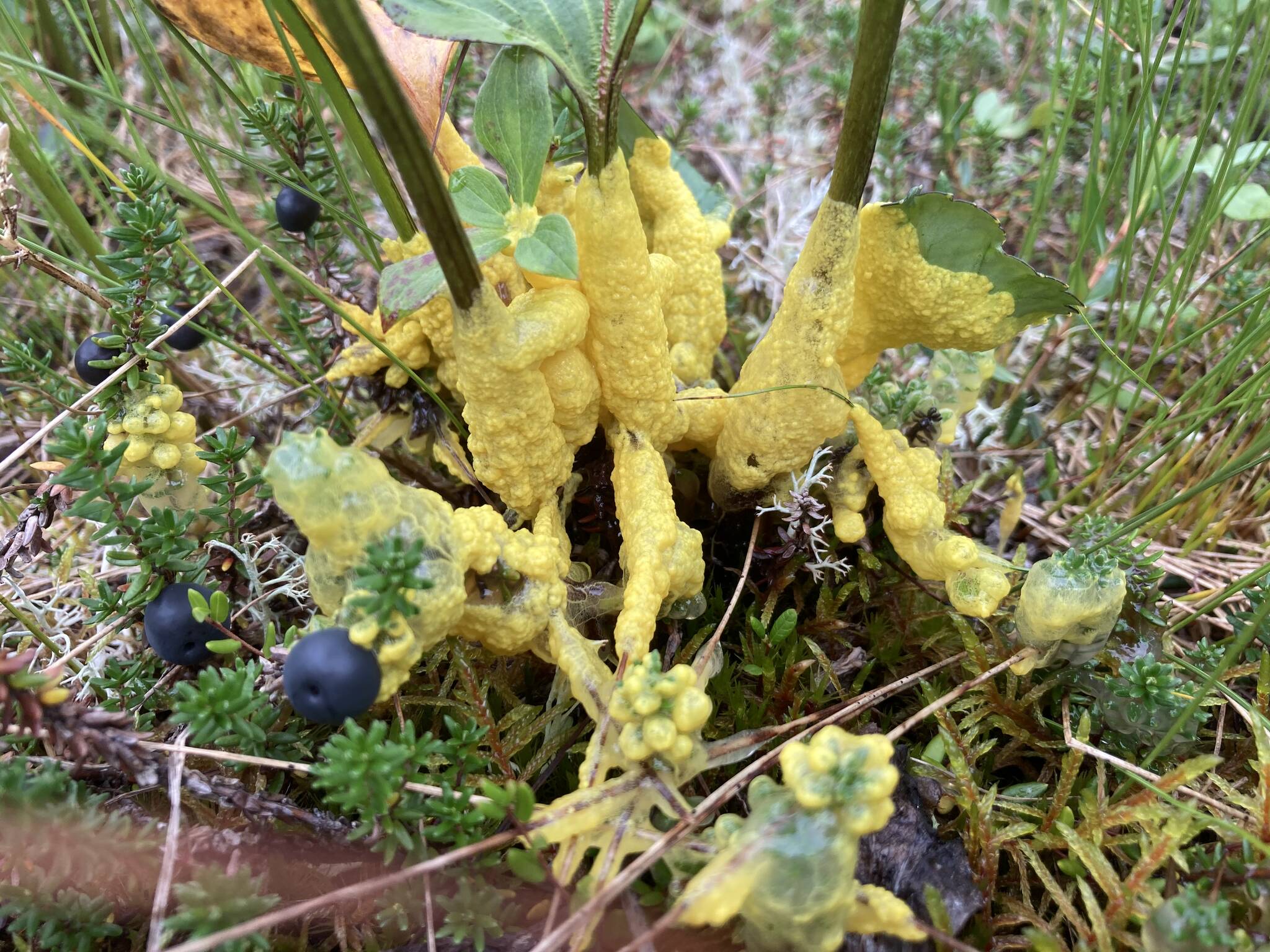
One area of the meadow featured bright yellow spots among the bases of various plants. This turned out to be a slime mold, fresh and in its prime. It spread itself over the mosses and up the stems of deer cabbage, sedges, and any other handy ladders. There are many kinds of slime molds, but I suspect that this one is a coming-together of many cells that lived independently for most of their lives, and joined up when a mysterious signal went out. This colorful gathering of cells will become the reproductive phase of the life cycle.
Sticky asphodel was fruiting and little green ‘looper’ caterpillars were investigating some of the capsules, apparently nibbling at the outside and contemplating a later dinner of seeds. Some of the sticky traps on the stems still held tiny insects, being digested by enzymes in the traps
Water striders skittered over many of the ponds. In the top of a stand of shore pines, a mixed flock of chickadees and juncos flitted rapidly from one clump of needles to another, conversing continually, and the chickadees performing their usual acrobatics as they probed among the needles. Down below, some Wilson’s warblers foraged for insects on blueberry and elderberry leaves.
A specific goal of this visit was finding a small aquatic plant (Scheuchzeria palustris) that we’d seen in previous years. It’s sometimes called Rannoch-rush (for a Scottish moor where it occurs) or, more prosaically, pod-grass (but it is not a grass). It is the only member of its taxonomic family in North America. We’ve never managed to find it in the flowering stage, but in fruit it is fairly easy to spot. In the main meadow, on this day, we finally found two skimpy little specimens hiding at the edge of a pond. Then, as we came down the hill on the brushy side trail through a string of small meadows, we stumbled on a good stand of Rannoch-rush—dozens of small plants in fruit. Success! Apparently, rather little study has been made of its life history details. The flower is said to have sepals that look like petals, making a six-rayed flower, the pollen is dispersed in ‘dyads’ (two grains together), and some insect eats the seeds in certain regions. But the possible pollinators and the mode of seed dispersal appear to be unrecorded. The narrow leaves have a pore at the end, for some reason. There is much to be learned about this plant.
Near the end of that brushy side trail, we also found a good population of what is variously called pumpkinberry or timberberry or false toadflax or bastard toadflax (Geocaulon lividum); some of the stems bore a single orange fruit. This odd plant is a hemiparasite, tapping into the roots of many other plants in addition to photosynthesizing some of its own carbohydrates.
• Mary F. Willson is a retired professor of ecology. “On the Trails” appears every Wednesday in the Juneau Empire.
