
HAVANA — In a stunning diplomatic display, U.S. President Barack Obama and Cuban President Raul Castro tussled in the Cuban capital Monday over human rights, democracy and the U.S. trade embargo as an American leader visited for the first time in decades.
Castro, who rarely takes questions from the media, fielded several from American and Cuban journalists, denying knowledge of any political prisoners. He rejected criticism of Cuba’s human rights record, pointing to the nation’s health care and education for all.
Obama, midway through his history-making trip, succeeded in getting Cuba’s leader to submit to questioning, a routine occurrence for U.S. presidents but an anomaly in a country that tightly controls media. Castro’s answers were far from forthcoming. Yet the mere occurrence of the news conference was an extraordinary sight for Cubans and those hoping the communist island will change its ways.
Asked by an American television reporter about political prisoners in Cuba, Castro seemed oblivious, first saying he couldn’t hear the question, then asking whether it was directed to him or Obama. Eventually he pushed back, saying if the journalist could offer up names of anyone allegedly imprisoned, “they will be released before tonight ends.”
“What political prisoners? Give me a name or names,” Castro said defiantly as Cuban citizens watched on state television. He added later, “It’s not correct to ask me about political prisoners in general.”
After responding to a handful of questions, Castro ended the news conference abruptly, declaring, “I think this is enough.”
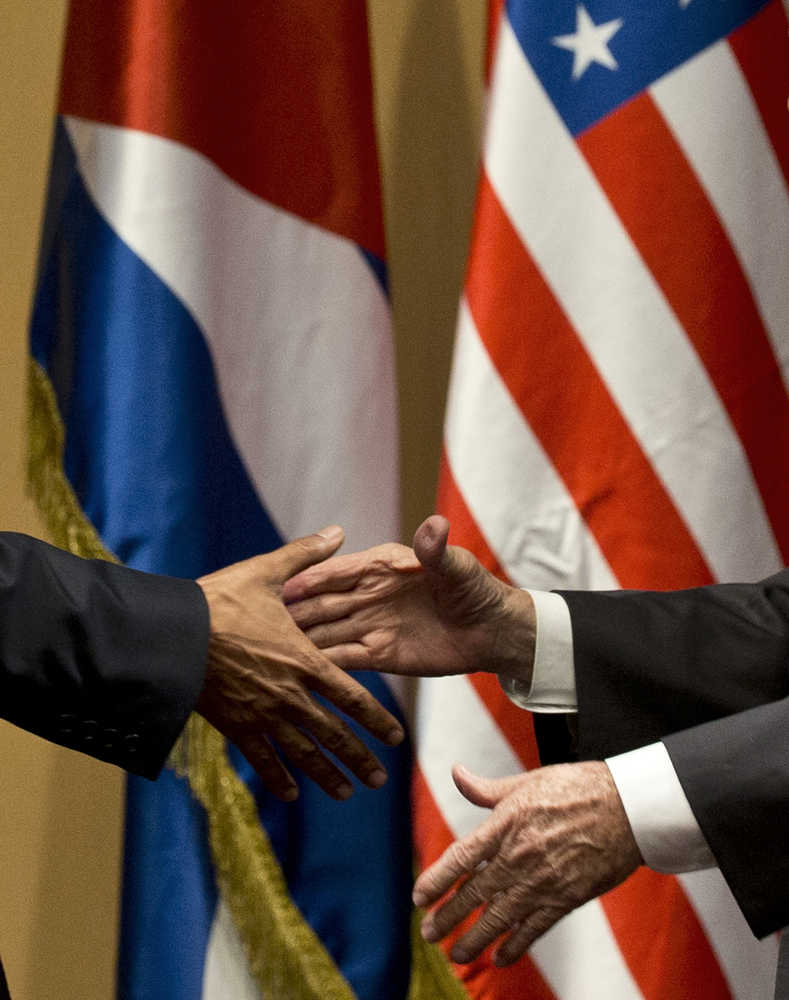
Obama then leaned in toward Castro, perhaps to pat him on the back. But in an awkward misfire, the Cuban leader tried to seize Obama’s arm triumphantly and ended up holding it in the air as Obama’s wrist dangled, a moment that immediately ricocheted on social media.
Criticized for briefly detaining demonstrators thousands of times a year, Cuba has drastically reduced its practice of handing down long prison sentences for crimes human rights groups consider political. Amnesty International said in a recent report that it knew of no prisoners of conscience in Cuba.
It’s extremely rare for Raul Castro to preside over a formal news conference, although he has sometimes taken reporters’ questions when the mood strikes. The White House worked hard to get him to agree.
“This is pure history, and I never thought I’d see something like this,” said Marlene Pino, a 47-year-old engineer in Havana. Added Ricardo Herrera, a street food vendor, “It’s like a movie, but based on real life.”
Obama, speaking earlier alongside Castro at the Palace of the Revolution, declared “a new day” for the U.S. and Cuba, which were estranged for half a century until he and Castro pursued a diplomatic thaw 15 months ago. Both men pledged to keep working toward a new path forward between their two countries, putting the onus on each other to take needed steps to clear the way.
Castro praised Obama’s recent steps to relax controls on Cuba but demanded more. He called anew for the U.S. to return its naval base at Guantanamo Bay to Cuba and to lift the U.S. trade embargo.
“The most recent measures adopted by his administration are positive but insufficient,” Castro said. Obama has eased travel restrictions and lifted a ban on Cuba’s access to the global financial system, but the sanctions remain an onerous challenge for Cuba’s economy and a hated symbol of U.S. efforts to squeeze the island 90 miles south of Florida.
Obama said he had been aggressive in rolling back what restrictions he can — moves that have triggered outrage among some Cuban-Americans who oppose a softer U.S. approach. Still, he said he’d look for more ways to ease the limits during his final months in office.
“The embargo’s going to end,” said Obama, who has tried but failed to get Congress to repeal it. “When, I cannot be entirely sure, but I believe it will end.”
Yet for all the talk about bread-and-butter issues, it was the astonishing sight of a Cuban and American leader taking questions together that promised to be an enduring image of Obama’s trip.
Since succeeding his brother Fidel in 2008, Castro has orchestrated economic and social reforms with broad-based impact, though to many Cubans and foreigners, they appear slow to materialize. Hundreds of thousands of Cubans can now pursue free enterprise, and restrictions on cellphones and Internet have been eased.
Yet Castro has given little ground when it comes to changing Cuba’s single-party system or easing strict limits on media, assembly and political dissent. His government has also repeatedly chided Obama for saying he wanted to empower Cubans.
Obama said he and Castro had spoken openly about U.S. concerns over Cuba’s human rights record, calling such delicate discussions a prerequisite to truly normalizing relations.
“This is something that we are going to stay on,” Obama said, adding that if the two countries could make progress on the issue, their relationship could blossom. “In the absence of that, I think it will continue to be a very powerful irritant.”
• Associated Press writers Julie Pace, Michael Weissenstein, Andrea Rodriguez and Peter Orsi contributed to this report.
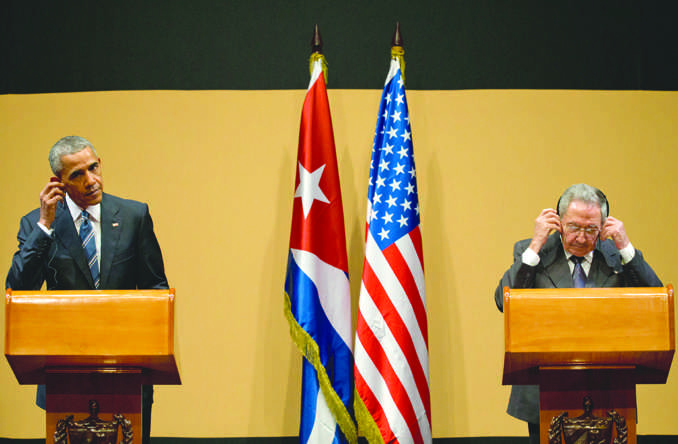
US President Barack Obama, left, and Cuba’s President Raul Castro use their headphones for translation during a press conference following a joint statement in Havana, Cuba, Monday, March 21, 2016. (AP Photo/Ramon Espinosa)
