
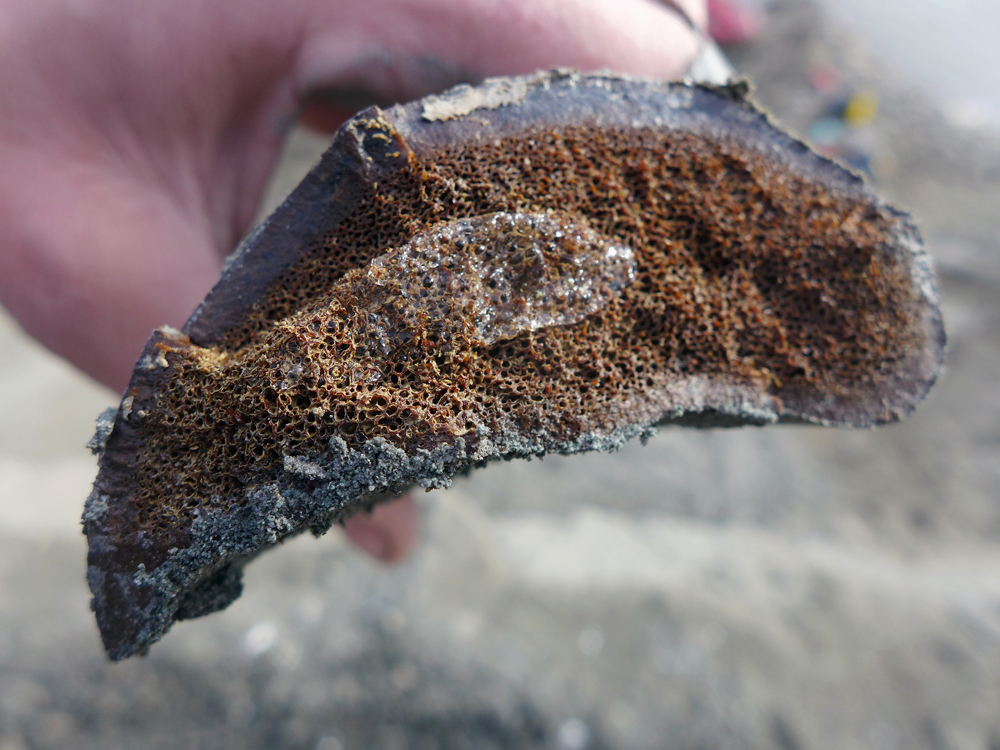
In this 2014 photo released by the University of Alaska Museum of the North, a sample of frozen bone is seen after researchers excavated it from the Liscomb Bed in the Prince Creek Formation near Nuiqsut. Researchers at the University of Alaska Fairbanks have found a third distinct dinosaur species documented on Alaska's oil-rich North Slope. The new species is a type of hadrosaur, a duck-billed plant-eater.

In this 2014 photo released by the University of Alaska Museum of the North, a sample of frozen bone is seen after researchers excavated it from the Liscomb Bed in the Prince Creek Formation near Nuiqsut. Researchers at the University of Alaska Fairbanks have found a third distinct dinosaur species documented on Alaska's oil-rich North Slope. The new species is a type of hadrosaur, a duck-billed plant-eater.

New duck-billed dinosaur found in Alaska, researchers say

ANCHORAGE — Researchers have uncovered a new species of plant-eating dinosaur in Alaska, according to a report published Tuesday.

The animal was a variety of hadrosaur, a duck-billed dinosaur that roamed in herds, said Pat Druckenmiller, earth sciences curator at the University of Alaska Museum in Fairbanks.

Northern Alaska likely was once covered by forest in a warmer climate. The dinosaur lived in darkness for months and probably experienced snow, researchers said.

The fossils were found in rock deposited 69 million years ago.

For at least 25 years, the fossils were lumped in with another hadrosaur, Edmontosaurus, a species well-known in Canada and the U.S., including Montana and South Dakota. The formal study of the Alaska dinosaur revealed differences in skull and mouth features that made it a different species, Druckenmiller said.

The differences were not immediately apparent because the Alaska dinosaurs were juveniles. Researchers teased out differences in the Alaska fossils, Druckenmiller said, by plotting growth trajectories and by comparing them with juvenile Edmontosaurus bones.

Researchers have dubbed the creature Ugrunaaluk kuukpikensis (oo-GROO’-nah-luk KOOK’-pik-en-sis). The name means “ancient grazer” and was chosen by scientists with assistance from speakers of Inupiaq, the language of Alaska Inupiat Eskimos.

The dinosaurs grew up to 30 feet long. Hundreds of teeth helped them chew coarse vegetation, researchers said. They probably walked primarily on their hind legs but could walk on four legs, Druckenmiller said.

Most of the fossils were found in the Prince Creek Formation of the Liscomb Bone Bed along the Colville River, more than 300 miles northwest of Fairbanks. The bed is named for geologist Robert Liscomb, who found the first dinosaur bones in Alaska in 1961 while mapping for Shell Oil Co.

Museum scientists have excavated and catalogued more than 6,000 bones from the species, more than any other Alaska dinosaur. Most were small juveniles estimated to have been about 9 feet long and 3 feet tall at the hips.

“It appears that a herd of young animals was killed suddenly, wiping out mostly one similar-aged population to create this deposit,” Druckenmiller said.

UA Fairbanks graduate student Hirotsugu Mori completed his doctoral work on the species. Florida State University researcher Gregory Erickson, who specializes in using bone and tooth histology to interpret the paleobiology of dinosaurs, also was part of the study. They published their findings in the “Acta Palaeontologica Polonica,” an international paleontology quarterly journal.

Researchers are working to name other Alaska dinosaurs.

“We know that there’s at least 12 to 13 distinct species of dinosaurs on the North Slope in northern Alaska,” he said. “But not all of the material we find is adequate enough to actually name a new species.”
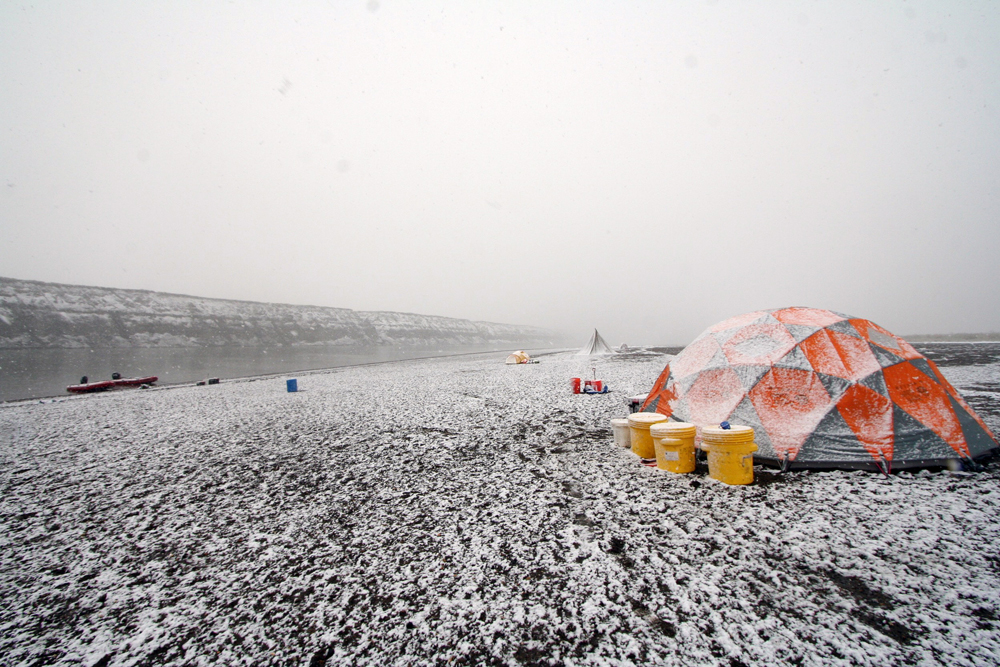
The campsite for researchers is seen at the dig site along the Colville River near Nuiqsut in 2014. Researchers at the University of Alaska Fairbanks have found a third distinct dinosaur species documented on Alaska's oil-rich North Slope. The new species is a type of hadrosaur, a duck-billed plant-eater.

The campsite for researchers is seen at the dig site along the Colville River near Nuiqsut in 2014. Researchers at the University of Alaska Fairbanks have found a third distinct dinosaur species documented on Alaska’s oil-rich North Slope. The new species is a type of hadrosaur, a duck-billed plant-eater.

More in News

Sen. Jesse Bjorkman, R-Nikiski, speaks Wednesday, April 23, 2025, on the floor of the Alaska Senate. (Photo by James Brooks/Alaska Beacon)
State senators express skepticism about proposed Juneau ferry terminal backed by Dunleavy

In a Friday hearing, members of the Alaska Senate spoke critically about… Continue reading

SouthEast Alaska Regional Health Consortium is one of the primary health care providers in Juneau, accepting most major public and private insurance plans. (Mari Kanagy / Juneau Empire)
Marketplace health premiums set to rise in 2026

Here’s what you need to know about how coverage is changing, and for whom.

Capital City Fire/Rescue completes last season’s ice break rescue training at the float pond near Juneau International Airport. (photo courtesy of Capital City Fire/Rescue)
On thin ice: Fire department responds to season’s first rescue at Mendenhall Lake

This week’s single digit temperatures have prompted dangerous ice ventures.

Brenda Schwartz-Yeager gestures to her artwork on display at Annie Kaill’s Gallery Gifts and Framing during the 2025 Gallery Walk on Friday, Dec. 5. (Mari Kanagy / Juneau Empire)
Alaska artist splashes nautical charts with sea life

Gallery Walk draws crowds to downtown studios and shops.

A totem pole, one of 13 on downtown’s Totem Pole Trail in Juneau, Alaska, Nov. 27, 2024. (Christopher S. Miller/The New York Times)
Downtown Juneau experiences its first significant city-level snow fall of the season as pictured on Saturday, Dec. 6, 2025. (Mari Kanagy / Juneau Empire)
Sub-zero temperatures to follow record snowfall in Juneau

The National Weather Service warns of dangerous wind chills as low as -15 degrees early this week.

A truck rumbles down a road at the Greens Creek mine. The mining industry offers some of Juneau’s highest paying jobs, according to Juneau Economic Development’s 2025 Economic Indicator’s Report. (Hecla Greens Creek Mine photo)
Juneau’s economic picture: Strong industries, shrinking population

JEDC’s 2025 Economic Indicators Report is out.

Most Read