
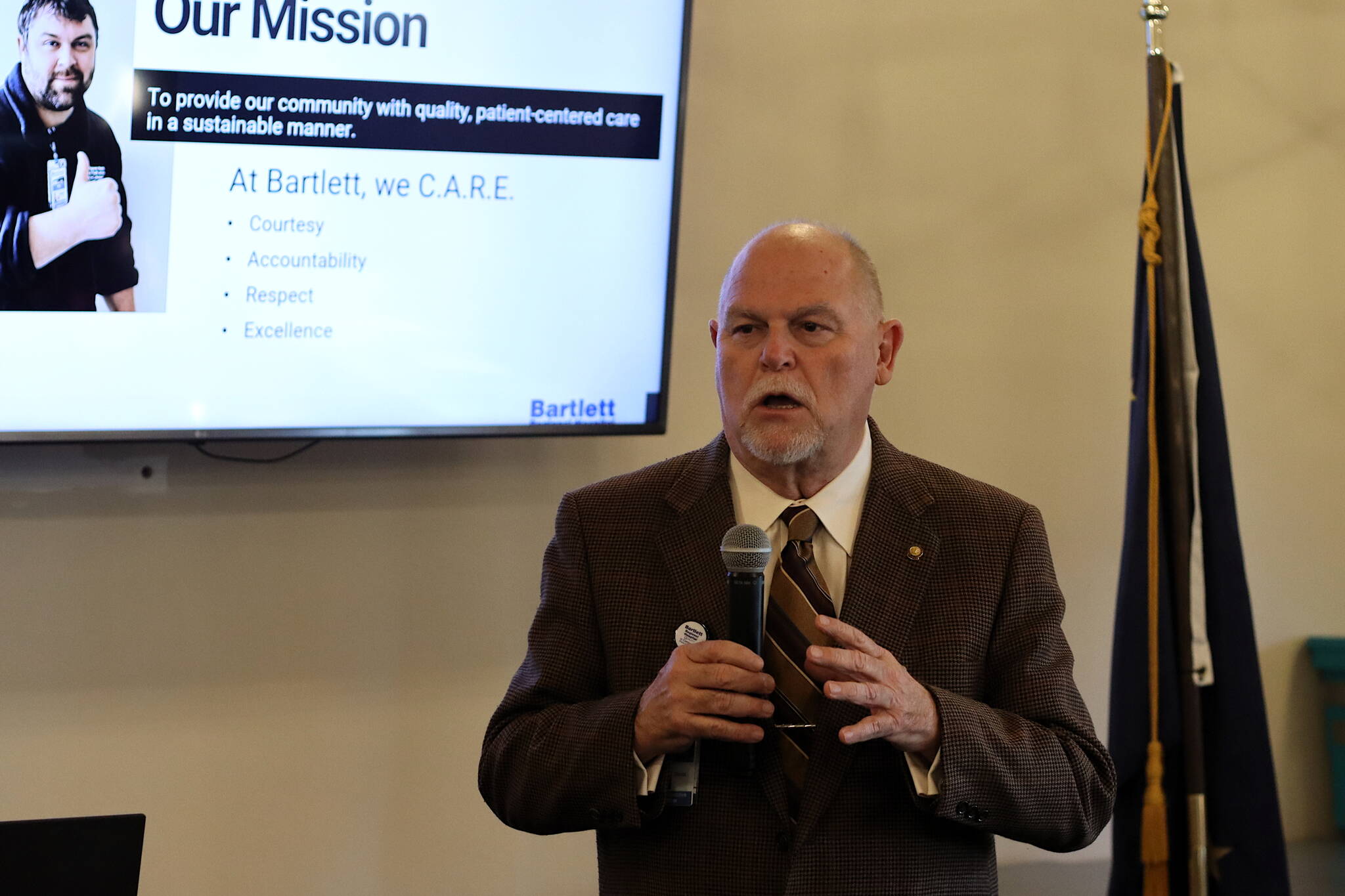
David Keith’s been in charge of Bartlett Regional Hospital for slightly more than 100 days, and is already facing dire issues involving local residents at the beginning and end of their adult lives.
Giving younger residents sufficient incentive to pursue health care careers locally and restoring hospice services that vanished last month were among the most prominent topics discussed by Keith during a presentation and question period at the Juneau Chamber of Commerce’s weekly luncheon. Keith became Bartlett’s chief executive officer in August following a turbulent two-year period for the hospital’s leadership when several CEOs and other top officials cycled through.
Those problems were absent from Thursday’s discussion as Keith focused on different struggles Bartlett is sharing with many other hospitals resulting from the COVID-19 pandemic. Most involve financial and employee issues, since a shortage of qualified providers and nurses makes enticing and sufficiently paying people to work in a small relatively remote place like Juneau heightens the nationwide dilemma.
“There’s not an Alaska hospital I’m aware of today that’s in the black,” Keith said. “They’re still in the red despite all those COVID dollars. In the last four months we’ve lost a few million dollars, but we’re moving in the right direction.”
One audience member asked if the hospital is still using traveling nurses — who generally earn considerably more and stay short periods of time compared to permanent staff — while another person asked why younger residents interested in the profession would remain here instead of “being a traveler and making twice as much.”
Keith said “the whole country is using rental nurses” out of necessity, but he is involved with efforts to recruit local health care students through efforts including an analysis of if the hospital’s salaries are competitive and collaborating with city officials on ways to provide affordable housing.
“It’s one thing to recruit,” he said. “It’s more important to retain.”
In addition to competitive pay and appealing living situations, Keith said ensuring Bartlett has equipment that allows providers to provide care to the best of their abilities is essential.
“I talked to a young surgeon asking if we have robotics,” he said. “We’re in the process of considering that…We need to make sure they get paid well, they get treated well and you give them the resources they need to do their jobs well.”
Also being sought by Keith is change at the legislative level, including allowing nurses who are certified in other states to be automatically certified in Alaska. About 40 states have such reciprocity agreements, but opponents including many health care labor organizations argue such policies can result in lower levels of care if people from states with low qualification standards are hired.
Juneau’s staffing and fiscal shortages recently resulted in the loss of the hospice and home care program operated for the past 20 years by Catholic Community Service. Bartlett officials immediately began working on a plan to transition those services after the shutdown occurred in October, including applying for the necessary state licenses, Keith said.
“These are critical services and we’ve lost that, but only temporarily and we’re going to pick that back up,” he said, adding in response to a question “I’m hopeful within 60 to 90 days you will see real evidence of home health and hospice in the community.”
Other auxiliary services such as telemedicine and a new behavioral health center being developed were mentioned by Keith as ways Bartlett is seeking both to maximize the use of its main hospital space while providing a broader range of care options people are seeking.
“The days of hospitals getting bigger and bigger and bigger is going by the wayside,” he said, adding “We know it’s very difficult to come to a crowded campus and feel a great patient experience.”
Keith, a former top administrator at Alaska Native Tribal Health Consortium/Alaska Native Medical Center and Providence Alaska Medical Center, was most recently CEO at McAlester Regional Health Center in Oklahoma. He said the hospital was weeks from insolvency when he began the job in 2011, but prior to the pandemic the facility was able to vastly expand its offerings and physical space during his tenure.
“The bottom line is this: We’re in way better shape than that hospital was then,” he said. “We have great local leadership, we have a strong board and my feeling is we’ll get out of the bump that we’re in.”
• Contact reporter Mark Sabbatini at mark.sabbatini@juneauempire.com
