
WASHINGTON — In an announcement that electrified the world of physics, scientists said Thursday that they have finally detected gravitational waves, the ripples in the fabric of space-time that Einstein predicted a century ago.
Astronomers hailed the finding as an achievement of historic proportions, one that opens the door to a new way of observing the universe and the violent collisions that are constantly shaping it. For them, it’s like turning a silent movie into a talkie because these waves are the soundtrack of the cosmos in action.
“Until this moment, we had our eyes on the sky and we couldn’t hear the music,” said Columbia University astrophysicist Szabolcs Marka, a member of the discovery team. “The skies will never be the same.”
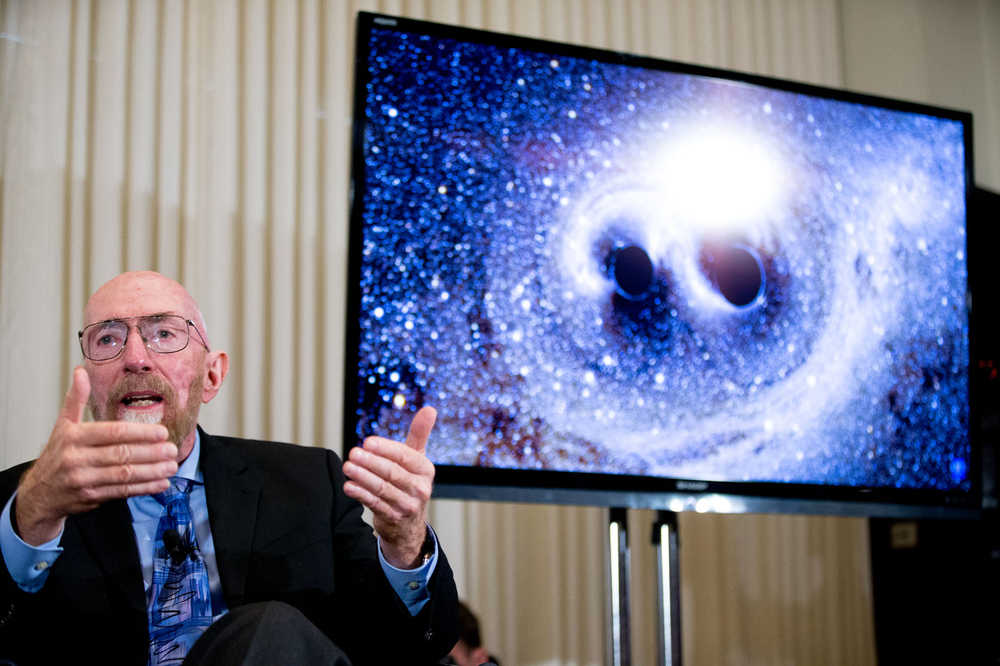
An all-star international team of astrophysicists used an exquisitely sensitive, $1.1 billion set of twin instruments known as the Laser Interferometer Gravitational-wave Observatory, or LIGO, to detect a gravitational wave generated by the collision of two black holes 1.3 billion light-years from Earth.
“Einstein would be beaming,” said National Science Foundation director France Cordova.
The LIGO control room is set up so that data comes in in audio form and scientists can listen by headphones. In this case, the evidence consisted of a single, faint chirp — or perhaps more accurately, a thud — that was picked on Sept. 14.
“That’s the chirp we’ve been looking for,” said Louisiana State University physicist Gabriela Gonzalez, scientific spokeswoman for the LIGO team. Scientists said they hope to have a greatest hits compilation of the universe in a decade or so.
Some physicists said the finding is as big a deal as the 2012 discovery of the subatomic Higgs boson, known as the “God particle.” Some said this is bigger.
“It’s really comparable only to Galileo taking up the telescope and looking at the planets,” said Penn State physics theorist Abhay Ashtekar, who wasn’t part of the discovery team.
Physicist Stephen Hawking congratulated the LIGO team, telling the BBC: “Gravitational waves provide a completely new way of looking at the universe. The ability to detect them has the potential to revolutionize astronomy.”
Gravitational waves, first postulated by Albert Einstein in 1916 as part of his theory of general relativity, are extraordinarily faint ripples in space-time, the continuum that combines both time and three-dimensional space.
When massive objects like black holes or neutron stars collide, they send gravitational waves across the universe, stretching space-time or causing it to bunch up like a fishing net.
Scientists found indirect proof of gravitational waves in the 1970s by studying the orbits of two colliding stars, and the work was honored as part of the 1993 Nobel Prize in physics. But now scientists can say they have actually detected a gravitational wave.
“It’s one thing to know soundwaves exist, but it’s another to actually hear Beethoven’s Fifth Symphony,” said Marc Kamionkowski, a physicist at Johns Hopkins University who wasn’t part of the discovery team. “In this case, we’re actually getting to hear black holes merging.”
In this case, the crashing of the two black holes stretched and squished Earth so that it was “jiggling like Jell-O,” but in a tiny, almost imperceptible way, said David Reitze, LIGO’s executive director.
The dual LIGO detectors went off just before 5 a.m. in Louisiana and emails started flying. “I went, ‘Holy moly,’” Reitze said.
But the finding had to be tested and verified, using even conventional telescopes, before the scientists could say with confidence that it was a gravitational wave. They concluded there was less than a 1-in-3.5-million chance they were wrong, he said.
LIGO technically wasn’t even operating in full science mode; it was still in the testing phase when the signal came through, Reitze said.
“We were surprised, BOOM, right out of the box, we get one,” Reitze said.
Reitze said that given how quickly they found their first wave, scientists expect to hear more of them, maybe even a few per month.
Detecting gravitational waves is so difficult that when Einstein theorized them, he figured scientists would never be able to hear them. In fact, the greatest scientific mind of the 20th century came to doubt himself in the 1930s and questioned whether such waves really do exist.
In 1979, the National Science Foundation decided to give money to the California Institute of Technology and the Massachusetts Institute of Technology to come up with a way to detect the waves.
Twenty years later, they started building two LIGO detectors in Hanford, Washington, and Livingston, Louisiana, and they were turned on in 2001. But after years with no luck, scientists realized they had to build a much more sensitive system, which was turned on last September.
Sensitivity is crucial because the stretching and squeezing of space-time by gravitational waves is incredibly tiny. Essentially, LIGO detects waves that pull and compress the entire Milky Way galaxy “by the width of your thumb,” said team member Chad Hanna of Pennsylvania State University.
Each LIGO has two giant perpendicular arms more than 2 miles long. A laser beam is split and travels both arms, bouncing off mirrors to return to the arms’ intersection. Gravitational waves stretch the arms to create an incredibly tiny mismatch — smaller than a subatomic particle — in the beams’ signature wave curves. That mismatch is what LIGO detects.
A giant team of scientists had to keep the discovery secret until it was time to be announced. The study detailing the research in the journal Physical Review Letters had 1,004 authors.
Kip Thorne, the Cal Tech physicist who co-founded LIGO and has been working on gravitational waves for more than half a century, said he kept the secret even from his wife until just a few days ago. When he heard about the wave, he said, “it was just sort of a sigh of happiness.”
___
Online:
LIGO: https://www.ligo.caltech.edu/
National Science Foundation’s video Einstein’s Messengers: http://www.nsf.gov/news/mmg/mmg_disp.jsp?med_id=58443
___
Follow Seth Borenstein at http://twitter.com/borenbears and his work can be found at http://bigstory.ap.org/content/seth-borenstein
