
This story has been updated with additional details
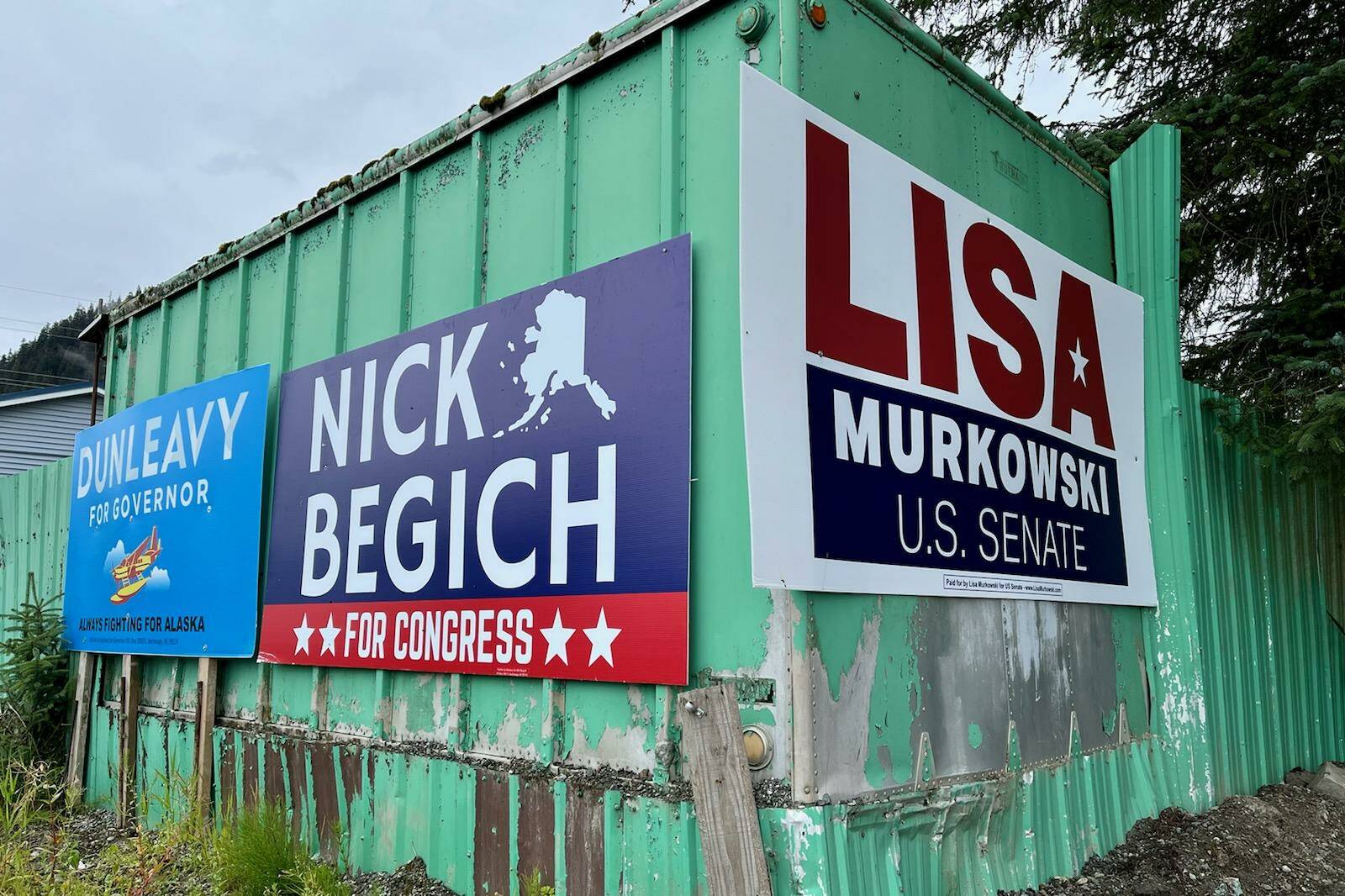
Incumbent Lisa Murkowski has a dominant fundraising advantage over challenger Kelly Tshibaka in the U.S. Senate race, and Nick Begich III enjoys a big cash advantage despite raising the least of the three main contenders in the U.S. House race, according to the most recent Federal Election Commission reports.
A total of about $4 million was raised on Murkowski’s behalf by her campaign ($1.6 million) and the political action committee Alaskans for L.I.S.A. ($2.4 million) during the three-month quarter ending June 30, and she now has $6.1 million in her campaign account. Tshibaka’s campaign reported raising $587,000 and she has $1.1 million in her account, with a supporting PAC (Alaska First) reporting $300 raised during the quarter.
The totals are consistent with reports showing all five nationwide congressional incumbents out-raising challenges backed by former President Donald Trump. The totals for the quarter ending June 30, with a filing deadline of July 15, do not include any activity following Trump’s rally in Anchorage on July 9 when he appeared with Tshibaka and former Gov. Sarah Palin to offer support.
Democratic Senate candidate Pat Chesbro, who entered the race in May, reported raising slightly less than $38,000, including $7,400 from herself, spending $21,000 and having about $16,000 cash-on-hand.
Palin led the House candidates with $203,000 raised during the period between May 23 and June 30 — the shorter period representing the timespan between the last reporting period before the special primary election. Democratic candidate Mary Peltola raised $161,000, and Republican candidate Begich $82,000.
But the cash-on-hand numbers for the three candidates are a mirror image, with Begich reporting $708,000 in the bank due primarily to loaning his campaign $650,000 earlier in the race, Peltola $115,000 (and $10,000 in debt), and Palin about $95,000 (and $40,000 in debt).
The cash-on-hand is available leading up to the Aug. 16 vote when a ranked choice special election will determine which of the three House candidates fills the remainder of the late Don Young’s term, and the primary for the regular House and Senate races where the state’s new voting system will set up to the top-four candidates for the November ranked choice general election.
The deadline for in-state reports to the Alaska Public Offices Commission for the period Feb. 2-July 15 is Monday (July 18).
A few standout numbers from the two congressional races:
– $1.5 million of the $2.4 million raised by Alaskans for L.I.S.A. came from Kenneth Griffin, a hedge fund manager who has contributed millions to support Republican candidates and PACs nationwide. The biggest donors to Murkowski’s campaign were PACs supporting GOP candidates nationally including the Cornyn Victory Committee with more than $66,000 and the National Republican Senatorial Committee with $46,500.
— Tshibaka reports all but $1,000 of her second-quarter fundraising came from individual donors.
— Of the $203,000 raised by Palin, about $95,000 went to fees charged by four fundraising entities.
— A fourth major contender in the full-term House race, Republican Tara Sweeney, raised about $46,000 during the most recent filing period and has $48,500 cash on-hand. But the PAC Alaskans for T.A.R.A. raised $230,000, mostly from Alaska Native corporations and related contributors.
– Al Gross, an independent House candidate who unexpectedly dropped out after the special election primary, raised $160,000, of which $3,700 was refunded, with $67,000 currently in his campaign account.
Numerous other candidates are running in the House and Senate races, but none reported significant numbers.
Begich, in an interview Monday, offered a quality-over-quantity spin on his second-quarter fundraising figures.
“I raised more money from Alaskans than Sarah Palin by far,” he said, adding his campaign does not use “fundraising mills” such as those charging the fees incurred by her (although he does have an employee hired to send fundraising emails).
Peltola’s deputy campaign manager, Hector Jimenez, said she’s “running against two millionaires” and the most recent reporting period shows her raising money at a “respectable rate.” He said he doesn’t have specifics on how much Peltola’s fundraising rate increased once she become the lone Democratic candidate in the special election — and de facto candidate for the party in the regular election — but “we definitely saw an increase after the (special) primary.”
The politicial diversity of Murkowski’s individual donors was emphasized by Shea Siegert, communications director and a spokesperson for the campaign.
“This was the campaign’s strongest quarter, with support across Alaska,” he said.
As for the large donors by national organizations, he said that reflects part of Murkowski’s support across a broader political spectrum, and also stated the campaign is a legally separate entity from the Alaskans for L.I.S.A. PAC and donations it receives.
Tshibaka had made that broader-range a support and its implications on ranked choice voting a centerpiece of her campaign, noting polls showing she is clearly favored by in-state Republican voters and Murkowski only prevails in the final round of ranked-choice when Democratic candidate votes are added to her tally.
The Tshibaka and Palin campaigns did not respond to inquires Monday. There were also no news releases about the reports by the campaigns at their websites or the social media networks linked to them.
The campaign report deadline occurred a week after a survey showed Begich scoring a dominant win in the special and general elections, and Murkowski taking advantage of ranked choice voting to narrowly prevail over Tshibaka. But the poll also shows Palin and Begich in a tight race among Republican voters, with Peltola possibly prevailing over Palin if the two women are the final two in that race.
Begich, while declining to comment on specific campaign spending strategy before the special election, said “I’m quite sure we’ll be highly competitive” relative to the other candidates. He said being the short-term incumbent going into the general election should be an asset for whoever prevails, “but how much of an advantage that proves to be” is an unknown — and may be affected by whatever business the House does find time for during the peak of election season.
While Palin and Tshibaka were national newsmakers a week ago due to the Trump rally — with unknown impacts on their finances and polls — at the start of this week it’s Murkowski and Palin making headlines. Murkowski is featured in Politico for getting the support of numerous Democratic and Democratic-leaning independents in Congress, while Palin is singled out by The Daily Beast which reports one of her biggest business partners is an Arizona developer accused by a House committee of bribing Trump for a Grand Canyon project in 2019.
• Contact reporter Mark Sabbatini at mark.sabbatini@juneauempire.com.
