
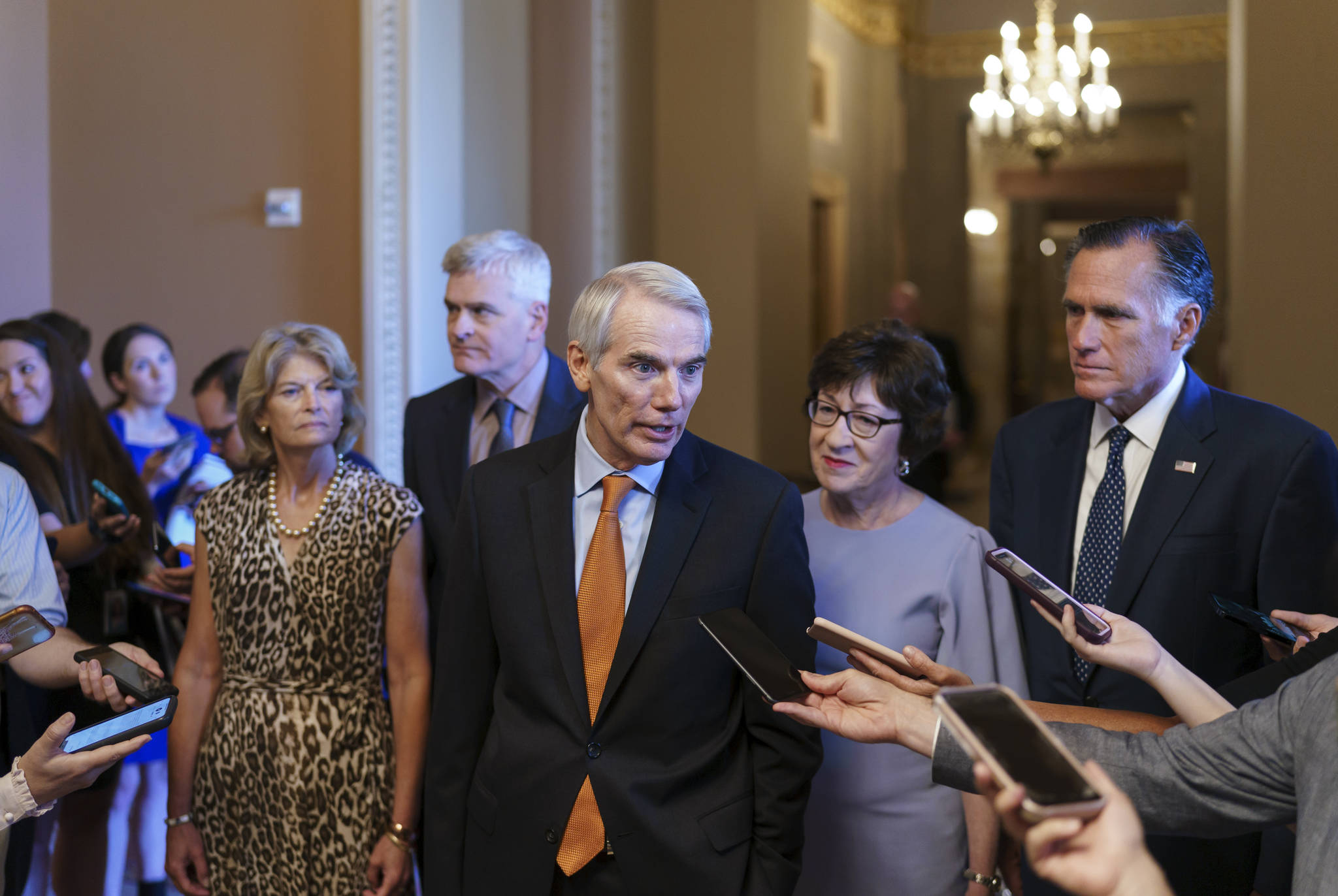
Alaska will be well taken care of if a massive infrastructure bill currently being crafted in the U.S. Senate passes Congress, Sen. Lisa Murkowski, R-Alaska, told reporters Thursday in a news conference with Alaskan media.
A bill being negotiated by a bipartisan group of senators, Murkowski among them, and President Joe Biden was taken up by the Senate Wednesday and contains roughly $1 trillion in investments for the nation’s infrastructure.
In a phone call from Washington, Murkowski told reporters the group had worked with the president to ensure roughly $550 billion for hard infrastructure such as roads, bridges and energy generation. Murkowski said the group wanted to focus on projects she referred to as legacy projects, projects like roads and power plants that will last for decades.
“This is a bipartisan deal. It is not necessarily good just for Republicans or just for Democrats, it is good for Americans,” Murkowski said, adding that she had worked hard to ensure Alaska’s specific infrastructure needs were met.
If the bill passes, Alaska will see funding for a variety of projects, but Murkowski said she made it clear to her colleagues that Alaska’s infrastructure was less traditional.
“Many of us come from places where you don’t necessarily connect by land, but you connect by water,” she said. “Ferry systems are recognized in the bill.”
The bill includes funding for traditional infrastructure such as roads and water systems but there’s a significant investment in the expansion of broadband internet and an emphasis on electric vehicles, Murkowski said. There are also specific carve-outs to help tribal governments bolster infrastructure for rural Alaska.
[Constitution bars Alaska attorney general case, judge says]
According to Murkowski, the bill also includes an accelerated permitting process for projects in certain areas including the Tongass National Forest, and that mining for critical resources would be a priority under the bill. The accelerated permitting did not mean taking shortcuts, Murkowski said, but was meant to provide certainty for companies who often spend significant time and money on the permitting process.
The bill still has a long way to go, but Murkowski said the bill is an indication of the importance of the funding and the willingness of lawmakers to work together. The bill will be taken up in Senate committees before being sent to the floor for a vote. The bill could change significantly in that time as items can be removed and added through amendments.
Even if the bill does pass the Senate, it must then go to the U.S. House of Representatives where some in the Democratic majority are pursuing a much more expansive bill. Murkowski said she and other lawmakers wanted to make sure the infrastructure bill was fiscally responsible. Some Democratic lawmakers have proposed an infrastructure bill worth upward of $3.5 trillion, an amount Murkowski called “reckless.”
The Senate bill contains funding for repairing and improving existing infrastructure, creating new infrastructure and cleaning up environmental damage left by industry. Funding for clean up at the state’s airports for per- and polyfluoroalkyl substances, otherwise known as PFAS chemicals is in the bill, according to Murkowski, as is funding for orphaned wells on Alaska’s North Slope.
Nationally, the bill would provide $39 billion for public transit; $7.5 billion for electric vehicle charging stations; $55 billion for wastewater infrastructure and $73 billion for modernizing electrical grids, according to the Associated Press.
Murkowski called the bill, “pretty historic,” and said there hadn’t been this much attention paid to the country’s infrastructure in decades.
Biden has been aggressively pushing for infrastructure investment at a level not seen since the New Deal in the 1930s, according to AP. Many New Deal programs remain in existence today including the Social Security Administration, the Federal Deposit Insurance Corporation and the Federal Housing Authority. The New Deal also created the Tennessee Valley Authority, which for the first time brought electricity to many parts of the South and still exists today.
“This is important from a policy perspective,” Murkowski said. “But I think it is also important from the perspective of good governance and what it means from a process within the institution demonstrating we can work together in a positive way for the good of the whole.”
• Contact reporter Peter Segall at psegall@juneauempire.com. Follow him on Twitter at @SegallJnuEmpire.
