
Correction: An earlier version of this article incorrectly stated that Alaska Natives are currently allowed to harvest 280 bowhead whales annually. The number is actually 336 whales landed or 402 possible strikes, over a seven-year period, shared between 11 whaling communities. Please see details below.
Sea ice is breaking up faster every year in the Arctic, opening up the Northwest Passage and Northern Sea Route to increased vessel traffic.
While that’s good news for freight and tourism — vessel traffic is expected to become routine by the midcentury — it’s bad news for certain Arctic marine mammals, a study released Monday shows.
A study by University of Alaska Fairbanks and University of Washington researchers, published Monday in the Proceedings of the National Academy of Sciences, is the first to assess the vulnerability of seven marine mammal species that could encounter more vessels as the ice-free season expands in Arctic seas.
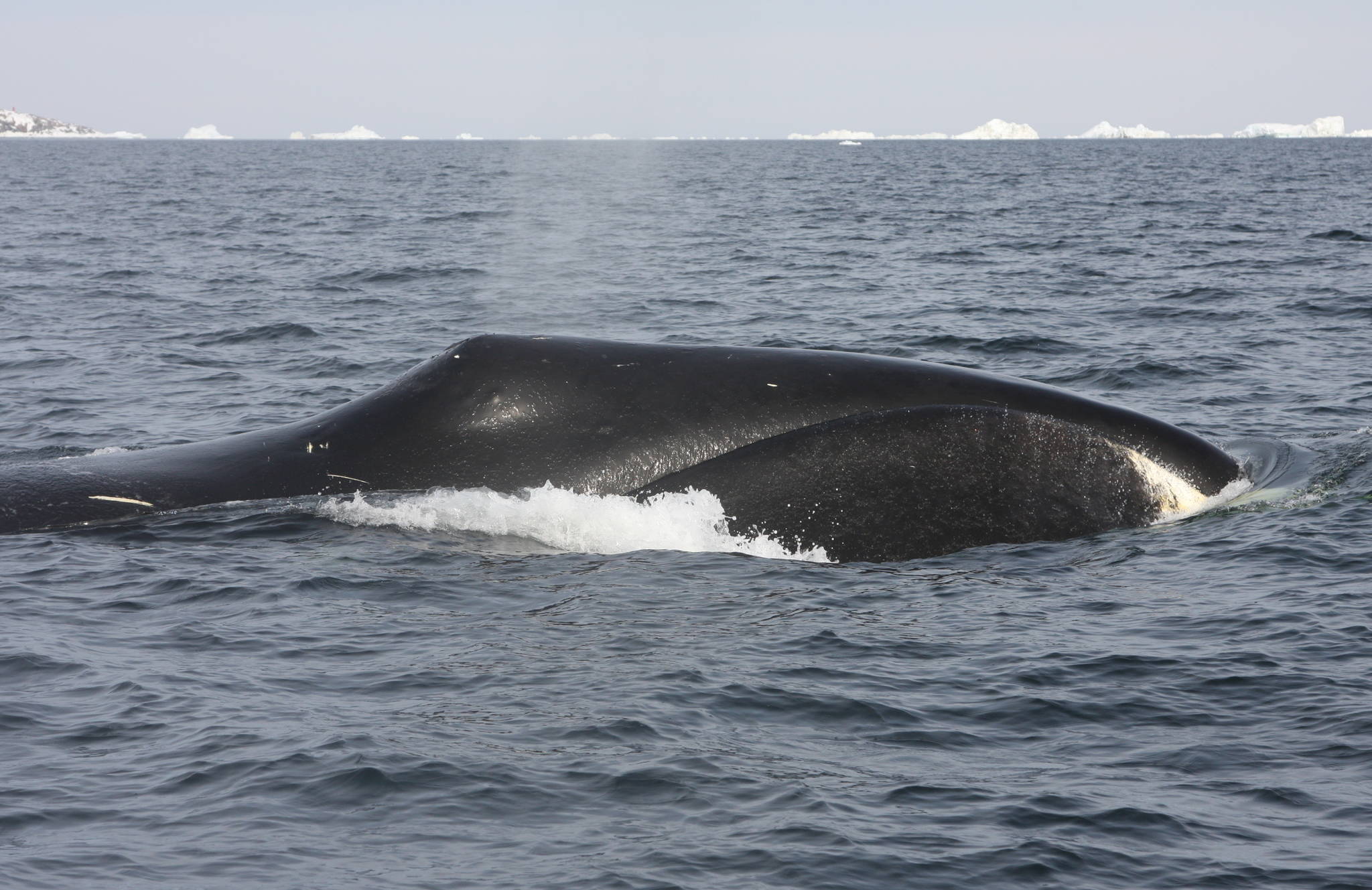
In Alaska, bowhead whales and marine mammals in the Bering Strait are particularly vulnerable to increased noise and strikings from vessel traffic, said lead author Donna Hauser in a Monday interview with the Empire.
“Our question was really, as sea ice is decreasing, there’re lots of projections that vessels are going to use these newly accessible sea routes. Therefore, the potential for conflict is there,” Hauser said.
The University of Alaska Fairbanks marine ecologist and her research partners looked at 80 subpopulations of seven species: beluga whale, polar bear, narwhal, ringed seal, bearded seal, walrus and bowhead whale. They scored each on a vulnerability index, using an established metric based on the animal’s exposure to vessel traffic, or how much their territory overlapped with shipping routes, and their sensitivity, or how much boats disturb the animals.
Overall, a subpopulation of narwhal in the Canadian Arctic scored highest on vulnerability index. They’re “smack dab” in the middle of the Northwest Passage, Hauser said.
Among Alaska populations, bowhead whale scored the highest. Alaska Natives have hunted bowhead whales for thousands of years and are allowed currently to harvest a small number of the whales annually. The Alaska Eskimo Whaling Commission six-year harvest quota for 2012-2018 sets a limit of 336 whales landed, or 402 possible strikes, shared between the 11 whaling communities that are members of the AEWC. There’s an annual limit of 67 strikes in any one year, 15 unused strikes can be transferred from previous years.
Increased vessel traffic could disrupt seasonal hunts, making it harder for Arctic villages to find the subsistence foods they depend on, Hauser said.
“These species are important traditional resources for indigenous communities throughout the Arctic, including much of coastal Alaska. … In this case, increased vessel traffic represents an additional factor that could not only affect Arctic marine mammals, but the people that rely on them,” Hauser said.
Polar bears scored relatively low, Hauser said, due largely to the fact that they spend more of their time on land than other species.
“In our study, we found that vessels do not pose the same risk to polar bears than they do to other species such as whales and narwhals,” Hauser said.
That’s not to say that polar bears aren’t experiencing the negative effects of sea-ice loss, Hauser added. Their study was seasonal, looking at the effect of increased vessel traffic during September, when sea-ice coverage is lowest in the Arctic. Earlier sea-ice breakup in the spring has negatively affected polar bears.
The study also assessed where vessels might have the greatest impact. The Bering Strait and southern Chukchi Sea are two “pinch points” for vessel traffic. Marine mammals there will be particularly vulnerable, Hauser said.
Commercial traffic through the Northwest Passage and Northern Sea Route, the two vessel routes looked at in the study, is expected to increase in coming years. The extent of sea ice during the month of September has decreased 14 percent every decade since 1979, according to the study, opening up the shipping season 5-10 weeks in all Arctic regions.
A cruise ship, the Crystal Serenity, became the first luxury vessel to transit the Northwest Passage in 2016, making the trip from Seward to New York City in 32 days.
“This is sort of this novel risk factor that we expect to increase. So we have sort of this unique opportunity to learn from experiences at lower latitudes and apply some of our lessons learned in this novel and unique, remote region,” Hauser said.
• Contact reporter Kevin Gullufsen at kgullufsen@juneauempire.com. Follow him on Twitter at @KevinGullufsen.
