
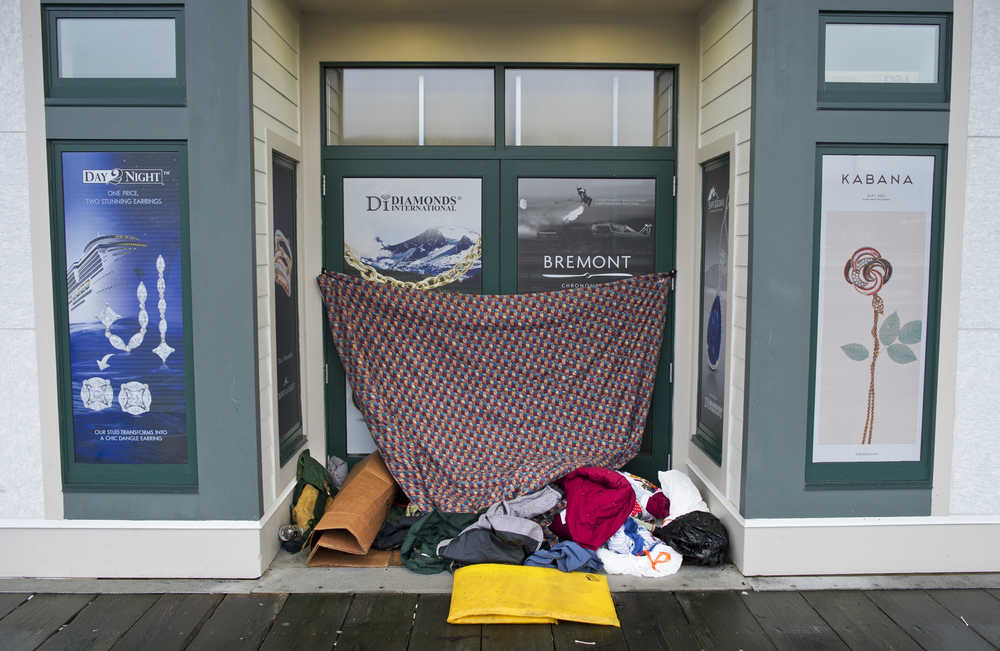
In a work session early next month the Juneau Assembly will begin work on an ordinance that — if passed in its current form — will make it harder to be homeless in the capital city.
As written, ordinance 2016-44, commonly referred to as the camping ordinance, would give police the ability to remove people spending the night in the entryways of businesses in Juneau’s downtown core.
“I can’t see how any business downtown hasn’t been negatively impacted by camping,” said Phil Wheeler, owner of the Alaskan Fudge Company. “People don’t want to come downtown because of it.”
According to Wheeler, the homeless people who camp in entryways are leaving garbage, blankets “and everything else” in front of businesses when they wake and move on. So far as Wheeler can tell, nobody is camping in front of his shop on South Franklin.
“If there are, they’re gone by the time I get there in the morning,” he said.
But he’s seen the signs at other downtown businesses, he explained; he passes campers every morning on the way to work.
Wheeler told the Empire on Wednesday that his business has suffered, and though he can’t pinpoint the reason, he believes camping has something to do with it. He and other business owners, such as Tanja Cadigan of Caribou Crossing, took the issue to Mayor Ken Koelsch in early December, prompting him to establish an “ad hoc committee on homelessness.”
City Attorney Amy Mead is quick to clarify that Koelsch’s “ad hoc committee” is, legally speaking, more of a “brainstorming session” than an actual committee. Whatever it is, it’s affecting city policy after two meetings.
“When you have a crisis, and I consider this a crisis, you need to get going on something,” Koelsch said in a phone interview Wednesday afternoon.
After his first meeting with the group — which comprises several city officials, a downtown police officer and a handful of downtown business owners — Koelsch directed Mead to draft the camping ordinance, which will head to the Assembly Chambers for a work session on Jan. 9. Only Koelsch and the city manager have the authority to direct city staff to draw up an ordinance without the backing of an empowered board or city government body.
The ins and outs
The city already prohibits camping in public rights of way, such as sidewalks, but the entryways of downtown businesses are private property.
That would seemingly put the issue under the city’s trespassing ordinance, but that’s not the case, say Mead and Lt. David Campbell, a spokesperson for the Juneau Police Department.
In order for police to trespass somebody from private property, they must first receive a complaint from the property owner or an acting manager of that property. An officer can’t trespass a camper on a business owner’s behalf, nor can a passerby report a camper to the police and expect action.
“The property owner has to see it to initiate the trespass process,” Mead said. “The problem is business owners don’t man their businesses all night.”
In the case of South Franklin Street’s seasonal businesses, where homeless people frequently camp, property owners are out of the picture for months at a time.
Koelsch’s ordinance would change this, allowing police officers to remove anybody camping without permission on private property downtown. Camping would be prohibited in the space between South Franklin and Main streets, from Fourth Street to the start of Thane Road.
Potential problems
Though Koelsch, Wheeler and others in the brainstorming sessions see the ordinance as progress, there are some who see it as a problem.
Brian Wilson, executive director of the Alaska Coalition on Housing and Homelessness, lives in Juneau and has been keeping an eye on the ordinance. He said ordinances such as this are a normal reaction in cities with a visible homeless problem.
“I understand that there can be economic or safety concerns, but I don’t think that the solution is displacing people experiencing homelessness; it’s housing them,” he said.
Most people involved with this ordinance don’t see it as a standalone solution. City Manager Rorie Watt and Chief Housing Officer Scott Ciambor both said the ordinance alone won’t solve the city’s homelessness problem. Mead said that it is not to be looked at in isolation but rather as “a companion piece” to other city initiatives aimed at helping the homeless.
Ciambor is putting together an “rapid rehousing” program that would aggressively secure housing and employment for people who have recently become homeless. He and other city officials are talking about emergency homeless shelters that would be open to everybody if the outside temperature dips below a certain threshold.
City officials are also considering keeping the city’s Thane Road campground open all year. It currently closes during the winter. It is in an avalanche zone.
These ideas are nothing more than discussion topics, Ciambor said.
The way Wilson sees it, that is troublesome.
A cause for pause
If the Assembly approves Koelsch’s camping ordinance as written, it could be in effect by late February or early March.
“That’s assuming that it flies through the Assembly,” Mead noted. But that’s not outside the realm of possibility. The ordinance is scheduled for a public hearing on Jan. 23.
If it were to go into effect before the city’s housing alternatives — such as the Juneau Housing First Project, which is slated for a summer opening — come online, Wilson said that the city would effectively be forcing people to move on without a place to go.
Mead and others point out that downtown has a homeless shelter. That shelter has a sobriety requirement, and it kicks people out, sometimes permanently, if they misbehave. This can leave bad actors and addicts with little but the entryways as shelter.
“I would really hope to see that if the Assembly does move forward with this ordinance, it’s contingent upon the opening of additional shelters with low barriers to entry,” Wilson said. “Otherwise, where do these people go? That’s the big question, and I think it’s a logical question to ask.”
Koelsch, author of the camping ordinance, says it should be passed regardless of what safety nets are in place.
“We’ve been dealing with the homeless and the vandalism and the aggressiveness that’s being displayed, and we can wait until Juneau when Housing First opens up and hope that solves our problem or we can deal with it now,” he said. “Right now, as far as I’m concerned, it’s full steam ahead.”
• Contact reporter Sam DeGrave at 523-2279 or sam.degrave@juneauempire.com.
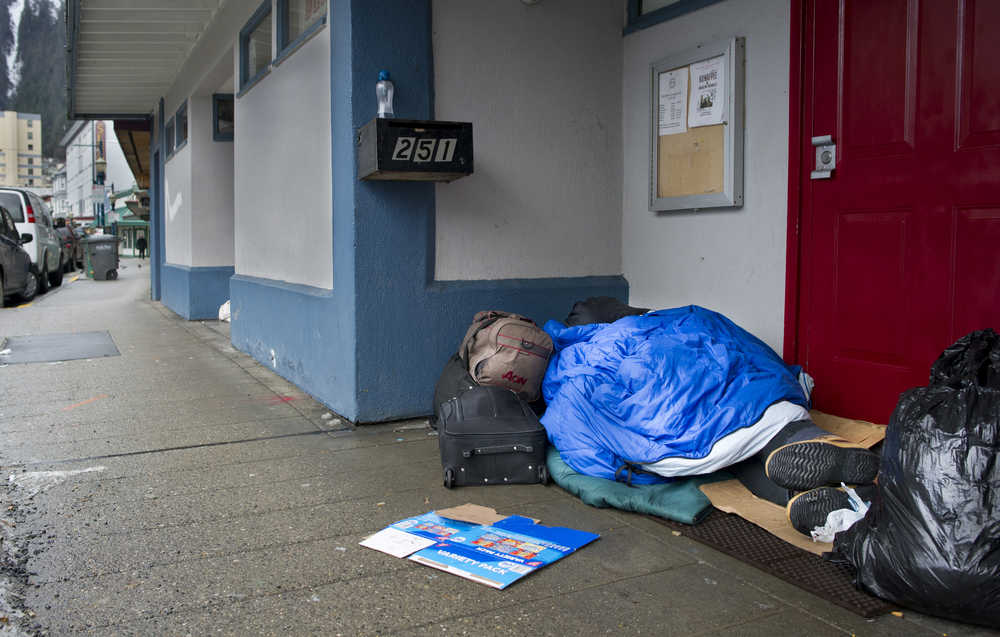
A homeless man sleeps in the doorway of the Filipino Community Hall on Wednesday, Dec. 21, 2016.
