
This story has been corrected to note Weldon served two years, not two terms, on the Assembly before being elected mayor.
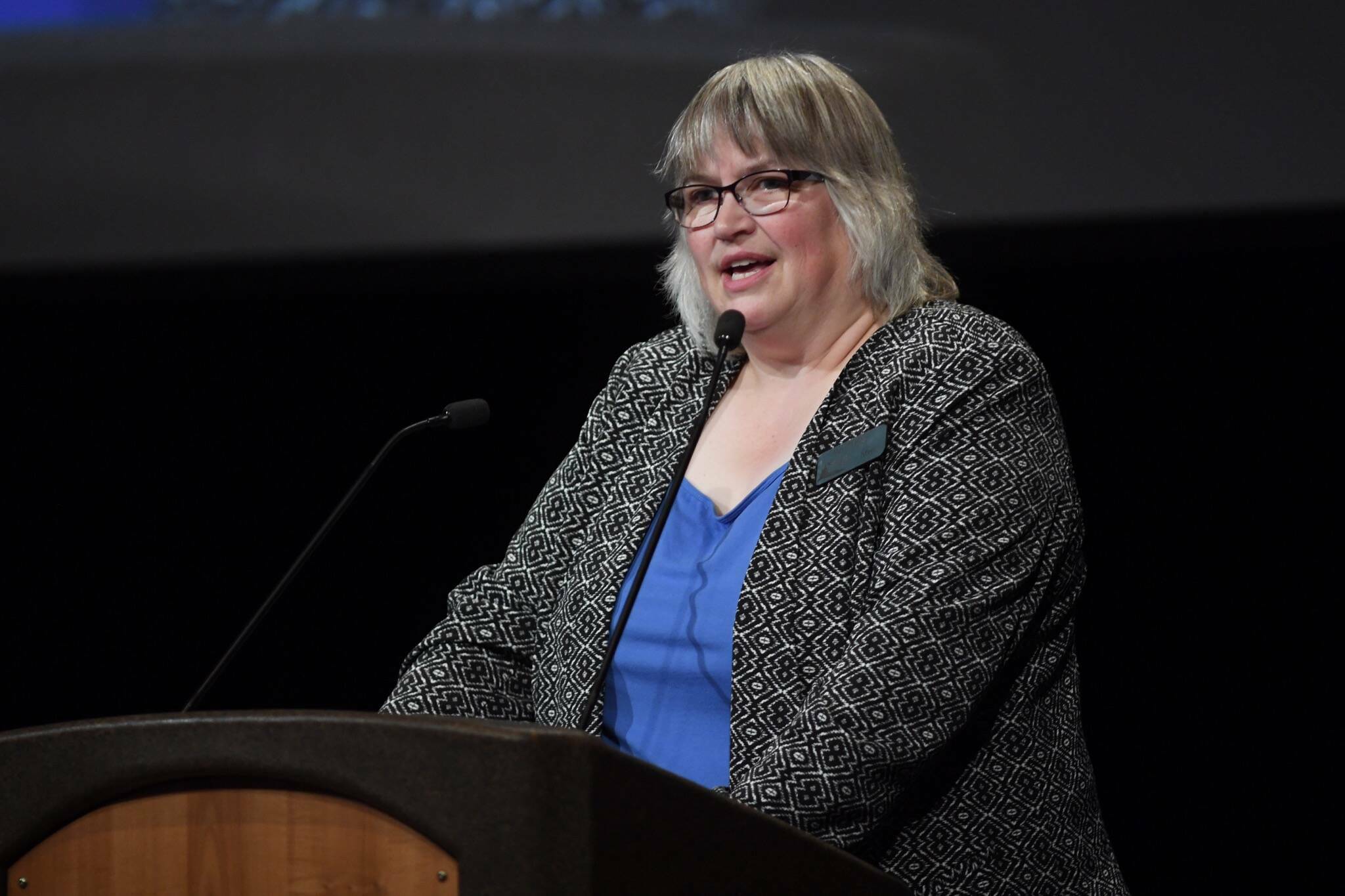
A lot has changed for Juneau and Mayor Beth Weldon during the past three years, and it appears the next three years will continue to be a period of major transitions for the community. This week she announced she wants to continue leading those developments by seeking a third term as mayor.
Since her last term began Juneau has emerged from the depths of the COVID-19 pandemic to record cruise tourism, seen substantial increases in property assessments while grappling with housing shortages, and engaged in contentious political situations including the consolidation of the Juneau School District and a proposed new City Hall.
Weldon, in an interview Wednesday, said the past three years have also seen significant new development, stable essential municipal services such as police and utilities, and efforts to expand services such as child care. Also, she said, the Assembly has passed responsible budgets despite some of the crises suffered by entities such as the school district not under their direct control.
“What we have control of is the mill rate and the mill rate has gone down during my tenure as mayor,” she said. When the Assembly passed a budget earlier this month with a 10.04 mill rate — the lowest in decades — Weldon officially proposed that level as a compromise between sides seeking higher and lower rates.
“It took a long time, we couldn’t get the five votes” for other proposals, she said. “And so I came up with that compromise. So that’s the ones that we got enough votes on to pass.”
Three Juneau Assembly seats including Weldon’s will be on the ballot for the Oct. 1 municipal election. Two of the seats will be an open competition among challengers since Deputy Mayor Michelle Bonnet Hale and Assembly member Wáahlaal Gíidaak Barbara Blake have said they will not seek reelection.
Three of the seven seats on the Juneau Board of Education will also be on the ballot, along with any ballot measures that qualify. Among the latter that are still in the pending stage are nearly $23 million in bonds for municipal projects, a ban on large cruise ships on Saturdays, recalls of two school board members and repealing an ordinance making by-mail elections the default locally.
The candidate filing period begins at 8 a.m. July 12 and closes at 4:30 p.m. July 22.
For Weldon, the decision to run again was a more difficult personal choice following the death of her husband Greg in a motorcycle accident in April.
“Before my husband’s passing he and I had talked about it, and my plan was to run,” she said. “But then when he passed away it’s taken me a while to get back into full swing personally…It’s taken me some time to get over it — and I’m not totally over with it…I’m back to taking some meetings, but I’m not ready for big public gatherings.”
Since returning to official business in recent weeks the Assembly, in addition to passing the municipal budget for next year, has taken up a multitude of major issues. They include the pending move of many downtown employees into the Michael J. Burns Building, the use of three buildings the city will take over from the school district when the consolidation becomes official on July 1, a financial crisis at Bartlett Regional Hospital that has officials there considering cutting some “non-core” programs such as drug rehabilitation, and issues related to people experiencing homelessness since there is no city-designated campground for them for the first time in many years.
A sore spot for many voters in last year’s election was a $27 million bond measure for a new City Hall, coming a year after voters rejected a similar $35 million measure. Weldon said that while she favored the second bond measure — based on hearing concerns about the price tag of the first being too high — “we got the message quite clear” after last year’s election and “since that vote happened you don’t see us doing a thing” toward a new building.
Instead, the city is relocating many offices into the Burns building, which city administrators say is less expensive and more practical than either trying to move into a building the school district is vacating or trying to make the necessary repairs to existing city facilities.
Weldon said the Assembly’s work with the school district to address that crisis earlier this year — which involved the Assembly approving a loan and taking over some “shared costs” such as maintenance of buildings used by both the municipality and district — is an example of successfully dealing with unexpected hardships. She said a similar approach will likely be needed as the city-owned hospital seeks help dealing with its finances.
“At some point we’ll have to go to the public and say ‘Do we want these services or not?’” she said. “Because if we want these services the mill rate has to increase or we’ll have to find other revenue, either a seasonal sales tax or something like that.”
Homelessness was raised at a recent meeting of Assembly members, with social agencies near the airport providing services to them asking for a protective zone due to threatening behavior from some people unable to find shelter. Weldon, who was among the Assembly members who supported a “dispersed camping” policy following reports of rampant illegal activity as a designated campsite, said she believes that policy is working out better than other alternatives considered.
“Specific spots are having issues,” she said. “I mean it’s not going to be great because we’re going to have people in the streets. But is it better than a bad place to put everybody? I think so. In that regard, I think it’s working. But this was the summer to try it out and see what worked, and then we’ll compile everybody’s thoughts at the end of the summer and see if we’re going to continue with dispersed camping or go to something else.”
Weldon, a retired Capital City Fire/Rescue division chief and current owner of Glacier Auto Parts, has two adult sons. She served for two years on the Assembly before successfully running for mayor and said she doesn’t expect the upcoming campaign to be much different than her previous ones.
“I have done lots of door-knocking in this town,” she said. “The first time I ran for mayor I think we figured that we did over 5,000 doors — and I did most of them — so we can certainly do that again.”
• Contact Mark Sabbatini at mark.sabbatini@juneauempire.com or (907) 957-2306.
