
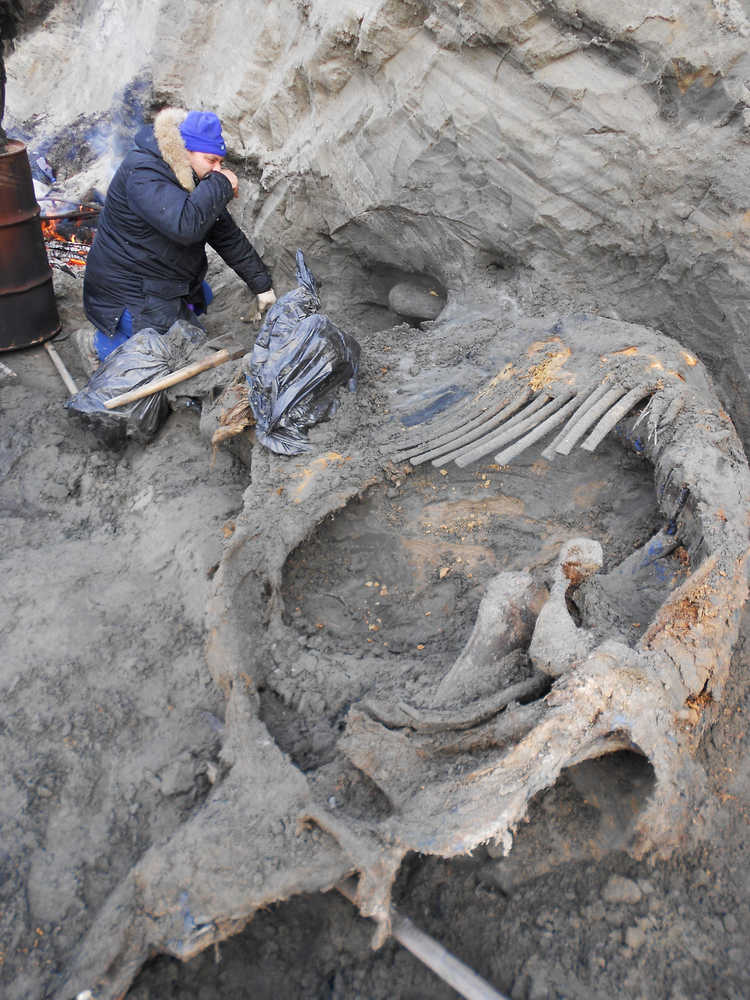
In this undated photo provided by researchers on Tuesday, volunteer Sergey Gorbunov works at the excavation site of a mammoth carcass in northern Russia's Siberia region near the Kara Sea.

In this undated photo provided by researchers on Tuesday, volunteer Sergey Gorbunov works at the excavation site of a mammoth carcass in northern Russia's Siberia region near the Kara Sea.

Mammoth bones show early human presence in Arctic

NEW YORK — The remains of a mammoth that was hunted down about 45,000 years ago have revealed the earliest known evidence of humans in the Arctic.

Marks on the bones, found in far northern Russia, indicate the creature was stabbed and butchered. The tip of a tusk was damaged in a way that suggests human activity, perhaps to make ivory tools.

With a minimal age estimate of 45,000 years, the discovery extends the record of human presence in the Arctic by at least about 5,000 years.

The site in Siberia, near the Kara Sea, is also by far the northernmost sign of human presence in Eurasia before 40,000 years ago, Vladimir Pitulko of the Russian Academy of Science in St. Petersburg and co-authors reported in a paper released Thursday by the journal Science.

They also briefly report evidence of human hunting at about the same time from a wolf bone found well to the east. That suggests a widespread occupation, although the population was probably sparse, they said.

Daniel Fisher, a mammoth expert at the University of Michigan who did not participate in the study, said the markings on the mammoth bone strongly indicate human hunting. It makes sense to conclude that the hunters were from our own species rather than Neanderthals, John Hoffecker of the University of Colorado at Boulder commented in an email.

But Robert Park, an archaeologist at the University of Waterloo in Canada who has studied the bones of hunted animals in the far north, called the evidence for human hunting “pretty marginal.” The beast had been found with remains of its fat hump, while hunters would be expected to take the fat for food and fuel, he said. And the skeleton shows far less butchering than one would expect, he said.

Park emphasized he’s not ruling out the idea that the mammoth was hunted.

If people were living this far north that long ago, he said, it implies they had not only the technical abilities to carry out mammoth hunts, but also a social organization complex enough to share the food from the relatively rare kills.

More in News

The northern lights are seen from the North Douglas launch ramp late Monday, Jan. 19. A magnetic storm caused unusually bright northern lights Monday evening and into Tuesday morning. (Chloe Anderson/Juneau Empire)
Rare geomagnetic storm causes powerful aurora display in Juneau

The northern lights were on full display Monday evening.

teaser
Juneau activists ask Murkowski to take action against ICE

A small group of protesters attended a rally and discussion on Wednesday.

A female brown bear and her cub are pictured near Pack Creek on Admiralty Island on July 19, 2024. (Chloe Anderson for the Juneau Empire)
Pack Creek permits for bear viewing area available now

Visitors are welcome from April 1 to Sept. 30.

Cars pass down Egan Drive near the Fred Meyer intersection Thursday morning. (Clarise Larson / Juneau Empire file photo)
Safety changes planned for Fred Meyer intersection

DOTPF meeting set for Feb. 18 changes to Egan Drive and Yandukin intersection.

Herbert River and Herbert Glacier are pictured on Nov. 16, 2025. (Mari Kanagy / Juneau Empire)
Forest Service drops Herbert Glacier cabin plans, proposes trail reroute and scenic overlook instead

The Tongass National Forest has proposed shelving long-discussed plans to build a… Continue reading

A tsunami is not expected after a 4.4-magnitude earthquake northwest of Anchorage Wednesday, Feb. 4, 2026. (U.S. Geological Survey)
No tsunami expected after 4.4-magnitude earthquake in Alaska

U.S. Geological Survey says 179 people reported feeling the earthquake.

ORCA Adaptive Snowsports Program staff member Izzy Barnwell shows a man how to use the bi-ski. (SAIL courtesy photo)
Adaptive snow sports demo slides to Eaglecrest

Southeast Alaska Independent Living will be hosting Learn to Adapt Day on Feb. 21.

Cars drive aboard the Alaska Marine Highway System ferry Hubbard on June 25, 2023, in Haines. (Photo by James Brooks)
Alaska’s ferry system could run out of funding this summer due to ‘federal chaos problem’

A shift in state funding could help, but a big gap likely remains unless a key federal grant is issued.

Photo by James Brooks/Alaska Beacon
U.S. Sen. Dan Sullivan stands with acting Coast Guard Commandant Adm. Kevin Lunday during the after the commissioning ceremony for the Coast Guard icebreaker Storis on Sunday, Aug. 10, 2025, in Juneau, Alaska.
Coast Guard’s new Juneau base may not be complete until 2029, commandant says

Top Coast Guard officer says he is considering whether to base four new icebreakers in Alaska.

Most Read