
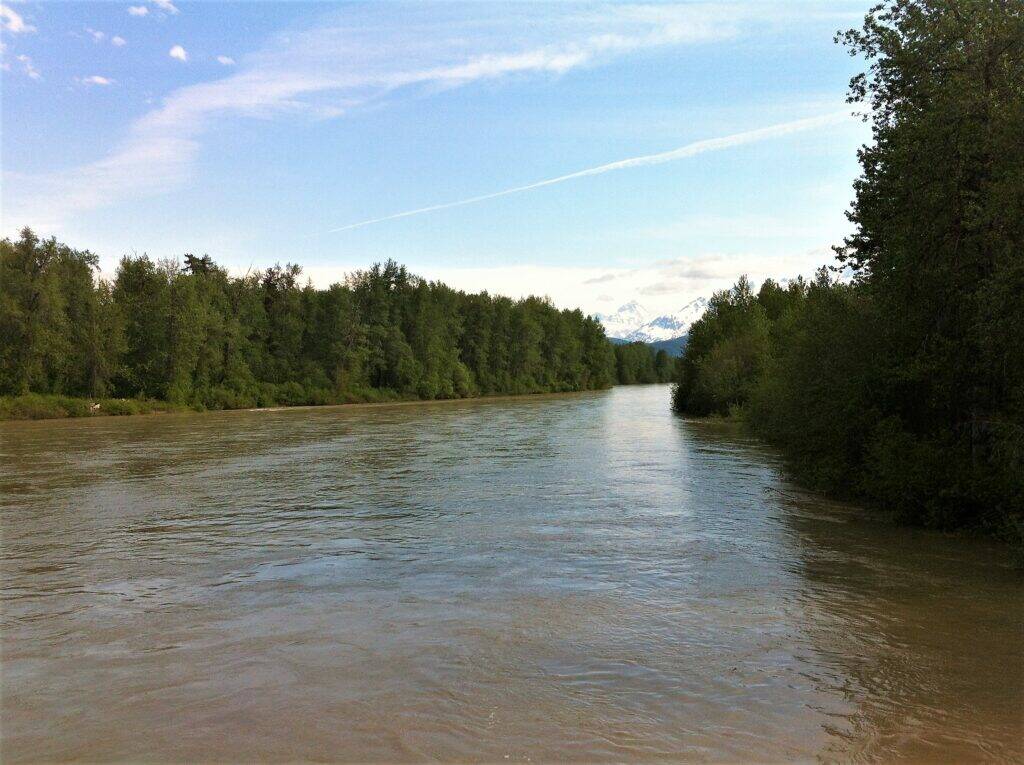
A pair of connected Southeast Alaska waterways are on the 2023 list of America’s Most Endangered Rivers issued by a national environmental organization.
The Chilkat River and its biggest tributary, the Klehini River, are among the rivers cited as at risk by the organization American Rivers, which issued its annual list of top 10 threatened rivers on Tuesday.
The Chilkat and Klehini rivers flow through the Alaska Chilkat Bald Eagle Preserve, which holds the world’s largest congregation of eagles. The rivers also support salmon runs and a population of bears, and they are important to the traditional culture of the region’s Tlingit people.
But the rivers are threatened by a mine, the Palmer Project, that is located about 18 miles upstream from the Tlingit village of Klukwan, which is upstream from Haines.
The Palmer Project is a proposed underground copper and zinc mine currently in the exploratory phase. That phase includes digging a mile-long tunnel permitted by the state.
Even in exploration, the mine project threatens the rivers, the report said.
“The excavation will create huge waste storage piles and contaminated wastewater discharges in an area with extremely high levels of sulfide deposits, rainfall, snowfall, and seismic activity. The acidic wastewater, contaminated with heavy metals, hydrocarbons from vehicles and drilling muds, and explosive residues, will flow into the nearby creeks and the Chilkat and Klehini rivers. This development is extremely dangerous to the fragile ecosystem of the Chilkat Valley,” the American Rivers report said.
The Alaska Department of Environmental Conservation has issued a wastewater permit to the mine developers for the tunnel, which is planned to run beneath a glacier and be big enough to carry truck traffic.
However, the Chilkat Indian Village, the local tribal government, and several environmental organizations have challenged that permit. They are pushing for the federal government to intercede to ensure that Clean Water Act standards are met.
The mine is a major threat, the tribe’s president said in a statement.
“The natural riches of these lands and waters have allowed our people not only to survive, but to thrive, for untold generations. Endangering the Chilkat River ecosystem with a hard rock mine will have devastating effects on our Tribal people that rely on the Chilkat River and Chilkat Valley as our sustainable food source,” Chilkat Indian Village President Kimberley Strong said in the statement.
The Palmer Project is being developed as a joint venture of Vancouver-based American Pacific Mining Corp. and Dowa Metals and Mining of Japan. On its website, American Pacific Mining says the project is in the “advanced exploration” stage and will not require large capital expenditures. The website characterizes the project as a “low capex, low operating cost, high margin underground mining operation with attractive environmental attributes.”
Other rivers on the endangered list released Tuesday include the Colorado River section flowing through the Grand Canyon, the Ohio River, the Pearl River of Louisiana and Mississippi and the Pacific Northwest’s Snake River.
• Yereth Rosen came to Alaska in 1987 to work for the Anchorage Times. She has been reporting on Alaska news ever since, covering stories ranging from oil spills to sled-dog races. She has reported for Reuters, for the Alaska Dispatch News, for Arctic Today and for other organizations. This article originally appeared online at alaskabeacon.com. Alaska Beacon, an affiliate of States Newsroom, is an independent, nonpartisan news organization focused on connecting Alaskans to their state government.
